
Gulf and Western North America (1540–1551 CE): …
Years: 1540 - 1551
Gulf and Western North America (1540–1551 CE): Spanish Exploration and Indigenous Transformations
Initial Spanish Contact and Consequences
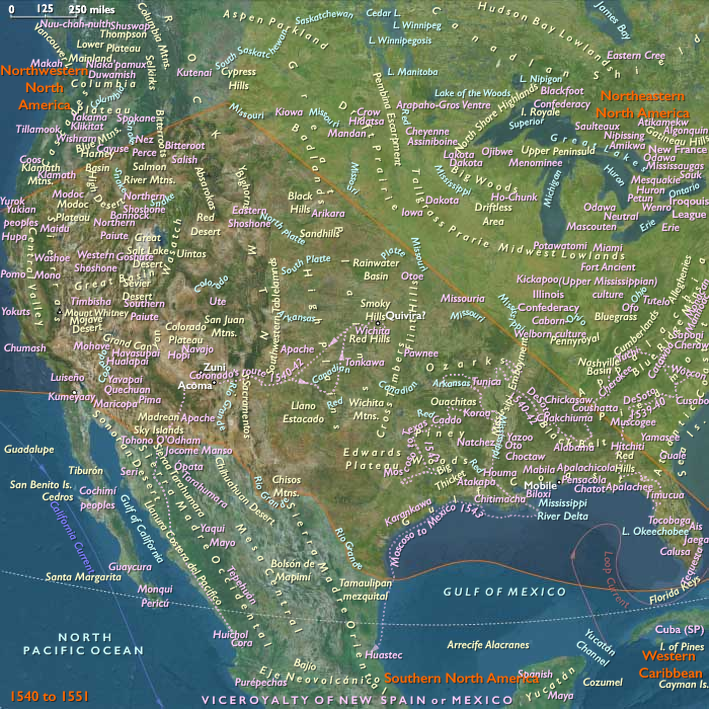
The early 1540s mark significant Spanish exploration in North America, notably through expeditions led by Hernando de Soto in the Southeast and Francisco Coronado in the Southwest. These expeditions introduce European warfare, disease, and domestic animals to indigenous populations. Though failing to discover anticipated riches, the Spanish presence initiates profound biological and cultural transformations among native peoples.
Southeastern Indigenous Societies
In Florida and the southeastern regions, Spanish explorers encounter densely populated agricultural societies such as the Apalachee, Timucua, Tocobaga, and Calusa peoples. The arrival of Europeans triggers catastrophic epidemics, significantly reducing these populations and disrupting their societal structures. Although these groups initially resist Spanish dominance, the spread of European livestock—particularly pigs introduced by de Soto—alters local ecological conditions.
Southwestern Indigenous Responses
In the Southwest, Coronado’s expedition impacts groups such as the Puebloan peoples, whose established agricultural villages begin to interact closely with the Spanish. The introduction of horses, initially controlled strictly by the Spanish, will later significantly transform regional cultures. By 1550, the mobile Apache and Navajo peoples are aware of these new animals, though widespread equestrian culture does not fully develop until later decades.
The Patayan culture of western Arizona, characterized by mobile lifestyles and modest settlements, experiences increasing pressure and environmental challenges around 1550, ultimately disappearing for uncertain reasons, possibly due to flooding and climatic stress.
Florida’s Complex Societies
Florida’s indigenous societies, shaped by millennia of ecological adaptation, experience dramatic changes with Spanish arrival. The rich estuarine environments sustain complex societies such as the Tequesta, Jaega, Ais, and Calusa. Although these established tribes do not immediately succumb to direct Spanish control, their exposure to European diseases begins a period of severe demographic decline.
In northern Florida and the panhandle region, the Pensacola and the succeeding Leon-Jefferson culture (which directly replaced the Fort Walton culture after 1500), with their maize agriculture and mound-building traditions, encounter profound disruptions. The arrival of European livestock, along with epidemics and sporadic violence, significantly reshapes their traditional lifeways.
Key Historical Developments
-
Expeditions of Hernando de Soto and Francisco Coronado introducing European animals and diseases.
-
Severe demographic and cultural impacts on southeastern societies such as the Apalachee and Timucua.
-
Initial, limited introduction of horses in the Southwest, altering future indigenous mobility.
-
Disappearance of the Patayan culture around 1550.
-
Early impact on Florida's indigenous cultures, particularly through disease and ecological changes introduced by European contact.
Long-Term Consequences and Historical Significance
The years 1540–1551 represent a turning point for indigenous societies in Gulf and Western North America, initiating profound demographic, cultural, and ecological transformations. These initial encounters set the stage for centuries of interaction, conflict, adaptation, and resistance between indigenous peoples and European settlers.
People
Groups
- Chumash people
- Calusa
- Tequesta
- Jaega
- Ais people
- Patayan
- Mississippian culture
- Pensacola culture
- Pueblo IV culture
- Tocobaga
- Tohono O'Odham, or Papago (Amerind tribe)
- Pima people (Amerind tribe)
- Apalachee (Amerind tribe)
- Spanish Empire
- Lipan Apache people (Amerind tribe)
- Western Apache
- Timucua (Amerind tribe)
- Leon-Jefferson culture
- Navajo people (Na-Dené tribe)
- Apache (Na-Dené tribe)
- Eight Northern Pueblos (Amerind tribal confederation)
- Acoma Pueblo
- Plains Apache, or Kiowa Apache; also Kiowa-Apache, Naʼisha, Naisha (Amerind tribe)
- Jicarilla Apache
- Mescalero
- Chiricahua
- Spanish Florida
- New Spain, Viceroyalty of
Topics
Commodoties
Subjects
Regions
Subregions
Related Events
Showing 10 events out of 37475 total
Years: 1540 - 1551
People
Groups
- Chumash people
- Calusa
- Tequesta
- Jaega
- Ais people
- Patayan
- Mississippian culture
- Pensacola culture
- Pueblo IV culture
- Tocobaga
- Tohono O'Odham, or Papago (Amerind tribe)
- Pima people (Amerind tribe)
- Apalachee (Amerind tribe)
- Spanish Empire
- Lipan Apache people (Amerind tribe)
- Western Apache
- Timucua (Amerind tribe)
- Leon-Jefferson culture
- Navajo people (Na-Dené tribe)
- Apache (Na-Dené tribe)
- Eight Northern Pueblos (Amerind tribal confederation)
- Acoma Pueblo
- Plains Apache, or Kiowa Apache; also Kiowa-Apache, Naʼisha, Naisha (Amerind tribe)
- Jicarilla Apache
- Mescalero
- Chiricahua
- Spanish Florida
- New Spain, Viceroyalty of
Topics
Commodoties
Subjects
Regions
Subregions