Gujarati king Ahmad Shah (r. 1411–1442) founds …
Years: 1411 - 1411
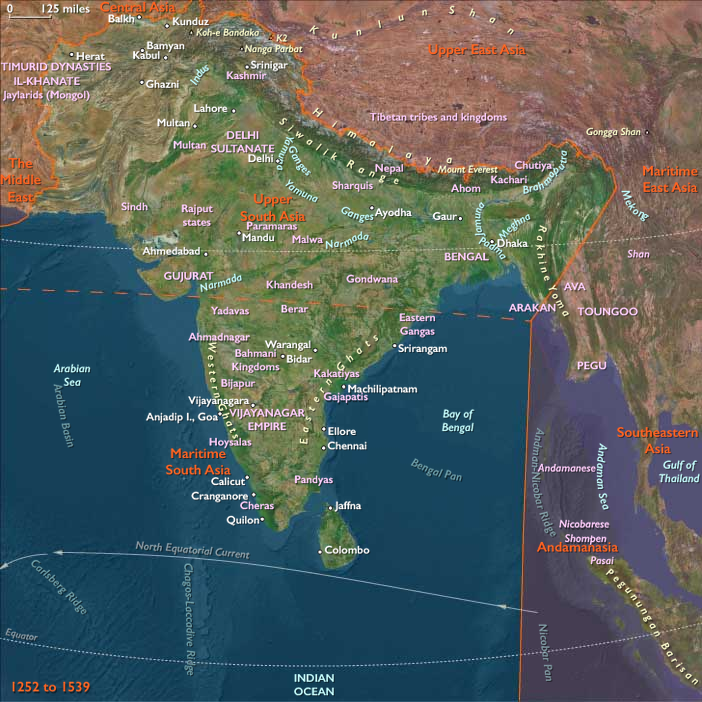
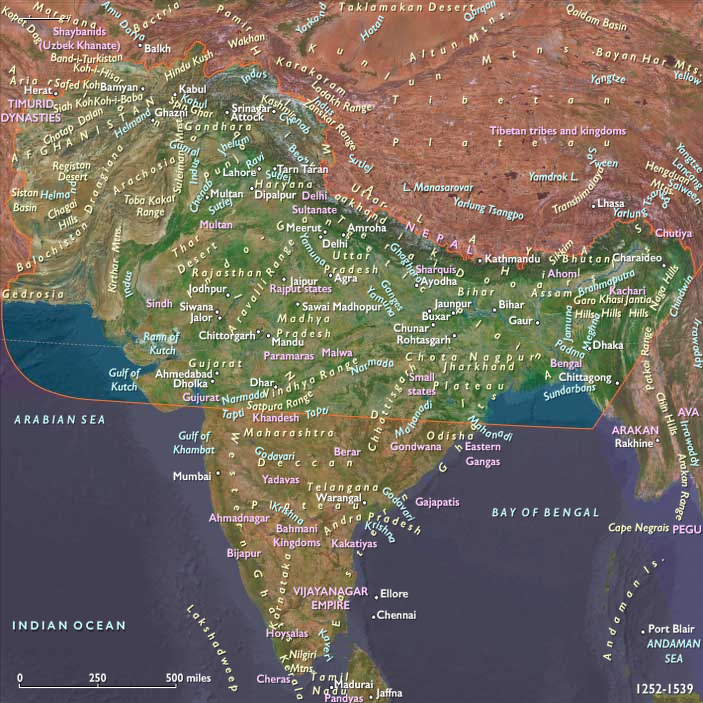
Gujarati king Ahmad Shah (r. 1411–1442) founds Ahmadabad, situated on the left bank of the Sabarmati River two hundred and eighty miles (four hundred and forty-five kilometers) north of Bombay, in 1411.
Locations
Groups
Topics
Subjects
Regions
Subregions
Related Events
Filter results
Showing 10 events out of 42404 total
Ayutthayan monarch Intharaja, responding to Prince Yi Kumkam’s request for aid in the succession dispute with his brother, dispatches an army north under vassal king Sai Lu Thai (Thammaraja) III of Sukhothai to install Yi Kumkam on Chiang Mai’s throne.
Sai Lu Thai’s Ayutthayan troops construct a seventy-two-foot tall (twenty-two meters) earthen hill fort to besiege and shoot—allegedly with cannon—into the town of Phayao.
Pahayao’s defenders, who allegedly melt down brass tiles to make a cannon, repulse the Ayutthayan invaders and destroy their fort.
The invading Ayutthayan forces supporting Prince Yi Kumkam’s bid for the throne of Chiang Mai, defeated at Phayao, besiege the capital city of Chiang Mai, whose defenders fiercely resist all efforts at conquest.
The other contender, Prince Sam Feng Ken, finally suggests that the succession dispute be resolved by a single contest between two champion warriors: one from Chiang Mai, the other Ayutthayan.
His brother agrees to renounce his claim to their late father’s throne if his Ayutthayan champion loses.
After several hours of combat, the Ayutthayan combatant is wounded in the big toe and thus declared the loser.
The Ayutthayans consequently withdraw from Chiang Mai, then march north to the town of Chiang Rai, where, as indemnifcation for the cost of the war, they carry off many captives to slavery in Ayutthaya.
The death of Chiang Mai’s King Sen Muang Ma at thirty-eight in 1411 triggers a succession dispute between his sons, Prince Sam Fang Ken and Prince Yi Kumkam.
Russian icon painter Andrei Rublev, a monk at the monastery of Trinity-Sergeyev near Moscow and at the Andronikov monastery in Moscow who began his career as an artist under the influence of Theophanes the Greek, develops his craft during a time of growing confidence and optimism in Moscow.
Although trained by Theophanes in the Eastern Roman (Byzantine) tradition, Rublev imparts to his icons a softer, more humanistic quality than those of Theophanes or other painters of the time.
His most famous icon, “The Old Testament Trinity,” painted in 1411, in which three angels, rendered in delicate curves, appear against a simple gold background, exemplifies Rublev's graceful, elegant, and singularly spiritual style, characterized by flowing outline and pure, deep color.
Jobst, elected in 1410, dies in 1411, and Wenceslas enter his candidacy once again, but Sigismund, party to a scheme whereby Wenceslas will retain his title and receive a pension, procures his own election as King of Germany and Holy Roman Emperor-elect.
Mûsa leads Turks and Wallachians against his brother Süleyman, having coaxing Süleyman's Serbian and Bulgarian Janissaries over to his side.
Süleyman’s indifference to state affairs has caused him to lose supporters, especially after the death of his able vizier Çandarlı Ali Pasha.
Thus, when Musa marches to Edirne in 1411, Süleyman has almost no one at his side.
He tries to escape to imperial Greek territories, but Musa captures him and orders his strangulation on February 17, 1411.
Musa now declares himself sultan in Edirne and undertakes the reconquest of the Ottoman territories in Rumelia.
Bedreddin, a convert to Sufism (Islamic mysticism) who had in 1383 undertaken the pilgrimage to Mecca, and, upon his return to Cairo, had been appointed tutor to the Mamluk crown prince of Egypt, had then traveled as a Sufi missionary throughout Asia Minor; his communalistic doctrines have made him a popular preacher.
Mûsa now appoints Bedreddin chief military judge.
The district of Appenzell and, by association, …
...the town of St-Gall, earn the protection in 1411 of the Swiss Confederacy, over which the King of Germany holds no power.
The Regency Council of the Spanish kingdom of Castile and Leon, inspired by the Jewish apostate Paul of Burgos, reinstitutes all the anti-Jewish legislation initiated by Alfonso the Wise (1252-1284).
As Solomon ha-Levi, his original name, Paul of Burgos had been, in the 1380s, the most wealthy and influential Jew of Burgos, a scholar of the first rank in Talmudic and rabbinical literature, and a rabbi of the Jewish community.
His father, Isaac ha-Levi, had come from Aragon or Navarre to Burgos in the middle of the fourteenth century.
Solomon ha-Levi also apparently filled the office of tax-farmer at the same time.
His scholarship and intelligence, no less than his piety, had won the praise of Spanish Talmudic authority Isaac ben Sheshet, with whom he had carried on a learned correspondence.
He had received Christian baptism on July 21, 1391 at Burgos, taking the name Paul de Santa Maria.
French historian Leon Poliakov writes that he converted in the aftermath of the great massacres of Jews which began on June 6, 1391 He himself said that he had been persuaded by the works of Thomas Aquinas.
At the same time, his brothers Pedro Suarez and Alvar Garcia, and his children, one daughter and four sons, aged from three to twelve years, had been baptized.
His wife, Joanna, whom he had married in his twenty-sixth year, remained faithful to Judaism, and will die in that faith in 1420, afterward being buried in the Church of S. Pablo, built by her husband.
Paul had spent some years at the University of Paris, receiving the degree of doctor of theology after several years, then visited London, where he probably remained only a short time, sending a Hebrew satire on Purim to Don Meïr Alguades from that city.
Appointed archdeacon of Treviño, in 1402 (or 1405) ha had became Bishop of Cartagena.
Some historians have written that following his conversion, Paul, like fellow convert Joshua ha-Lorki (Gerónimo de Santa Fe) took an active role in persecuting Spanish Jews.
Kenneth Levin has stated that when a wave of forced conversions of Jews to Christianity began in 1411, Paul "took a leading role in the assault on Spain’s remaining Jews and was responsible for drawing up edicts that isolated the Jews, stripped them of many communal rights, and, most importantly, deprived them of almost all means of earning a living, leaving them with the choice of death by privation for themselves and their families or conversion."
Levin also argued that Paul converted for social and economic (as opposed to religious) reasons following the wave of anti-Jewish violence and forced conversions throughout Spain in 1391.

Hasdai Crescas, the last important successor of Maimonides, undertakes a critique of Aristotle in the interest of simple faith, and in an attempt to show that Aristotelian rationalism is far from infallible.
The Spanish Jewish philosopher deplores the fact that Maimonides, whose scholarship and honesty he otherwise admires, seemed to make Greek philosophy the basis for Jewish doctrine.
Coming from a family of scholars, he had been a disciple of the Talmudist and philosopher Nissim ben Reuben, known as The RaN (for the Hebrew acronym of his name).
Following in the footsteps of his teacher, he had become a Talmudic authority and a philosopher of great originality.
He is considered important in the history of modern thought for his deep influence on Baruch Spinoza.
While Crescas does not occupy an official position as rabbi, he seems to have been active as a teacher.
Among his fellow students and friends, Isaac ben Sheshet (known as the RIBaSH), famous for his responsa, takes precedence.
Joseph Albo is the best known of his pupils, but at least two others will win recognition, Rabbi Mattathias of Saragossa, and Rabbi Zechariah ha-Levi.
Crescas, a man of means, had been appointed sole executor of the will of his uncle Vitalis Azday by the King of Aragon in 1393.
Although Crescas enjoys the high esteem even of prominent non-Jews, he had been imprisoned upon a false accusation in 1378, and suffers personal indignities because he is a Jew.
His only son had died in 1391, one of many thousands of martyrs for his faith during the anti-Jewish persecutions of this year in Iberia; Crescas had nevertheless kept his faith.
Notwithstanding his bereavement, his mental powers had remained intact: after that terrible year he wrote the works for which he will become celebrated.
He is said to have become one of the adherents of the pseudo-Messiah of Cisneros, Moses Botarel, a “miracle-worker” who had announced himself as the Messiah in Cisneros in the year 1393, but this allegation may be a spurious one.
In 1401-02, Crescas had visited Joseph Orabuena at Pamplona at the request of the King of Navarre, who paid the expenses of his journey to various Navarrese towns (Jacobs, l.c.
Nos.
1570, 1574).
He was at that time described as "Rav of Saragossa."
His works on Jewish law—if indeed ever committed to writing—have not survived, but his concise philosophical work Or Adonai, (The Light of the Lord) will become a classical Jewish refutation of medieval Aristotelianism, and a harbinger of the scientific revolution in the sixteenth century.
He dies in 1410 or 1411.