
Guido di Castello, possibly the son of …
Years: 1143 - 1143
Guido di Castello, possibly the son of a local noble, Niccolo di Castello, was born either in Città di Castello, situated in Paterna Santa Felicità upon the Apennines, or at Macerata in the March of Ancona.
Guido had studied under Pierre Abélard, and eventually became a distinguished master in the schools.
Eventually, Guido began his career in Rome as a subdeacon and a scriptor apostolicus under Pope Callixtus II.
He was created Cardinal-Deacon of Santa Maria in Via Lata by Pope Honorius II in 1127; as such, he signed the papal bulls issued between April 3, 1130 and December 21, 1133.
In the double papal election of 1130, he joined the obedience of Pope Innocent II.
In December 1133, Innocent promoted him to the rank of Cardinal-Priest of San Marco.
He signed the papal bulls as S.R.E.
indignus sacerdos between January 111, 134 and May 16, 1143.
As the cardinal of San Marco’s, he supported Innocent’s claims with regards to Monte Cassino, and as a mark of his confidence in him, Innocent made Guido the rector of Benevento.
Afterwards, he made him a papal legate to France in 1140.
He participates in the papal election of 1143, the first undisturbed papal election that Rome has seen for eighty-two years, and is elected pope two days after the death of Innocent II, on September 25, 1143, taking the name of Celestine.
Celestine II will govern the Church for only five months and thirteen days from his election until his death on March 8, 1144.
Upon his accession he writes to Peter the Venerable and the monks of Cluny, asking them to pray for him, while he is congratulated by Arnulf of Lisieux.
Regardless of the brevity of his reign, he is prepared to chart a very different course from that of his predecessor.
He is opposed to Innocent II’s concessions to King Roger II of Sicily and is in favor of the House of Plantagenet’s claim to the English throne, thus opposed to King Stephen of England.
To emphasize this shift, he refuses to renew the legatine authority that Innocent II had granted to King Stephen’s brother, Henry of Blois.
Celestine also favors the Templars, ordering a general collection for them, as well as the Hospitallers, giving them control of the hospital of Saint Mary Teutonicorum in Jerusalem.
Locations
People
Groups
- Papal States (Republic of St. Peter)
- Italy, Kingdom of (Holy Roman Empire)
- Christians, Roman Catholic
- England, (Norman) Kingdom of
- Hospitallers of St. John of Jerusalem
- Templar, Knights (Poor Knights of Christ and of the Temple of Solomon)
Topics
- Crusades, The
- Inter-Crusade Period
- Anarchy, the, or The Nineteen Year Winter, or English Dynastic War
Commodoties
Subjects
Regions
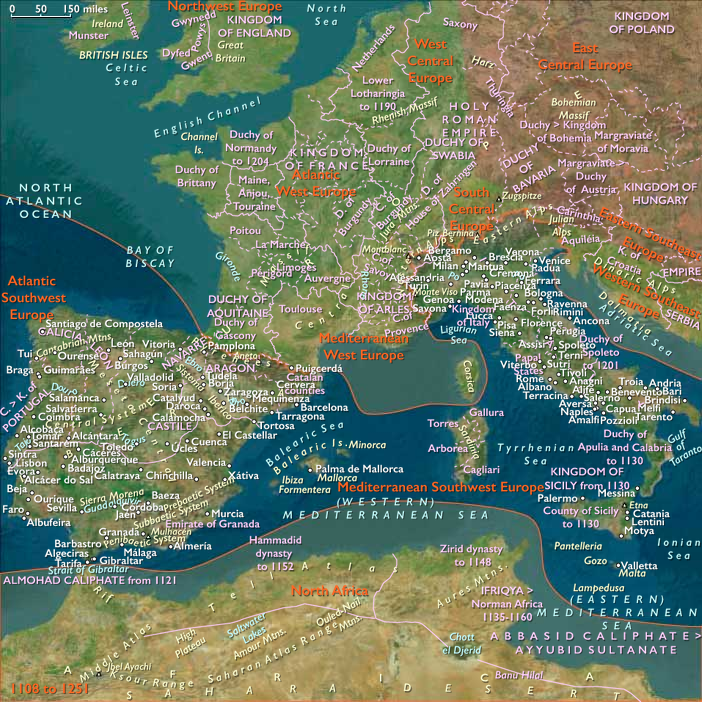
Subregions
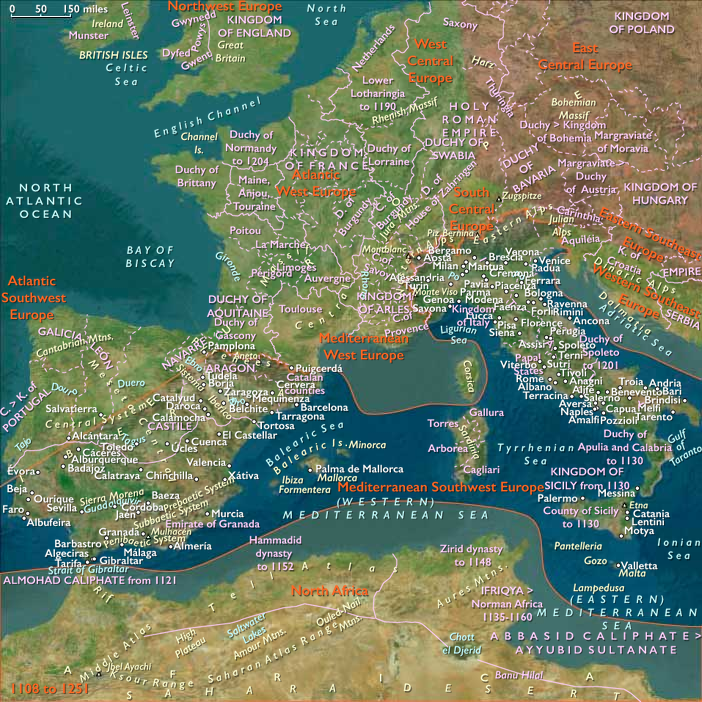
Related Events
Showing 1 events out of 1 total
Years: 1143 - 1143
Locations
People
Groups
- Papal States (Republic of St. Peter)
- Italy, Kingdom of (Holy Roman Empire)
- Christians, Roman Catholic
- England, (Norman) Kingdom of
- Hospitallers of St. John of Jerusalem
- Templar, Knights (Poor Knights of Christ and of the Temple of Solomon)
Topics
- Crusades, The
- Inter-Crusade Period
- Anarchy, the, or The Nineteen Year Winter, or English Dynastic War
Commodoties
Subjects
Regions
Subregions