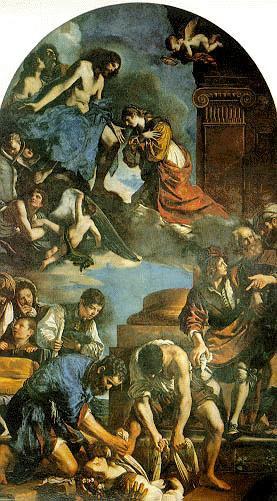
Dirck van Baburen, also known as Teodoer van Baburen and Theodor Baburen, was probably born in Wijk bij Duurstede, but his family moved to Utrecht when he was still young.
The earliest reference to the artist is in the 1611 records of Utrecht's Guild of St. Luke as a pupil of Paulus Moreelse.
He traveled sometime between 1612 and 1615 to Rome, where he collaborated with fellow countryman David de Haen and befriended the close follower of Caravaggio, Bartolomeo Manfredi.
Baburen had also come to the attention of the art collectors and patrons Vincenzo Giustiniani and cardinal Scipione Borghese, and possibly under their influence received the commission to paint the altarpiece of the Entombment for the chapel of the Pietà in San Pietro in Montorio around 1617.
Baburen was one of the earliest artists to belong to the group of Dutch-speaking artists active in Rome in the seventeenth-century known as the "Bentvueghels" ("Birds of a Feather"); his nickname is "Biervlieg" ("Beer Fly", or one who drinks a lot).
Baburen in late 1620 had returned to Utrecht, where he began painting genre scenes.
The painter, along with Hendrick ter Brugghen and Gerard van Honthorst, has helped establish the stylistic and thematic innovations now known as the Utrecht School of Caravaggisti.
Dirck van Baburen's career is short—he dies in 1624—and only a few of his paintings are known today.
He mostly painted religious subjects in Rome, including the San Pietro in Montorio Entombment that is indebted to Caravaggio's version of the same subject in the Vatican Museums.
Baburen also painted a Capture of Christ (Borghese Gallery) for Scipione Borghese and Christ Washing the Feet of the Apostles (Gemäldegalerie, Berlin) for Vincenzo Giustiniani.
Baburen is among the first artists to popularize genre subjects such as musicians and cardplayers.
One of his best-known works is The Procuress (Museum of Fine Arts, Boston).
It depicts a man offering a coin for the services of a lute-playing prostitute while an old woman, the lady's procuress, inspects his money.
This painting (or a copy) was owned by Johannes Vermeer's mother-in-law and appears in two of that artist's works, The Concert (stolen from the Isabella Stewart Gardner Museum, Boston) and Woman Seated at a Virginal (National Gallery, London).