
…Guam, the largest, most populous, and southernmost …
Years: 1521 - 1521
March
…Guam, the largest, most populous, and southernmost of the islands.
Magellan and his fleet, continuing northwest with his three Spanish ships, had reached the equator on February 13, 1521.
Crossing the vast Pacific Ocean, he runs low on supplies, then runs out.
His crews, reduced to chewing leather, have begun to die of scurvy: about nineteen men have died since departing Cape Horn.
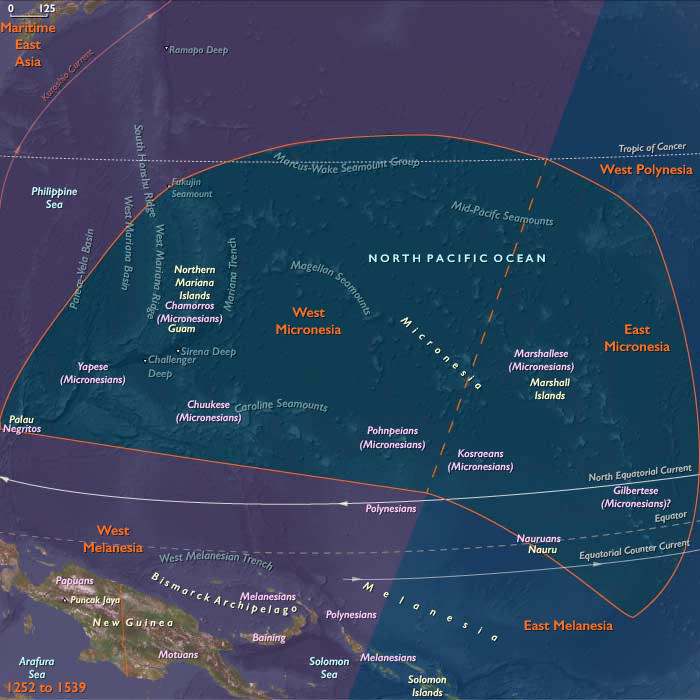
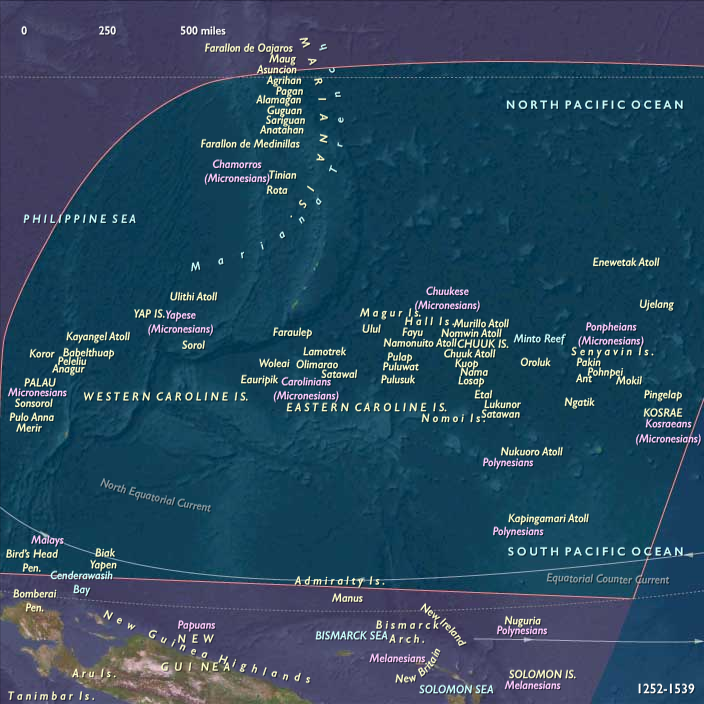
On March 6, 1521, three months after they left the Strait of Magellan, they become the first Europeans to discover the fourteen-member archipelago later known as the Mariana Islands, located in the western Pacific Ocean, about fourteen hundred miles (two thousand two hundred and fifty kilometers) south of Japan.
They find a suitable harbor at the southern end of Guam.
The Europeans are greeted by the Chamorro in hundreds of small outrigger canoes, called Proas, that appear to be flying over the water, due to their considerable speed.
Pigafetta describes the "lateen sail" used by the inhabitants of Guam, hence the name "Islas de las Velas Latinas", but he also writes the inhabitants "entered the ships and stole whatever they could lay their hands on", including "the small boat that was fastened to the poop of the flagship."
"Those people are poor, but ingenious and very thievish, on account of which we called those three islands the islands of Ladroni.” Conflicts with the nearby island of Rota initially prevent Magellan and Elcano from resupplying their ships with food and water.
The Spaniards cross to shore after a couple of days and forcibly requisition rice and fresh fruit, then sail east on March 9.
Locations
People
Groups
Topics
- Age of Discovery
- Colonization of the Americas, Spanish
- Colonization of Asia, Spanish
- Magellan's circumnavigation of the earth
- Colonization of Oceania, European
Commodoties
Subjects
Regions
Subregions
Related Events
Showing 10 events out of 38729 total
Years: 1521 - 1521
March
Locations
People
Groups
Topics
- Age of Discovery
- Colonization of the Americas, Spanish
- Colonization of Asia, Spanish
- Magellan's circumnavigation of the earth
- Colonization of Oceania, European
Commodoties
Subjects
Regions
Subregions