
Groups of people still using stone tools …
Years: 6093BCE - 5950BCE
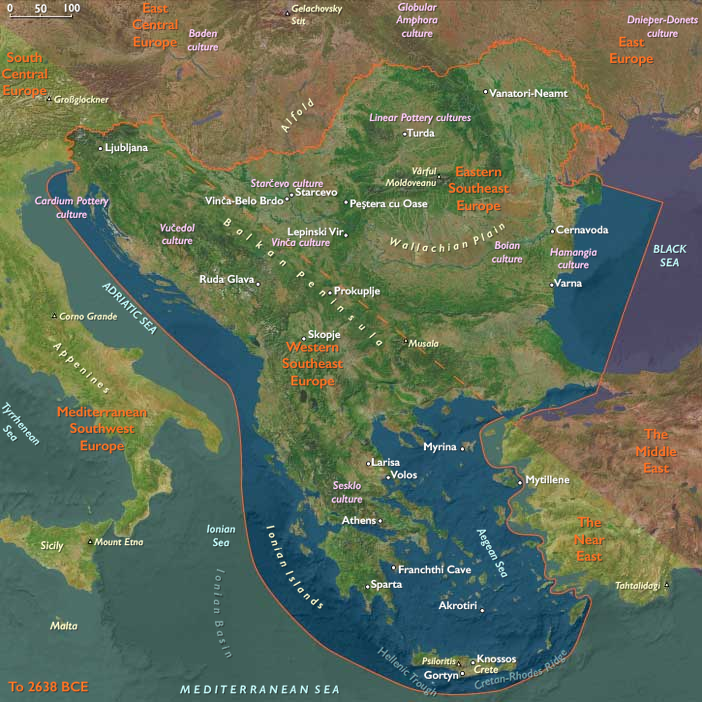
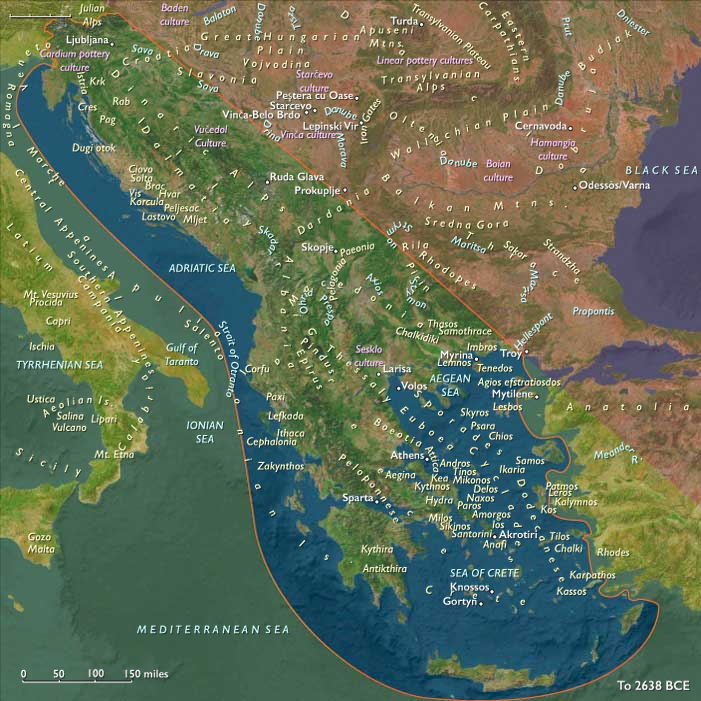
Groups of people still using stone tools but with knowledge of agriculture reach the Aegean from Anatolia or farther east and settle in parts of the mainland and in Crete.
Because of a lack of written records, estimates of Cretan chronology are based on well-established Aegean and Ancient Near Eastern pottery styles, so that Cretan timelines have been made by seeking Cretan artifacts traded with other civilizations (such as the Egyptians)—a well established occurrence.
For the earlier times, radiocarbon dating of organic remains and charcoal offers independent dates.
Based on this, it is thought that Crete was inhabited from the seventh millennium BCE onward.
The first human settlement in Crete dates to the aceramic Neolithic.
There have been some claims for Paleolithic remains, none of them very convincing.
The native fauna of Crete included pygmy hippo, pygmy elephant, dwarf deer (Praemegaceros cretensis), giant rodents and insectivores as well as badger, beech marten and a kind of terrestrial otter.
Large carnivores were lacking.
Most of these animals died out at the end of the last ice age.
Humans played a part in this extinction, which occurred on other medium to large Mediterranean islands as well, for example on Cyprus, Sicily and Majorca.
A group of the first people to land in Crete at the end of the seventh millennium BCE settles a hill west of the Kairatos stream; the settlement’s remains will be found under the Bronze Age palace at Knossos (layer X).
The first settlers introduce cattle, sheep, goats, pigs, and dogs, as well as domesticated cereals and legumes.
Up to now, Knossos remains the only aceramic site.
The settlement covers approximately three hundred and fifty thousand square meters.
The sparse animal bones contain the above-mentioned domestic species as well as deer, badger, marten and mouse: the extinction of the local megafauna had not left much game behind.
Locations
Groups
Topics
Commodoties
Subjects
- Commerce
- Sculpture
- Labor and Service
- Fashion
- Conflict
- Faith
- Government
- Technology
- Anthropology
- Archaeology
- Zoology
Regions
Subregions
Years: 6093BCE - 5950BCE
Locations
Groups
Topics
Commodoties
Subjects
- Commerce
- Sculpture
- Labor and Service
- Fashion
- Conflict
- Faith
- Government
- Technology
- Anthropology
- Archaeology
- Zoology
Regions
Subregions