
Great Britain takes possession of Natal in …
Years: 1843 - 1843
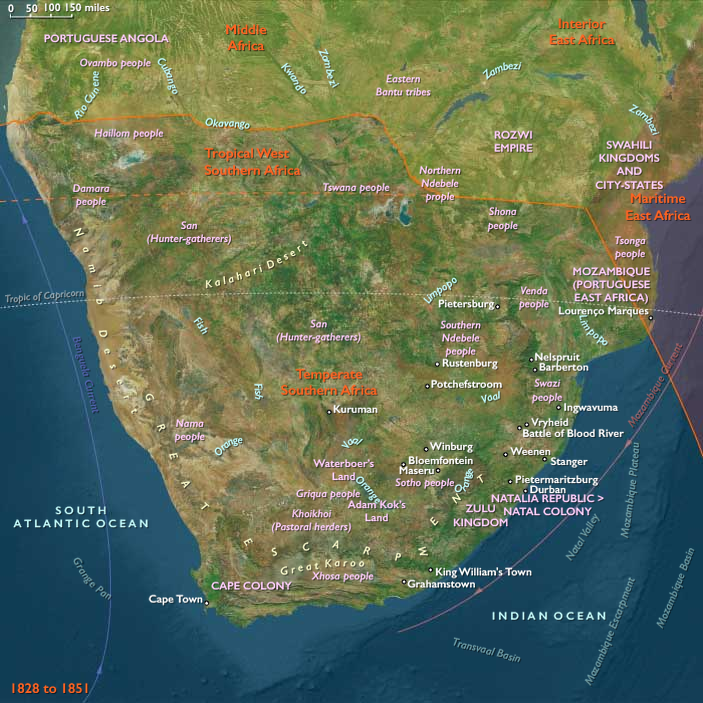
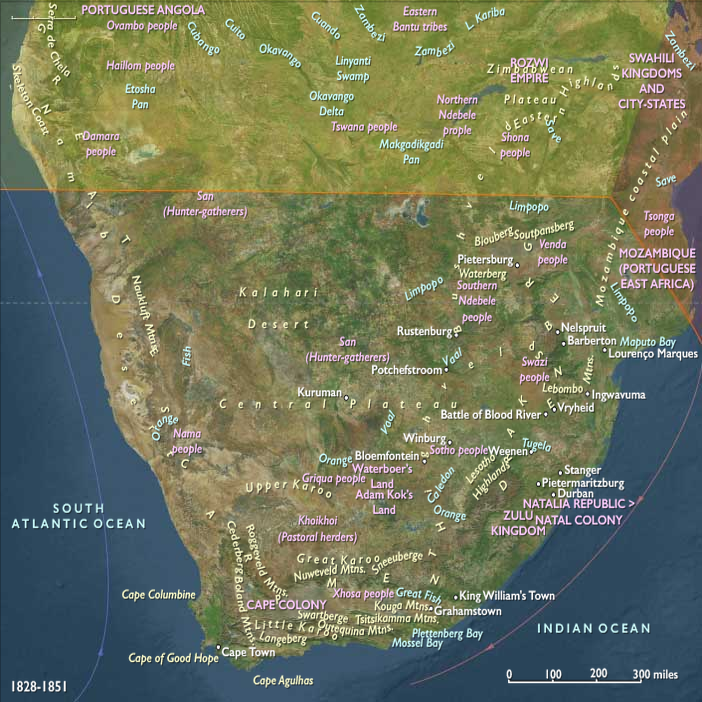
Great Britain takes possession of Natal in 1843, prompting an Afrikaner exodus.
Locations
Groups
Commodoties
Subjects
Regions
Subregions
Related Events
Filter results
Showing 10 events out of 17323 total
The New Zealand Company has sent out eighteen ships with one thousand and fifty-two men, eight hundred and seventy-two women and thirteen hundred and eight-four children within eighteen months.
However, fewer than ninety of the settlers have the capital to start as landowners.
Notably, the early settlement of Nelson province includes a proportion of German immigrants, who arrive on the ship Sankt Pauli and form the nucleus of the villages of Sarau (Upper Moutere) and Neudorf.
These are mostly Lutheran Protestants with a small number of Bavarian Catholics.
British Royal Navy officer John Franklin, after six years as governor of van Diemen’s Land, has not endeared himself with the local civil servants, who particularly dislike his humane ideals and his attempts to reform the Tasmanian penal colony.
Removed from office in 1843, he returns to northern climes to resume his Arctic explorations.
Swedish chemist Carl Gustav Mosander separates from gadolinite three oxide fractions that he calls yttria, erbia, and terbia.
Later, what Mosander had called terbia in 1843 will become known as erbia and is shown to contain five distinct rare earths, now called erbia, scandia, holmia, thulia, and ytterbia (The element whose oxide Mosander called erbia will be known as terbium from 1877, shortly after its existence is confirmed.
Pure compounds of terbium will not be prepared until 1905.
Although Mosander is credited with the discovery of erbium, he does not succeed in isolating the element.
Fairly pure erbium oxide will not be first isolated until 1905; fairly pure erbium, in 1934)
The safety matches are mainly the work of two Swedish chemists; Jöns Jacob Berzelius, inventor of fthe modern chemical notation, had discovered that the dangerous white phosphorus in matches could be replaced with the more benign red phosphorus, but had not been able to produce a match reliable enough for everyday use.
Pasch, a student of Berzelius, had managed to construct the match by both replacing the white phosphorus with red, and moving the phosphorus from the head of the match to a specially prepared striking surface.
Pasch is granted a patent on the safety match in 1844.
Manufacturing is started at "J.S. Bagge & co:s Kemiska fabrik" (J.S. Bagge & Company's Chemical Factory) in Stockholm, but runs into difficulties due to the quality of the striking surface.
Another problem is that the production of red phosphorus is prohibitively expensive, making the final matches very costly.
Because of this, Pasch will be unable to commercially exploit his invention and production will soon cease.
It will not be until John Edvard Lundström and his younger brother Carl Frans, who will take the Pasch design and improve on it that, the safety match will became commercially successful a decade later, around 1855-60.
Lundström's safety match will receive an award at the “World Exhibition” in Paris 1855.
Pasch will die without getting rich from the invention that will be the fuel of the Kreuger empire.
He is, however, successful in his role as professor and a member of many prominent societies.
Modeled after the Loggia dei Lanzi in Florence, it was commissioned in 1841 by King Ludwig I of Bavaria to honor the tradition of his army.
Moldavia’s Prince Mihail Sturdza decrees the emancipation of the Gypsies in 1844.
Until now, the Gypsies had been treated as slaves and owned by the Church or by private landowners; they had been bought and sold in the open market.
Faisal effects a second escape from his captors two years later, returning to Nejd in 1843.
'Abd Allah resists, only to be overpowered and slain by Faisal, who resumes his reign after an interruption of five years to rule essentially unchallenged, other than by occasional tribal uprisings and friction with the townspeople of Al-Qaysumah.
The Hejaz remains in Ottoman hands, while northern Arabia (the province of Jabal Shammar) is locally autonomous but acknowledges the supremacy of Riyadh.
Administration under Faisal is simple, involving few people, mostly members of the Al-Sa'ud family and descendants of Muhammad ibn 'Abd al-Wahhab.
Riyadh-appointed officials enforce justice in the provinces; the tribes pay taxes, and the writing of poetry and history flourish.
Sher Singh is unable to meet the pay demands of the Khalsa, although he reportedly lavishes funds on a degenerate court.
In September 1843 he is murdered by an officer of the Khalsa, Ajit Singh Sindhanwalia.
The Dogras take their revenge on those responsible, and the Messalina of the Punjab (Maharani Jind Kaur), Ranjit Singh's youngest widow, becomes Regent for her infant son Duleep Singh (whose paternity is disputed).
Dost Mohammad returns to Kabul in 1843 and, aided by Akbar Khan, attempts with some success to regain control of outlying sections of the country.
Britain's annexation of Sindh province in 1843 cuts off the native independent Indian kingdoms' access to the sea other than through British-controlled ports.
