
The United States of the Ionian Islands, …
Years: 1815 - 1815
November
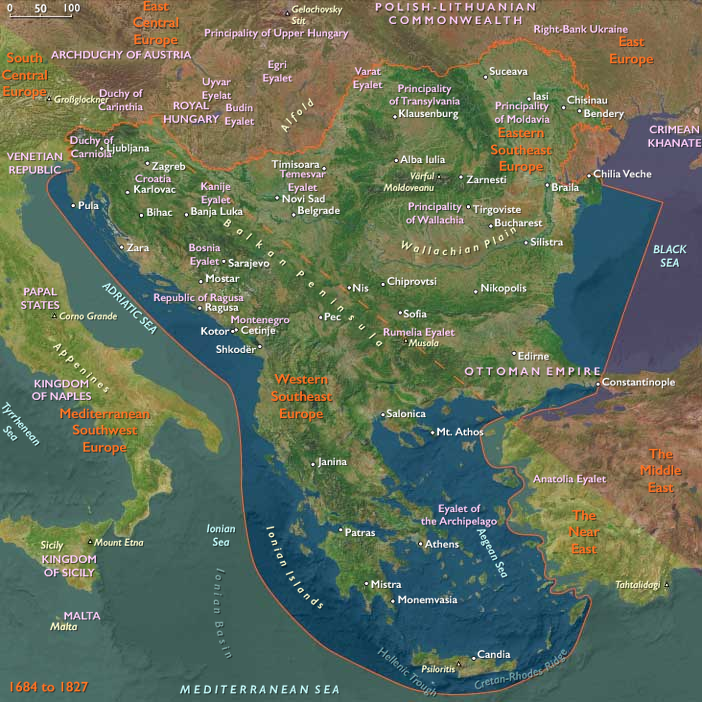
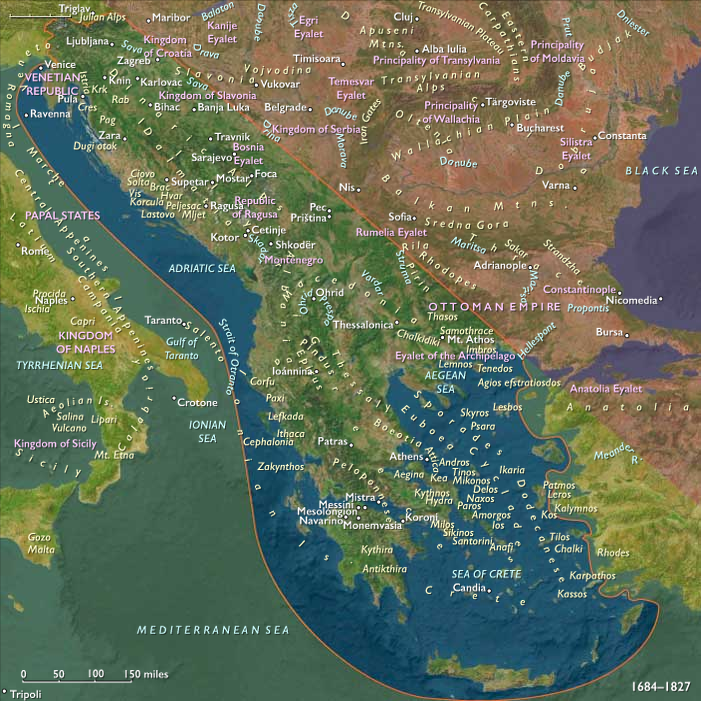
The United States of the Ionian Islands, a state and amicable protectorate of the United Kingdom, is created on November 5, 1815, as the successor state of the Septinsular Republic; it covers the territory of the Ionian Islands, in modern Greece.
Locations
Groups
- Greece, Ottoman
- Britain (United Kingdom of Great Britain and Ireland)
- Septinsular Republic (French Protectorate)
- Ionian Islands, The United States of the
Topics
Commodoties
Subjects
Regions
Subregions
Related Events
Filter results
Showing 10 events out of 20977 total
The harbor at Okhotsk is ice-free from May to November but the sailing season is only four months, from June through September.
The town is built on a low narrow spit blocking the mouths of the two rivers.
The harbor inside the spit is large, but three quarters of it is a mud flat during low water.
Large ships can only cross the bar on an incoming or outgoing high tide and sailing ships sometimes have to wait for days for the wind to blow in the right direction.
Ice-choked water during the spring breakup frequently floods the town (twenty times from 1723 to 1813), as does high surf on a number of occasions.
The Okhota, its mouth jammed by ice in 1810, had cut a new channel through the spit and isolates the town site.
The town is moved in 1815 to the spit east of the harbor mouth.
Goods now have to be unloaded and barged across the harbor.
Because the harbor is shallow, Yakuts have to wade with loads from shore to barge.
Fresh water has to be fetched from two and a half miles away.
Goods cannot be brought down along the Kukhtui River because of swamps.
Naukane returns to the Hawaiian Islands in 1815 following the demise of the Pacific Fur Company.
The first full-blooded European native born in New Zealand, Thomas King, is born in the Bay of Islands.
Ruatara dies in 1815, leaving Hongi Hika as protector of the Anglican mission at Russell.
The Congress of Vienna (1815) and the United Kingdom of Portugal, Brazil, and the Algarves
One of the significant geopolitical outcomes of the 1815 Congress of Vienna was the elevation of Brazil from a colony to an equal partner in a "United Kingdom" with Portugal, a move initiated by King João VI of the House of Braganza.
Background – The Portuguese Court in Brazil (1807–1815)
- In 1807, facing Napoleon’s invasion of Portugal, the Portuguese royal family fled to Brazil, establishing their government in Rio de Janeiro.
- For the first time, a European monarchy ruled from the Americas, making Brazil the de facto center of the Portuguese Empire.
- During his stay in Brazil, João VI enacted major reforms, including opening Brazilian ports to foreign trade (breaking the colonial monopoly system) and founding cultural and educational institutions.
The Creation of the United Kingdom of Portugal, Brazil, and the Algarves (1815)
- At the Congress of Vienna, João VI sought to legitimize Brazil’s elevated status, ensuring that it would not return to its former colonial position.
- On December 16, 1815, João VI formally declared Brazil a co-equal kingdom, creating the United Kingdom of Portugal, Brazil, and the Algarves.
- This was a historic change, as Brazil was now legally and politically equal to Portugal, rather than a subordinate colony.
Impact of the Decision
-
Preserved Braganza Rule
- The move ensured Portuguese sovereignty over Brazil, preventing Brazilian independence—at least temporarily.
-
Enhanced Brazilian Prestige
- Brazil gained a higher international status, allowing it to develop politically and economically.
- Rio de Janeiro remained the capital of the United Kingdom, solidifying its importance in the empire.
-
Resentment in Portugal
- Many Portuguese resented the shift of power to Brazil, leading to growing demands for João VI’s return to Lisbon.
- This tension would contribute to the 1820 Liberal Revolution in Portugal.
-
Brazilian Path to Independence
- Though it temporarily unified Portugal and Brazil, the creation of the United Kingdom ultimately fueled Brazilian nationalism.
- In 1822, João VI’s son, Pedro I of Brazil, would declare Brazilian independence, dissolving the United Kingdom.
Conclusion – A Short-Lived but Pivotal Transformation
The elevation of Brazil to equal status with Portugal in 1815 was a direct result of the Congress of Vienna’s goal of restoring European monarchies and stabilizing borders. However, rather than reinforcing Portugal’s colonial rule, it set Brazil on the path toward full independence, marking a key transitional moment in the history of both nations.
The victorious European states had convened the Congress of Vienna in November 1814 in an attempt to reestablish a balance of power and, where feasible, restore pre-Napoleonic dynasties.
Austrian emperor Francis I (the former Holy Roman Emperor Francis II) hosts the meeting; in attendance are Russia’s Emperor Alexander I, Prussia’s King Frederick William III, and several other lesser crowned heads.
The principal negotiators include Britain’s Viscount Castlereagh, Prussia’s Prince Karl August von Hardenburg, Russia’s Count Karl Robert Nesselrode, Austria’s Prince Klemens von Metternich and Metternich’s aide Friedrich von Gentz as secretary general of the congress.
The Prussian statesman Heinrich Friedrich Karl vom und zum Stein serves as an advisor to Alexander.
Baron vom Stein labors in vain for a unitary German empire and the restoration of the imperial knights.
The congress reduces the approximately three hundred states of eighteenth-century Germany to the thirty-eight members of the loose German Confederation.
The ethnic Germans of Switzerland choose not to join; the Germans living in the French provinces of Alsace-Lorraine and the Danish Duchies of Schleswig and Holstein have no opportunity to choose.
Within the newly-formed German Confederation’s borders are three of Austria’s Slavic provinces: Carniola, the Slovenian homeland, and Czech-speaking Bohemia and Moravia.
Finally, the congress restores legitimate dynasties in Italy, Portugal and Spain.
Turkish atrocities spark a second Serbian uprising on April 24, 1815, directed by Milos Obrenovic.
Many Bulgarians in areas adjacent to Serbia fight beside the Serbs in the campaigns of 1815, as in those of 1804.
The rebellion is successful, resulting in autonomy under Turkish control for some regions by the year's end.
The occupation of the Garwhal kingdom by the Gurkhas had gone unopposed from 1803 to 1814 until a series of encroachments by the Gurkhas on British territory led to the Anglo-Nepalese War in 1814.
At the termination of the campaign, on April 21, 1815, the British establish their rule over the eastern half of the Garhwal region, lying east of Alaknanda and the Mandakini river, and later known as British Garhwal an the Dun of Dehradun, together with Kumaon, which is merged with British India as a result of the Treaty of Sugauli.
The former Kumaon Kingdom is joined with the eastern half of the Garhwal region and is governed as a chief-commissionership, also known as the Kumaon Province, on the non-regulation system.
Meanwhile, the western part of the erstwhile Garhwal Kingdom is restored to Sudarshan Shah.
As Srinagar is now part of the British Garhwal, a new capital is established at Tehri, giving the new polity name of Tehri state (popularly known as Teri Garhwal).
The Ottomans regain Egypt in the Congress of Vienna, but Muhammed Ali, the governor appointed by the Sultan, operates quite independently of Constantinople.
Years: 1815 - 1815
November
Locations
Groups
- Greece, Ottoman
- Britain (United Kingdom of Great Britain and Ireland)
- Septinsular Republic (French Protectorate)
- Ionian Islands, The United States of the
