…Goslar, where he gives the duchy of …
Years: 1045 - 1045
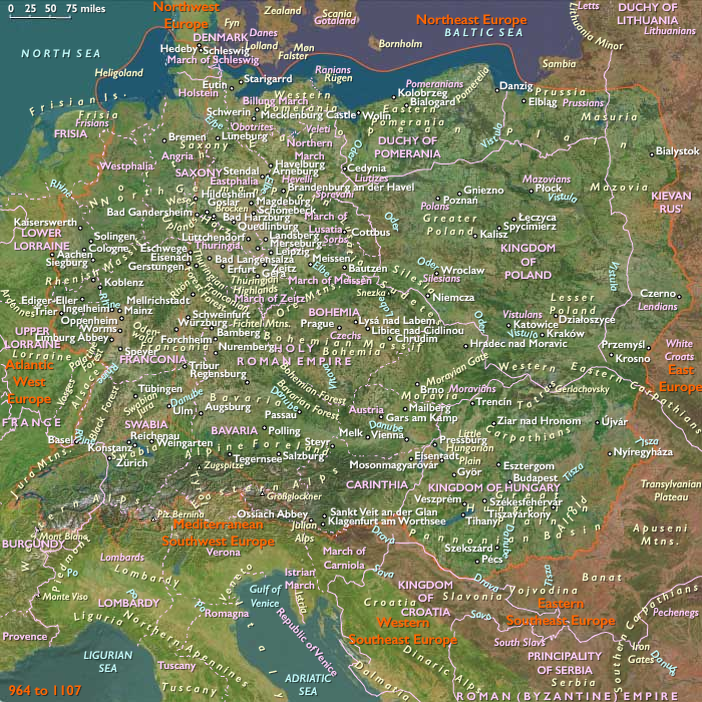
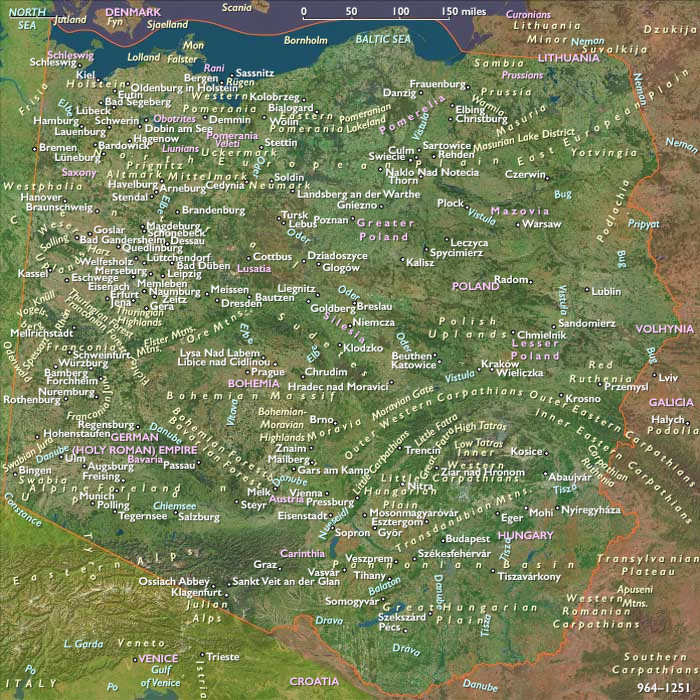
…Goslar, where he gives the duchy of Swabia to Otto, Count Palatine of Lorraine.
Henry also gives the margrave of Antwerp to Baldwin, the son of Baldwin V of Flanders.
Locations
People
- Godfrey III, Duke of Lower Lorraine
- Gothelo I
- Henry I of France
- Henry III, Holy Roman Emperor
- Peter, King of Hungary
Groups
- Germans
- Hungarian people
- Flanders, County of
- Swabia, Duchy of
- German, or Ottonian (Roman) Empire
- Lorraine, (second) Duchy of
- Lorraine (Lothier), Lower, (second) Duchy of
Commodoties
Subjects
Regions
Subregions
Related Events
Filter results
Showing 10 events out of 51316 total
Airrlangga had bestowed titles upon his loyal followers when the capital of Kahuripan was moved from Watan Mas to Kahuripan in 1037.
According to the Kelagen inscription (dated 1037) Airlangga also took a keen interest on agriculture development, embarking on grand irrigation project by constructing the Wringin Sapta dam, located in today Jombang regency.
By building a dam on Brantas river, he provides irrigation to surrounding paddy fields and maintaining hydraulic system in the area.
Airlangga divides Kahuripan in 1045 into two kingdoms which are inherited by his two sons; Janggala and Kediri.
Airlangga himself abdicates the throne in 1045, returning to the hermit life by assuming a new name as Resi Gentayu, bestowed by Mpu Bharada, a famous hermit.
The reasons behind the partition of a kingdom that Airlangga had so painstakingly united during his younger years remains a puzzle for historians.
Fan Zhongyan, who had been prefect of Kaifeng, the imperial capital during the Northern Song era, in the 1030s, had been demoted to regional posts for criticizing the Chief Councilor.
In 1040, the Liao and Western Xia to the north were threatening Song security, and Fan had been brought back to organize a strong defense.
Ouyang Xiu, posted to Kaifeng four years after passing his jinshi examination in 1030, had begun his association with Fan from this time in Kaifeng.
Like Fan, he also had been demoted.
After Fan’s demotion, Ouyang had criticized Fan’s principle critic, resulting in his being sent to a minor post in Hubei.
Like Fan, he had been brought back to the capital in the 1040s where he was assigned to work on cataloguing the entire imperial library.
Fan Zhongyan had in 1041 submitted a ten-point memorial in which he outlined his reform objectives, divided into three categories: administrative efficiency; strengthening of local governments; and strengthening of defense.
The first set of proposals has met with deep resistance from groups of bureaucrats.
The second set, while farsighted, seems remote to the court.
The third seeks to correct Song over corrections for the Tang Dynasty’s mistakes of giving local military commanders too much independent authority.
Many of these reforms have been put into effect during 1043 and 1044.
However, without the full support of the emperor, there is never complete implementation of the reforms, and not long after they began, backlash from conservative elements at the court results in the reformers being brought down and sent out to remote postings in the provinces.
The Wujing Zongyao, a military treatise written and compiled by scholars Zeng Gongliang, Ding Du, and Yang Weide during the Song Dynasty, is the first book in history to include formulas for gunpowder and its use for various bombs (thrown by sling or trebuchet catapult).
Although the Wujing Zongyao emphasizes the importance of many weapons, it reserves high respect for the crossbow and the ability of crossbowmen to fell charging units of nomadic cavalrymen.
It also describes the double-piston pump flame thrower and a thermoremanence compass, a few decades before Shen Kuo wrote of the first known magnetic mariners compass.
The Chinese of the early eleventh century are thus aware that a piece of iron can be magnetized by heating until it is red hot and then quenched in water.
While quenching, it is oriented in the Earth's field to get the desired polarity.

Song Dynasty Chinese judge and magistrate Bao Zheng (Bao Qingtian) writes a memorial to the throne, warning about governmental corruption and a foreseeable bankruptcy of the Chinese iron industry, if increasingly poorer families continue to be listed on the register for iron-smelting households (while more rich households avoid being listed for fear of financial calamity).
Apparently the government heeds the warning, and by 1078 will produce more iron than China ever had before.
Bi Sheng is a commoner and his ancestry and details were not recorded other than the information given in the Writings Beside the Meng Creek (Mengxi Bitan, or Dream Pool Essays) by Chinese scholar, official, and polymath scientist Shen Kuo (1031–1095).
Writings Beside the Meng Creek, however, gives detailed and sufficient description on the technical details of Bi Sheng's invention of movable type.
Bi Sheng's fragile clay types are not practical for large-scale printing.
The government official Wang Zhen (fl.
1290–1333) will improve Bi Sheng's fragile clay types by innovation through wood; his process will increased the speed of typesetting as well.
Later in China by 1490, cast bronze movable type will be developed by the wealthy printer Hua Sui (1439–1513).
The original pagoda that stood at the site of the Lingxiao Pagoda, a Chinese pagoda west of the Xinglong Temple in Zhengding, Hebei Province, China, dubbed the Wooden Pagoda, had been built in 860 during the Tang Dynasty.
The pagoda's present form of brick and wood dates to 1045 during the reign of Emperor Renzong of the Song Dynasty.
The brick base and structure of the forty-two meter (one hundred and thirty-seven feet) tall pagoda ends after the fourth floor, as the rest of its height from the fifth floor up is purely wooden construction.
It features a total of nine stories with nine wooden tiers of eaves encircling the octagonal frame of the pagoda.
In the center of the pagoda stands a large column, a feature of Chinese architecture in pagodas that will be discontinued sometime after the Song and Yuan periods.
Emperor Henry enters Székesfehérvár following Samuel Aba's death.
He restores Peter, who introduces Bavarian law in his realm, which suggests that Hungary became an imperial fief.
He accepts the emperor's suzerainty on Whitsun 1045, giving his royal lance to his overlord (who returns to Hungary).
A number of plots to overthrow Peter indicate that he remains unpopular.
Two of King Stephen I's maternal cousins (Bolya and Bonyha) conspire against Peter in 1045, but the king has them arrested, tortured and executed; Bishop Gerard of Csanád invites the late Vazul's exiled sons to the country.
Henry discusses the Italian political scene with some Lombard magnates at Augsburg and goes on to …
A floor collapses in one of Henry's halls, killing Bruno, Bishop of Würzburg, while Henry is on his way to Hungary to spend Pentecost with King Peter.
Peter gives over the golden lance, symbol of sovereignty in Hungary, to Henry and pledges an oath of fealty along with his nobles.
Hungary is now pledged to Peter for life and peace is fully restored between the two kingdoms of Germany and Hungary.
Constantine IX is not outstanding for his diplomacy.
It is under his auspices, however, that the University of Constantinople is reorganized, with an efflorescence of learning and letters.
He endows the university with a new charter in 1045, partly to ensure a steady flow of educated civil servants for the bureaucracy.
The urban aristocracy of Constantinople, reacting against the brutalization of war, is striving to make the city a center of culture and sophistication.
Constantine belongs to the civil party, the opponents of the military magnates, and he neglects the defenses of the empire and reduces the army.
He spends extravagant sums on luxuries and magnificent buildings and seriously debases the coinage.
Rebellions have broken out at home and abroad.
Abu Harb, the third son of Muhammad, had rebelled against his older brother and called upon help from the Buyids of Fars.
Faramurz had defeated him, however.
Relations with Faramurz and Tughril are highly important.
It seems that Faramurz was present with the Seljuqs at the battle of Dandanaqan against the Ghaznavids.
When Faramurz ascended to the Kakuyid throne, Tughril had secured his allegiance by sending a tribute of payment to Faramurz.
However, neither Faramurz nor his brother Garshasp I are willing to turn to the side of Seljuqs.
In 1045, the Dailamites and Kurds of Jibal make a stand together to resist the advance of the Turkmens from Khorasan.
Years: 1045 - 1045
Locations
People
- Godfrey III, Duke of Lower Lorraine
- Gothelo I
- Henry I of France
- Henry III, Holy Roman Emperor
- Peter, King of Hungary
Groups
- Germans
- Hungarian people
- Flanders, County of
- Swabia, Duchy of
- German, or Ottonian (Roman) Empire
- Lorraine, (second) Duchy of
- Lorraine (Lothier), Lower, (second) Duchy of