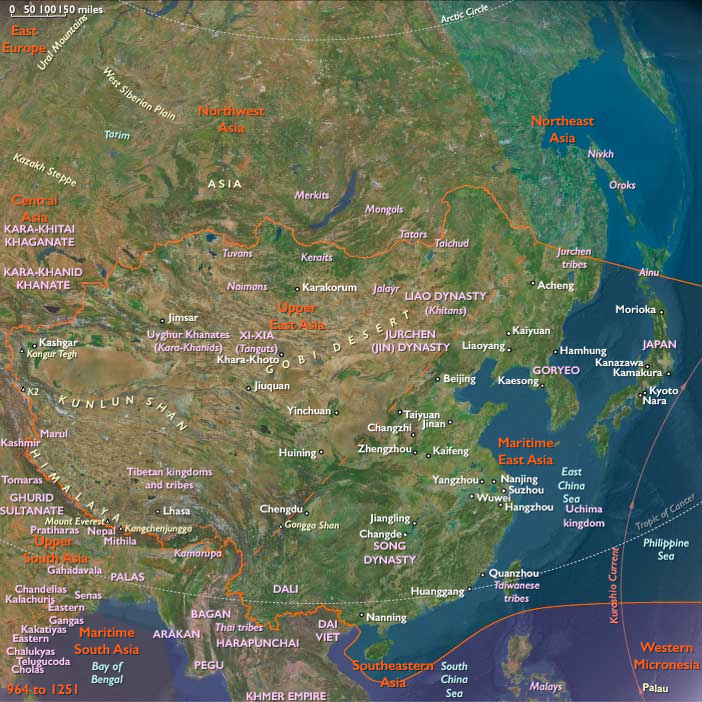
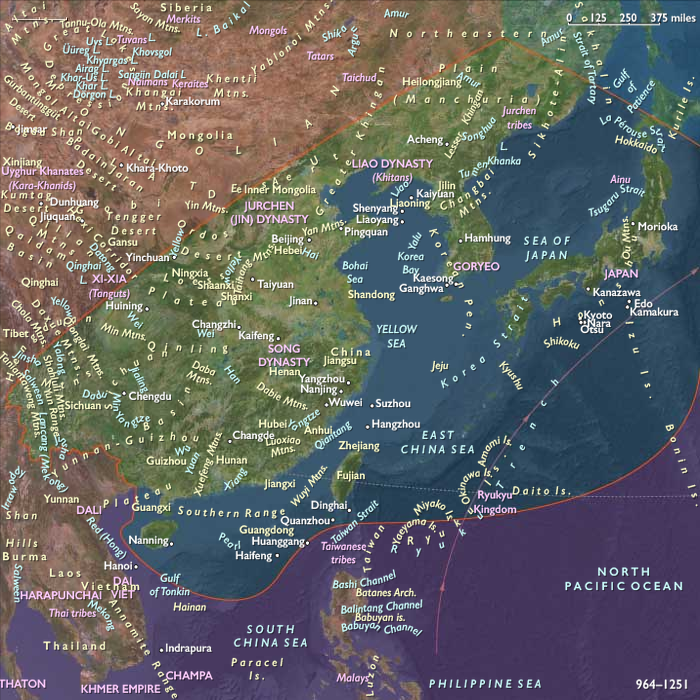
Goryeo and the Liao dynasty reach a …
Years: 1023 - 1023
Goryeo and the Liao dynasty reach a negotiated peace agreement in 1023 and establish normal relations.
The Khitan will never again invade Goryeo.
The surrendered Khitan troops have been divided up among the provinces of Goryeo and settled in isolated and guarded communities.
These prisoners are valued for their skill in hunting, butchering, skinning, and leather tanning.
Over the next few centuries, they will evolve into the Baekjeong class, who will come to form the lowest caste of the Korean people.
Locations
Groups
Commodoties
Subjects
Regions
Subregions
Related Events
Filter results
Showing 10 events out of 51644 total
Bernard II returns now to war with the Slavs (Obodrites and Lutici) and draws them into his sphere of power and influence through their leader, Godescalc (Gottschalk).
Basil is pictured both in near-contemporary history and in manuscript illustrations as a short, well-proportioned figure, with brilliant light-blue eyes, a round face, and full, bushy whiskers, which he twirls in his fingers when angry or while giving an audience.
He dresses plainly and even when wearing the purple chooses only a dark hue.
An abrupt speaker, he scorns rhetoric yet is capable of wit.
He has been described as mean, austere, and irascible, spending most of his time as though he were a soldier on guard.
He shows no obvious interest in learning, but he does apparently commission works of religious art, and has churches and monasteries rebuilt or completed in Boeotia and in Athens, though this may be accounted for by conventional piety.
The ruthlessness and tenacity that serve Basil in his military and diplomatic activities are displayed in his domestic policy as well.
Its keynote is the strengthening of imperial authority by striking at his overpowerful subjects, particularly the military families who rule like princes in Asia Minor.
The byproduct of this policy is the imperial protection of the small farmers, some of whom owe military service to the crown and pay taxes to the central exchequer.
Title to land is rigorously inspected, and vast estates are arbitrarily confiscated.
Thus, in spite of his costly wars, Basil can boast a full treasury, some of it stored in specially constructed underground chambers.
The emperor now looks further west and plans to strengthen imperial control in southern Italy and to regain Sicily from the Arabs.
Giorgi, the future George I of Georgia, was born in 998 or, according to a later version of the Georgian chronicles, in 1002, to King Bagrat III.
Upon his father’s death on May 7, 1014, he had inherited the kingdoms of Abkhazia, Kartli and Kakheti united into a single state of Georgia.
As his predecessor, Giorgi continued to be titled as King of the Abkhazians (Ap'xaz) and Georgians (K'art'velians).
Contemporary sources, however, frequently omit one of the two components of this title when abbreviating it.
The new sovereign’s young age had been immediately exploited by the great nobles, who had been suppressed under the heavy hand of Bagrat.
Around the same year, the easternmost provinces of Kakheti and Hereti, not easily acquired by Bagrat, had staged a revolt and reinstated their own government under Kvirike III (1010/1014–1029), who had also incorporated a portion of the neighboring Arran (Ran), allowing him to claim the title of King of the Kakhetians and Ranians.
Giorgi, unable to prevent the move, had sought an alliance with this kingdom, rather than attempting to reincorporate it into the Georgian state, thus leaving a long-standing claim to Kakheti and Hereti to his successors.
The major political and military event during Giorgi’s reign, a war against Constantinople’s Empire, has its roots back in the 990s, when the Georgian prince David III Kuropalates of Tao, following his abortive rebellion against Emperor Basil II, had to agree to cede his extensive possessions in Tao and the neighboring lands to the emperor on his death.
All the efforts by David’s stepson and Giorgi’s father, Bagrat III, to prevent these territories from being annexed to the empire had been in vain.
Giorgi, young and ambitious, had launched a campaign to restore the Kuropalates’ succession to Georgia and occupied Tao in 1015–1016.
He had also entered in an alliance with the Fatimid Caliph of Egypt, Al-Hakim, putting Basil in a difficult situation by forcing him to refrain from an acute response to Giorgi’s offensive.
Beyond that, the Empire has been involved in a relentless war with the Bulgarians, limiting their actions to the west.
But as soon as Bulgaria is conquered, and Al-Hakim is no longer alive, Basil leads his army against Georgia.
An exhausting war has lasted for two years, and ends in a decisive imperial victory, forcing Giorgi to agree to a peace treaty, in which he has not only to abandon his claims to Tao, but to surrender several of his southwestern possessions to Basil, and to give his three-year-old son, Bagrat, as hostage.
Following the peace treaty, Constantinople is visited by Catholicos-Patriarch Melkisedek I of Georgia, who gains imperial financial aid for the construction of "Svetitskhoveli" (literally, the Living Pillar), a major Orthodox cathedral in the eastern Georgian town of Mtskheta.

The defendable position, flow of money from pilgrims, and power embodied in the church at Durham ensures that a town forms around the cathedral, establishing the early core of the modern city.
A very simple temporary structure to house the relics of Cuthbert at Durham had been built initially from local timber.
The shrine was then transferred to a sturdier, probably wooden, building known as the White Church.
This church was itself replaced three years later in 998 by a stone building also known as the White Church, which had been completed by 1018 apart from its tower.
Durham will soon become a site of pilgrimage, encouraged by the growing cult of Saint Cuthbert.
King Cnut is one such early pilgrim, granting many privileges and much land to the Durham community.
The qadi (religious judge) Abu al-Qasim Muhammad ibn Abbad is named governor of Seville by caliph Yahya ibn Ali ibn Hammud al-Mu'tali in 1023.
However, with the caliphate of Cordoba losing integrity, the Abbadids, a Sevillan family of Arabic origins, seizes control.
As a result, later in 1023, Abu al-Qasim Muhammad ibn Abbad declares Seville independent from Córdoban rule, establishing the taifa of Seville.
Yahya reigns until 1023, when al-Qasim takes back the throne.
The latter is in turn ousted by the Umayyad party, which raises Abd ar-Rahman V to the caliphate in December 1023.
In the following month, he will be murdered by a mob of unemployed workmen, headed by one of his own cousins.
Srivijaya, dominating the Malacca and Sunda straits, controls both the spice route traffic and local trade, charging a toll on passing ships.
Serving as an entrepôt for Chinese, Malay, and Indian markets, the port of Palembang, accessible from the coast by way of a river, has accumulated great wealth.
Although historical records and archaeological evidence are scarce, it appears that Srivijaya, with its main urban centers at Palembang, had by the seventh century established suzerainty over large areas of Sumatra, western Java and much of the Malay Peninsula.
Envoys travel to and from China frequently.
The relation between Srivijaya and the Chola dynasty of south India had been friendly during the reign of Raja Raja Chola I but beginning in 1025, during the reign of Rajendra Chola I, the Chola Dynasty starts to attack Srivijaya cities to protect Chola trade with China.
The kingdom survives, but henceforth will decline in importance.
The penultimate Russo-Byzantine War, as documented by medieval Greek sources, takes place in 1024, when a relative of the Kievan prince, with eight hundred men and twenty ships, penetrates into the Bosporus and, defeating a unit of the imperial coast guard, sails into the Aegean Sea.
The Kievans reach the island of Lemnos, where they are annihilated by a much stronger imperial fleet.
The conflict is not documented in Kievan sources and its motivation is obscure.
Millennial Panic and the Fear of Apocalypse (c. 1033 CE)
As the one-thousandth anniversary of Christ’s crucifixion approached, widespread apocalyptic anxiety gripped medieval Europe. Rooted in interpretations of the Book of Revelation, many believed that the year 1033—a millennium after the death of Christ—would mark the end of the world. This fear was intensified by extreme weather patterns, leading to an outburst of religious fervor across Christendom.
Origins of the Apocalyptic Fear
- The Book of Revelation spoke of a thousand-year period before the final judgment and the destruction of the world.
- While some earlier interpretations had focused on the year 1000, attention soon shifted to 1033, believed to be the millennial anniversary of Christ’s crucifixion, reinforcing expectations of divine reckoning.
- Religious preachers warned that the signs of the apocalypse were unfolding, driving people to acts of extreme penitence and devotion.
Harsh Weather and Omens of Doom
- The early 1030s saw a period of harsh spring weather, including floods, famines, and cold spells, which many interpreted as divine warnings of impending judgment.
- These climate anomalies heightened fears, prompting mass pilgrimages, public acts of penance, and donations to monasteries in hopes of securing divine mercy.
- Natural disasters, famines, and plagues—common in the Middle Ages—were woven into the apocalyptic narrative, reinforcing the collective anxiety.
Responses to the Millennial Panic
- Many abandoned their daily lives, seeking spiritual refuge in monasteries and pilgrimage sites, most notably Jerusalem and Santiago de Compostela.
- Religious reform movements gained momentum, as people sought to purify their souls in preparation for the expected Day of Judgment.
- Some local rulers and clerics exploited the fear, encouraging acts of piety, charity, and church-building, further strengthening the Church’s moral and social authority.
The Gradual Dissipation of Fear
- When 1033 passed without apocalyptic events, fear gradually subsided, and confidence in continued earthly existence was restored.
- The failure of the anticipated apocalypse led to shifts in religious thought, encouraging a more practical focus on Church reform, social order, and economic expansion.
- This period laid the foundation for new religious and cultural movements, including the Cluniac reforms, the Peace of God, and the intellectual revival of the later Middle Ages.
Legacy
- The millennial panic of 1033 was one of the first documented cases of widespread eschatological fear in medieval Europe, illustrating how scriptural interpretation, natural events, and social uncertainty could trigger mass hysteria.
- Although no apocalypse occurred, the religious fervor it inspired deepened faith, strengthened monastic institutions, and reinforced the Church’s moral authority.
- The failure of the prophecy also led some to rethink eschatological beliefs, shifting toward a more long-term, institutionalized approach to salvation rather than immediate end-times expectations.
The anxieties of 1033 serve as a reminder of how historical events, environmental changes, and religious beliefs have long shaped societal reactions to perceived existential threats, influencing the course of medieval Europe’s religious and cultural development.
Christianization has to some extent settled the Vikings.
The Danes, who, under Cnut the Great, have created a North Sea empire by reconquering England, swallow parts of Sweden and all of Norway in 1028, although the Norse Earldom of Orkney in Northern Scotland never really falls into the Danish sphere.