
Africans participate actively in the new industrial …
Years: 1888 - 1899
Africans participate actively in the new industrial economy.
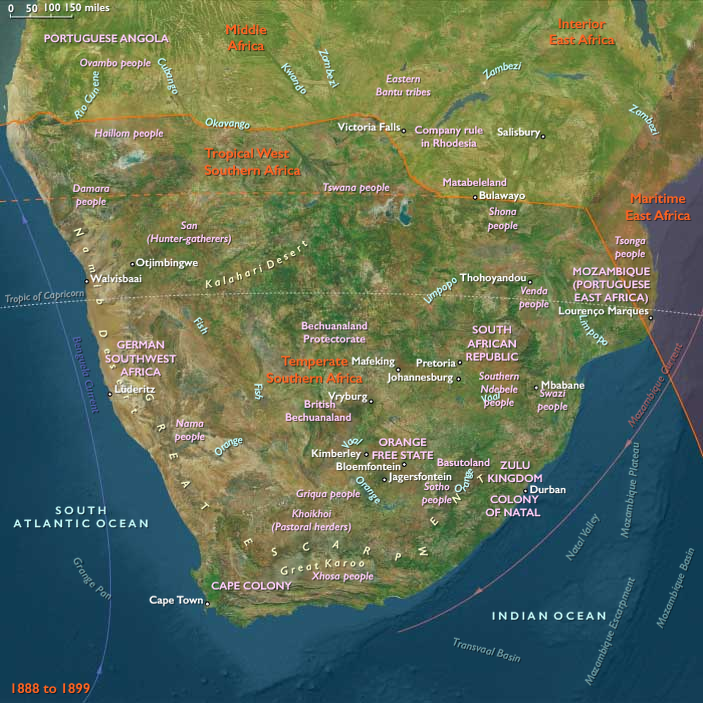
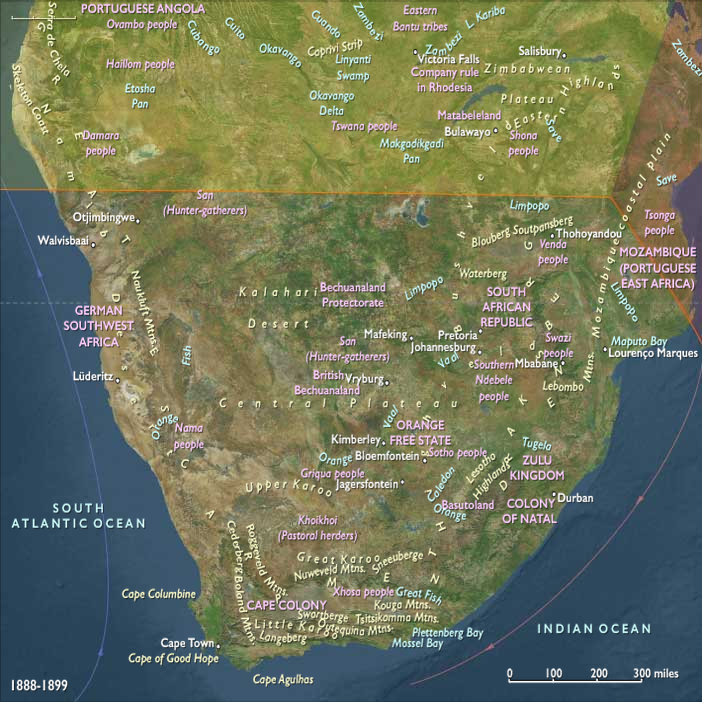
Thousands had come to Kimberley in the early 1870s, some to obtain diamond claims, the majority to seek jobs in the mines and thereby to acquire the cash that would enable them to rebuild cattle herds depleted by drought, disease, and Boer raids.
n the early 1870s, an average of fifty thousand men a year had migrated to work in the mines, usually for two to three months, returning home with guns purchased in Kimberley, as well as cattle and cash.
Many who lived in the area of the diamond finds had chosen to sell agricultural surpluses, rather than their labor, and to invest their considerable profits in increasing production for the growing urban market.
African farmers in British Basutoland (the British protectorate established in Lesotho), the Cape, and Natal had also greatly expanded their production of foodstuffs to meet rising demand throughout southern Africa, and out of this development has emerged a relatively prosperous peasantry supplying the new towns of the interior as well as the coastal ports.
The growth of Kimberley and other towns also provide new economic opportunities for Cape Coloureds, many of whom are skilled tradesmen, and for Indians, who, once they had completed their contracts on the sugar plantations, establish shops selling goods to African customers.
Locations
Groups
- Khoikhoi
- Indian people
- Sotho (Basotho or Basuto) people
- Swazi
- Zulu people
- Xhosa people
- Shona people
- Afrikaners
- Boers
- Britain (United Kingdom of Great Britain and Ireland)
- Cape Colony, British
- Zululand
- Zulu, Kingdom of the
- Zimbabwe, Ndebele Kingdom of
- South African Republic (the Transvaal)
- Swaziland, Kingdom of
- Swaziland, Kingdom of
- Natal Colony, British
- Orange Free State, Republic of the (Boer Republic)
- Basutoland
- British South Africa Company (SAC)
- Rhodesia, Company rule in
Topics
Commodoties
Subjects
Regions
Subregions
Years: 1888 - 1899
Locations
Groups
- Khoikhoi
- Indian people
- Sotho (Basotho or Basuto) people
- Swazi
- Zulu people
- Xhosa people
- Shona people
- Afrikaners
- Boers
- Britain (United Kingdom of Great Britain and Ireland)
- Cape Colony, British
- Zululand
- Zulu, Kingdom of the
- Zimbabwe, Ndebele Kingdom of
- South African Republic (the Transvaal)
- Swaziland, Kingdom of
- Swaziland, Kingdom of
- Natal Colony, British
- Orange Free State, Republic of the (Boer Republic)
- Basutoland
- British South Africa Company (SAC)
- Rhodesia, Company rule in
Topics
Commodoties
Subjects
Regions
Subregions