
New Zealand's Premier Julius Vogel borrows money …
Years: 1870 - 1870
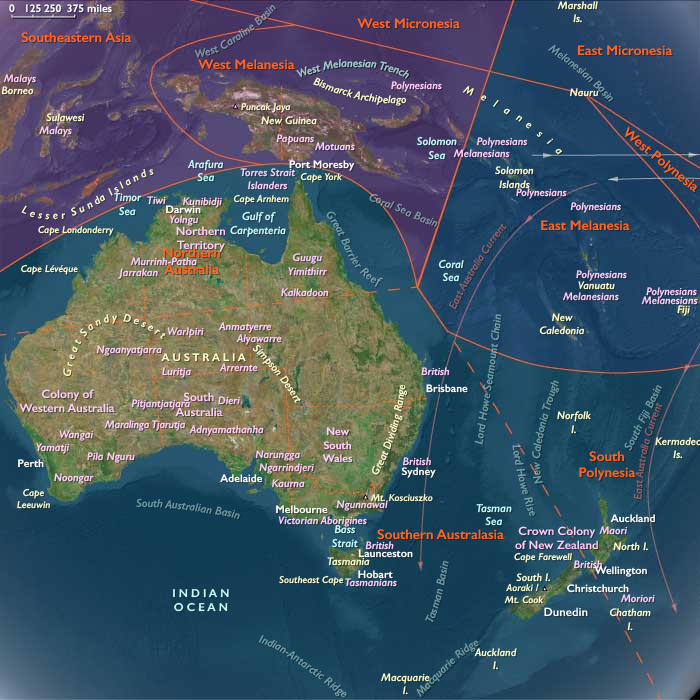
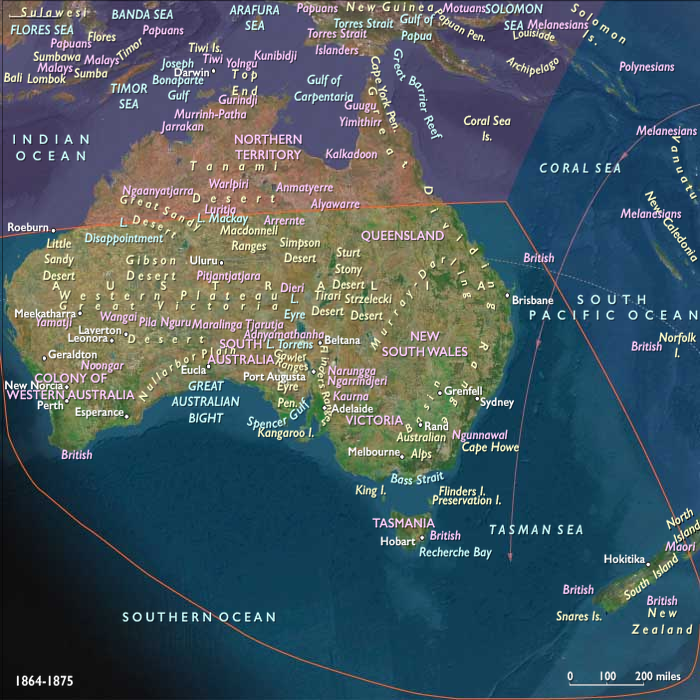
Successive governments will expand the program with offices across Britain that entice settlers and give them and their families one-way tickets.
Gold discoveries in Otago (1861) and Westland (1865), had caused a worldwide gold rush that had more than doubled New Zealand’s population in a short period, from seventy-one thousand in 1859 to one hunded and sixty-four thousand in 1863.
The value of trade has increased fivefold from two million pounds million to ten million pounds.
Locations
Groups
Topics
Commodoties
Subjects
Regions
Subregions
Related Events
Filter results
Showing 10 events out of 12847 total
Dutch businessmen set up large, profitable plantations.
Dutch finances had been severely affected by the cost of the Java and Padri Wars, despite increasing returns from the Dutch system of land tax, and the Dutch loss of Belgium in 1830 had brought the Netherlands to the brink of bankruptcy.
In 1830, a new Governor-General, Johannes van den Bosch, had been appointed to make the Indies pay their way through Dutch exploitation of its resources.
With the Dutch achieving political domination throughout Java for the first time in 1830, it had become possible to introduce an agricultural policy of government-controlled forced cultivation
Termed cultuurstelsel (cultivation system) in Dutch and tanam paksa (forced plantation) in Indonesian, farmers had been required to deliver, as a form of tax, fixed amounts of specified crops, such as sugar or coffee.
Much of Java has become a Dutch plantation and revenues have risen continually through the nineteenth century, which have been reinvested into the Netherlands to save it from bankruptcy.
Between 1830 and 1870, one billion guilders have been taken from Indonesia, on average making up twenty-five per cent of the annual Dutch government budget.
The Cultivation System, however, has brought much economic hardship to Javanese peasants, who had suffered famine and epidemics in the 1840s.
Critical public opinion in the Netherlands leads to much of the Cultivation System's excesses being eliminated under the agrarian reforms of the "Liberal Period".
Many Chinese scholars and followers of China's numerous religions resent the white Christian missionaries who had flocked to China in the mid-nineteenth century; to stir up the common people, they frequently circulate rumors that the foreigners are sorcerers.
The French Sisters of Charity at their orphanage in the city of Tianjin give small cash rewards to people who bring in homeless or unwanted children, which gives rise to the rumor that children are being kidnapped, mutilated, and used for witchcraft.
Hostility mounts, and on June 21, 1870, an angry Chinese crowd of locally prominent representatives led by a local magistrate stands outside the orphanage; the French consul, Henri Fontanier, fires on the mob to disperse it, missing the district magistrate but killing his servant.
Enraged by this, the Chinese immediately storm and sack the orphanage, killing and mutilating in the process eighteen mostly French foreigners, including the consul and ten nuns.
A storm of protest, demanding severe punishment for those responsible, issues from both Paris and Rome.
European warships sail to Tientsin and Chinese troops are activated at battle stations.
Hostilities are averted only after the execution of sixteen Chinese, under pressure from the Western powers, nd the dispatch of an official mission to convey China's apologies to France.
Yakub Beg rules at the height of The Great Game era, when the British, Russian, and Manchu Qing empires are all vying for Central Asia.
His domain, Kashgaria, extends from the capital, Kashgar, in southwestern Xinjiang to Ürümqi, Turfan, and Hami in central and eastern Xinjiang more than a thousand kilometers to the northeast, including a majority of what is known at this time as East Turkestan.
Yaqub Beg and his Turkic Uyghur Muslims also declare a Jihad against Chinese Muslims in Xinjiang.
Yaqub goes as far as to enlist Han Chinese to help fight against Chinese Muslim forces.
Turkic Muslims also massacre Chinese Muslims in Ili.
The great Dungan Revolt, or insurrection of the Chinese Muslims, which had broken out in 1862 in Gansu, had spread rapidly to Zungaria and through the line of towns in the Tarim basin.
The Dungan troops in Yarkand had risen and massacred some seven thousand Chinese on August 10, 1863, while the inhabitants of Kashgar, rising in their turn against their masters, had invoked the aid of Sadik Beg, a Kyrgyz chief, who had been reinforced by the Naqshbandi shaykh Buzurg Khan (Busurg Khan) (the heir and only surviving son of Jahangir Khoja) of the White Mountain, and Yakub Beg, his general, these being dispatched at Sadik's request by the ruler of Kokand to raise what troops they could to aid Muslims in Kashgar.
Sadik Beg had soon repented of having asked for a Khojah, and had eventually marched against Kashgar, which by this time had succumbed to Buzurg Khan and Yakub Beg, but had been defeated and driven back to Khkand.
Buzurg Khan had delivered himself up to indolence and debauchery, but Yakub Beg, with singular energy and perseverance, has made himself master of Yangi Shahr, Yangi-Hissar, Yarkand, and other towns.
By 1865, Yakub Beg had become the commander-in-chief of the army of Kokand.
Taking advantage of the Hui uprising in China's Xinjiang province, he has led his Andijani army to capture Kashgar and Yarkand from the Chinese and gradually takes control of most of the region, including Aksu, Kucha, and other cities in 1867.
He then deposed his former master, Buzurg Khan, and declared himself Amir of Kashgaria.
For the first few years, he had been a vassal of the Khan of Kokand, but eventually declares independence.
Elected city councils, or duma, are formed in Russia in 1870.
Dominated by property owners and constrained by provincial governors and the police, the zemstva and duma raise taxes and levy labor to support their activities.
Waltzes by the younger Johann Strauss, including The Beautiful Blue Danube (1867), Artists’ Life (1867), Tales of the Vienna Woods (1868) and Wine, Women and Song (1869) dominate cafe life in Vienna.
Lyuben Karavelov founds the Bulgarian Revolutionary Central Committee (BRCC) in Bucharest in 1870.
Rakovski had died in 1867 without achieving Bulgarian independence, but he had united the émigré intelligentsia, and the presence of his army influences Turkish recognition of the Bulgarian church in 1870.
Because the cultivation of Bulgarian national consciousness is initially a cultural rather than a political movement, it is consequently directed more against the “cultural yoke” of the Greeks than the “political yoke” of the Ottoman Empire.
After the Turkish conquest of the Balkans, the Greek patriarch had become the representative of the Rum millet, or the “Roman nation,” which comprised all the subject Christian nationalities.
The desire to restore an independent Bulgarian church is a principal goal of the national “awakeners,” whose efforts are rewarded in 1870 when the Sublime Porte issues a decree establishing an autocephalous Bulgarian church, headed by an exarch, with jurisdiction over the fifteen dioceses of Bulgaria and Macedonia.
Although the Greek patriarch refuses to recognize this church and excommunicates its adherents, it will become a leading force in Bulgarian life, representing Bulgarian interests at the Sublime Porte and sponsoring the further expansion of Bulgarian churches and schools.
The Franco-Prussian War in 1870 precipitates a political crisis in Romania as Francophile Liberal Party members denounce Romania's German prince.
Pro-French activists lead an abortive revolt against Carol at Ploiesti in August, nearly forcing his abdication.
Although the government quickly suppresses the uprising, a jury acquits the leaders.
Imam Azzan, in resorting to military means to unify Oman, has alienated members of the Ghafiri tribes, who revolt in 1870.
The British give financial and political support to Imam Azzan's rival, Turki ibn Said Al Said.
India's anticipated harvest of spring 1870 does indeed arrive, finally ending the famine.
Sayyid Majid bin Said Al-Busaid’s marriage has produced only one daughter, Sayyida Khanfora bint Majid (who will marry her cousin, the seventh Sultan).
As a consequence, Majid is succeeded as Sultan of Zanzibar in 1870 by his brother Barghash bin Said.
Majid bin Said had become Sultan of Zanzibar and Oman on the death of his father, Sayyid Said bin Sultan, but his accession had been contested.
Following the struggle over the accession to the position of Sultan of Oman, Zanzibar and Oman had been divided into two separate principalities, with Majid ruling Zanzibar and his older brother Thuwaini ruling Oman.
The sultans have developed an economy of trade and cash crops in the Zanzibar Archipelago with a ruling Arab elite.
Ivory is a major trade good.
The archipelago, also known as the Spice Islands, is famous worldwide for its cloves and other spices, and plantations are developed to grow them.
The archipelago's commerce gradually falls into the hands of traders from the Indian subcontinent, whom Said bin Sultan had encouraged to settle on the islands.
During his fourteen-year reign as sultan, Majid has consolidated his power around the East African slave trade.
Malindi in Zanzibar City is East Africa's main port for the slave market between Africa and Asia (including the Middle East), and in the mid-nineteenth century as many as fifty thousand slaves have passed annually through the port.
Many are captives of Tippu Tib, a notorious Arab slave trader and ivory merchant.
Tib leads huge expeditions, some four thousand strong, into the African interior, where chiefs sell him their villagers for next to nothing.
These Tib uses to caravan ivory back to Zanzibar, then sells them in the slave market for large profits.
Tib has become one of the wealthiest men in Zanzibar, the owner of multiple plantations and ten thousand slaves. (Swahili Coast: East Africa's Ancient Crossroads", in a "Did You Know?" sidebar authored by Christy Ullrich, National Geographic)
