
Gogukwon’s son and successor, Sosurim, born as …
Years: 372 - 372
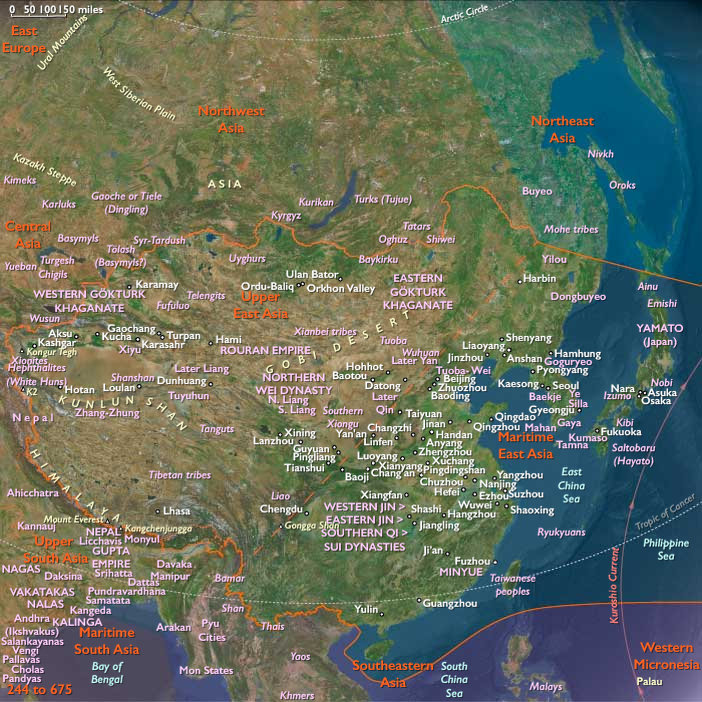
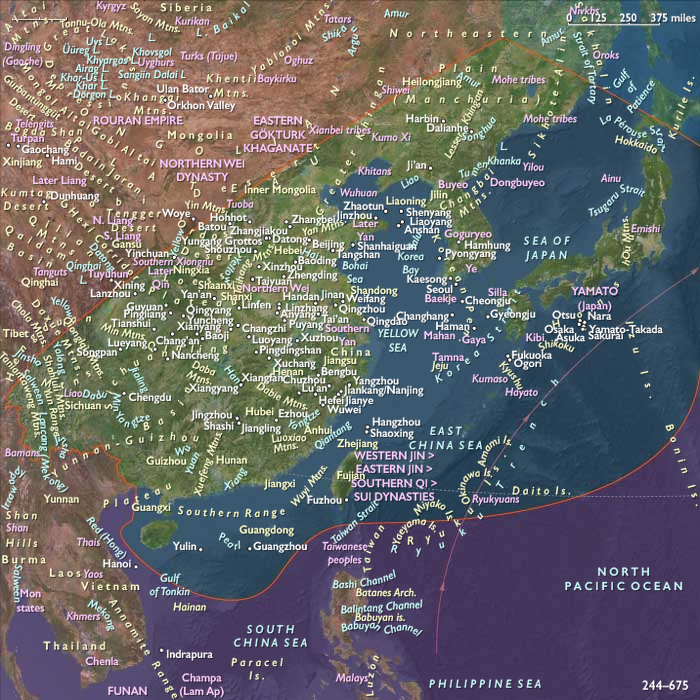
Gogukwon’s son and successor, Sosurim, born as Go Gu-Bu and made crown prince in 355, had assisted his father in leading the country and strengthening royal authority.
Turning to domestic stability and the unification of various conquered tribes, he establishes state religious institutions to transcend tribal factionalism.
Having received Buddhism through traveling monks of Former Qin, he builds temples to house them, embracing Buddhism as the national religion in 372.
In the same year, he establishes a national educational institute called the Taehak, a Confucian institution meant to educate the children of the nobility.
Locations
People
Groups
Topics
Subjects
Regions
Subregions
Related Events
Filter results
Showing 10 events out of 42 total
Middle Africa (1828–1971 CE): Abolition, Partition, Extraction, and Independence
Geographic & Environmental Context
The subregion of Middle Africa includes Chad, the Central African Republic, Cameroon, Equatorial Guinea, São Tomé and Príncipe, Gabon, the Republic of the Congo, the Democratic Republic of the Congo, and Angola.Anchors included the Congo–Kasai–Ubangi river system and ports (Matadi, Léopoldville/Kinshasa, Brazzaville), the Atlantic harbors of Luanda, Lobito, Pointe-Noire, Libreville, Douala, the Cameroon Highlands and forest massifs, the northern savanna and Lake Chad basin, and the Gulf of Guinea islands (São Tomé, Príncipe, Bioko). From equatorial rainforest to Sahelian margin, the region’s corridors were re-engineered by abolition’s aftermath, the Scramble for Africa, and 20th-century state formation.
Climate & Environmental Shifts
With the retreat of the Little Ice Age, rainfall belts oscillated. Congo basin forests stayed humid, but dry-season length varied by decade; high river years expanded floodplain farming yet raised erosion risk. The Lake Chad basin swung between flood and shrinkage pulses (notably late 1960s drought). Along the Atlantic, heavy rains alternated with stormy seasons that reshaped estuaries and mangroves. Logging, plantation clearance, and later oil extraction intensified local micro-climate and watershed stress.
Subsistence & Settlement
Abolition redirected labor from slave corridors to plantations, mines, and ports.
-
Forest and riverine belts: Cassava (by now a staple famine reserve), plantain/banana, yam, taro, maize, oil palm, groundnuts, and beans anchored household nutrition; fishing and smoked/dried fish stores remained vital. Cocoa and coffee spread in Cameroon, Gabon, and on São Tomé and Príncipe, where plantation monoculture dominated.
-
Savanna and Lake Chad: Millet, sorghum, rice, and cattle herding persisted, with recession farming along floodplains.
-
Urbanization: Port and rail towns (Douala, Pointe-Noire, Libreville, Léopoldville/Kinshasa, Brazzaville, Luanda) expanded around docks, depots, and workshops; mining towns rose in Katanga (copper, cobalt), Kasai (diamonds), and the Angolan interior (iron, diamonds).
Technology & Material Culture
Colonial regimes laid railways that reoriented trade: the Congo–Ocean Railway (1921–1934) to Pointe-Noire; the Benguela Railway linking Katanga to Lobito; Douala–Nkongsamba and other lines in Cameroon. River steamers, dredged channels, and ports (Matadi, Boma) integrated the Congo corridor with the Atlantic. Concession companies built mills for palm oil, timber yards, and mining plants; mission presses, schools, and clinics proliferated. Forced-labor systems supplied roads, rails, and estates—prestations in French Equatorial Africa, contract labor and chibalo in Portuguese Angola, with coerced migration to São Tomé and Príncipe cocoa roças (sparking early 1900s boycotts). Household craft and market production—blacksmithing, weaving, pottery, canoe carpentry—adapted to cash economies; urban workshops forged a new artisanal landscape.
Movement & Interaction Corridors
-
River and rail grids funneled palm products, timber, copper/cobalt, diamonds, and cocoa to Atlantic ports.
-
Atlantic lanes connected Luanda, Lobito, Pointe-Noire, Douala, Libreville, and São Tomé with Lisbon, Antwerp, Marseille, and later New York.
-
Labor migrations moved workers from savannas to mines, plantations, and docks; seasonal and contract flows tied the Lake Chad fringe to forest and port towns.
-
Mission and medical circuits (sleeping-sickness campaigns) penetrated deep inland. Late in the period, roads and airstrips extended state reach; large projects (e.g., Inga on the lower Congo, planned in the 1960s) heralded hydro-modernity at decade’s end.
Cultural & Symbolic Expressions
Mission Christianity spread schooling, print, and new associational life; prophetic and African-initiated churches transformed religious landscapes—Kimbanguism (founded 1921) in the lower Congo became a mass church by mid-century; later Angolan movements (e.g., Tokoist strands) blended biblical and local idioms. Urban music and dance forged modern publics: Congolese rumba/soukous, Cameroonian makossa, Angolan semba, all carried ngoma drum lineages into amplified nightlife. Writers (e.g., Ferdinand Oyono, Mongo Beti) and painters chronicled colonial contradiction. Court and village arts endured—masks, nkisi figures, raffia and cotton textiles—now circulating through markets and museums alike.
Environmental Adaptation & Resilience
Households hedged risk with multicropping (cassava as standing reserve), compound gardens, and fish smoking/drying. Forest communities rotated fields and protected sacred groves; savanna herders shifted grazing with the rains; floodplain cultivators followed river pulses. During epidemics and forced labor drives, kin networks rehomed dependents; mutual-aid societies, mission parishes, and later unions buffered shocks. Conservation began as colonial game reserves and national parks (e.g., Odzala 1930s) and post-colonial protected areas; fisheries and forest regulations emerged unevenly under pressure from urban markets.
Technology & Power Shifts (Conflict & Polity Dynamics)
The Atlantic slave trade collapsed, but concessionary regimes (rubber, ivory) in the Congo Free State (1885–1908)produced catastrophic violence—amputation terror and demographic collapse—before annexation as the Belgian Congo. France consolidated French Equatorial Africa; Germany took Kamerun (later partitioned to France/Britain after World War I); Spain held Equatorial Guinea; Portugal deepened rule in Angola and on São Tomé and Príncipe. After 1945, anticolonial nationalism surged: strikes, student leagues, churches, and cultural clubs nurtured parties and fronts.
Key turning points:
-
Congo–Léopoldville independence (1960): crisis—Patrice Lumumba, Katanga secession (1960–1963), UN intervention, and the 1965 coup by Joseph-Désiré Mobutu; the country was renamed Zaire in 1971.
-
Congo–Brazzaville, Gabon, Chad, Central African Republic, Cameroon: 1960 independence, followed by one-party consolidations and, in places, insurgencies (UPC in Cameroon; conflict in Chad from 1965).
-
Equatorial Guinea: independence (1968), authoritarian turn under Francisco Macías Nguema.
-
Angola: anticolonial war from 1961 (MPLA, FNLA, UNITA), still under Portuguese rule within our span.
-
São Tomé and Príncipe: plantations persisted under Portugal; independence would follow after 1971.
Transition
By 1971 CE, Middle Africa had traversed coerced extraction, partition, and a turbulent decolonization. New states—Cameroon (federation of 1961), Congo-Brazzaville, Gabon, Chad, the Central African Republic, Equatorial Guinea, and Zaire—stood astride river and rail grids built for export, now reimagined for nation-building. Angola fought a widening independence war; São Tomé and Príncipe remained under plantation rule; Gabon entered an oil economy; Kinshasa’s rumba and Brazzaville’s dance bands broadcast urban modernities from riverbanks to continents. Beneath the rush of copper and oil, timber and cocoa, household multicropping, river fisheries, and kin solidarities still sustained everyday life—resilient repertoires forged across forests and floodplains, now tasked with the work of sovereignty.
Atlantic West Europe (1864–1875): Industrial Maturity, National Conflicts, and Social Reform
From 1864 to 1875, Atlantic West Europe—including northern France, Belgium, the Netherlands, Luxembourg, and the Atlantic and English Channel coasts—entered a crucial phase marked by sustained industrial maturity, increased national tensions culminating in the Franco-Prussian War, significant urban and social transformations, and the emergence of deeper political divisions driven by class, religion, and nationalism.
Political and Military Developments
The Franco-Prussian War (1870–1871)
-
The era’s defining political event was the Franco-Prussian War, triggered in part by France’s ambitions under Napoleon III and manipulated by Prussian Chancellor Otto von Bismarck to unify Germany.
-
France’s devastating defeat, highlighted by Napoleon III’s capture at the Battle of Sedan (1870), ended the Second French Empire and led to the proclamation of the Third French Republic.
-
The humiliating loss and subsequent occupation by Prussian troops, including parts of northern France, profoundly impacted French national identity and political stability.
Emergence of the French Third Republic
-
The newly established Third Republic (1870) began navigating internal political instability, social tensions, and lingering monarchist aspirations. Under Adolphe Thiers and later Patrice de MacMahon, the republic struggled to consolidate its institutions and heal national divisions.
Belgium: Stability amid Neutrality and Reform
-
Belgium, under King Leopold II (r.1865–1909), continued its policy of neutrality but faced growing internal tensions between liberals and Catholics. Electoral reforms expanded suffrage modestly, setting the stage for future democratization.
-
Leopold II began focusing on overseas ambitions in Africa, laying early foundations for Belgian colonialism.
Netherlands and Luxembourg: Liberal Reforms and Stability
-
The Netherlands under King William III remained politically stable, with liberal parliamentary forces pushing progressive reforms in education, infrastructure, and public administration.
-
Luxembourg, following the Luxembourg Crisis of 1867, was reaffirmed as an independent and perpetually neutral state, ending previous Dutch sovereignty, and entering a new era of political autonomy.
Economic Developments: Industrial Consolidation and Growth
Post-War Economic Resilience in France
-
Despite political turmoil, northern French industry rapidly recovered after the Franco-Prussian War. Cities such as Lille, Roubaix, Dunkirk, and Le Havre continued to expand, driven by textiles, steel production, shipbuilding, and railways.
-
The Suez Canal’s opening (1869), though geographically distant, enhanced French maritime trade routes, indirectly benefiting Atlantic ports.
Belgian Industrial Strength and Expansion
-
Belgium sustained significant industrial growth, particularly in iron, coal, and textiles. Antwerp continued its ascent as a major global trade hub, while Wallonia’s steel and coal production surged, powering broader economic expansion.
Dutch Maritime Commerce and Industrial Diversification
-
The Netherlands experienced continued growth in maritime commerce, shipbuilding, and agricultural exports. Rotterdam emerged as a vital port city, increasingly surpassing Amsterdam as the nation’s primary commercial gateway.
-
New industrial sectors developed, including chemical manufacturing, textiles, and machinery production, enhancing economic diversification and resilience.
Social Developments: Labor Activism and Urbanization
Labor Movements and the Paris Commune (1871)
-
In France, profound social tensions emerged after the Franco-Prussian War, notably culminating in the revolutionary uprising known as the Paris Commune (March–May 1871), reflecting urban working-class dissatisfaction, socialist aspirations, and republican ideals.
-
Although brutally suppressed by government forces, the Commune deeply influenced European socialist thought and labor movements, inspiring workers and radical intellectuals across Atlantic West Europe.
Belgian and Dutch Labor Activism
-
Belgium experienced significant labor activism, particularly in industrial regions such as Liège, Antwerp, and Ghent, with workers demanding improved working conditions, higher wages, and political representation.
-
In the Netherlands, the rise of trade unions and early socialist movements, especially in urban centers such as Rotterdam and Amsterdam, signaled a gradual but increasing demand for social reform.
Cultural and Intellectual Developments
Realism and Naturalism in Literature and Art
-
Cultural life remained profoundly shaped by realism and emerging naturalism, notably in France, through writers like Émile Zola, whose works (beginning with Thérèse Raquin, 1867) highlighted the stark realities of industrial urban life and social inequalities.
-
Painters such as Édouard Manet and early Impressionists challenged traditional academic art, focusing instead on modern urban experiences and candid portrayals of daily life, reshaping artistic expression throughout Europe.
Advancements in Science and Technology
-
Significant advancements occurred in industrial technology, chemistry, medicine, and sanitation. These improvements supported rapid urban growth and increased industrial productivity, notably through innovations in steel production and public health infrastructure.
Religious Developments
Continued Secularization and Religious Conflict
-
Secularization intensified, particularly in France, where the Catholic Church's political influence was increasingly challenged by republican governments and secular intellectuals.
-
Belgium continued experiencing significant tensions between Catholic conservatives and liberal secularists, particularly over educational reforms and church-state relations, shaping the country's long-term political landscape.
Urbanization and Social Dynamics
Accelerated Urban Growth and Infrastructure
-
Urbanization accelerated dramatically, driven by industrial expansion and rural migration. Major cities—Paris, Lille, Roubaix, Antwerp, Rotterdam, Brussels, and Amsterdam—expanded rapidly, investing significantly in urban infrastructure, public transportation, and sanitation systems.
Deepening Class Divisions
-
Economic prosperity was unevenly distributed, deepening class divides. Wealthier merchant and industrialist classes thrived, especially in urban centers, while industrial workers faced difficult living conditions and periodic unemployment, fueling labor unrest and demands for reform.
Long-Term Consequences and Historical Significance
The era 1864–1875 represented a crucial phase in Atlantic West Europe’s historical trajectory:
-
Politically, the fall of Napoleon III and the establishment of the Third Republic reshaped France’s internal dynamics and European alliances, profoundly influencing subsequent geopolitical alignments.
-
Economically, the region demonstrated resilience and sustained industrial maturity, firmly integrating into global trade networks and setting foundations for late 19th-century prosperity.
-
Socially, intensified labor activism, epitomized by the Paris Commune, revealed growing class tensions and demands for political and social reforms that would drive subsequent European socialist and democratic movements.
-
Culturally, realism and emerging naturalism influenced European literature, art, and intellectual thought, reflecting a deeper engagement with social realities and the complexities of modern industrial life.
By 1875, Atlantic West Europe had emerged from a turbulent decade politically transformed, economically vibrant, socially dynamic, and culturally influential—poised for continued prominence in the rapidly modernizing Europe of the late 19th century.
Ministers of other European countries rush to offer compromise proposals to avert a war that might drag their own countries into conflict.
Austria's Foreign minister, Count Beust, proposes transferring Luxembourg to neutral Belgium, in return for which France would be compensated with Belgian land.
However, Belgian King Leopold II refuses to part with any of his lands, putting paid to Beust's proposal.
With the German public angered and an impasse developing, Napoleon III seeks to backtrack; he certainly does not want to appear to be unduly expansionist to the other Great Powers.
Thus, he demands only that Prussia withdraw its soldiers from Luxembourg City, threatening war in the event that Prussia does not comply.
To avoid this fate, the Russian Emperor Alexander II calls for an international conference, to be held in London.
The United Kingdom is more than happy to host the talks, as the British government fears that the absorption of Luxembourg, by either power, would weaken Belgium, its strategic ally on the continent.
All of the Great Powers are invited to London to hammer out a deal that will prevent war.
The negotiations at London had centered upon the terms of Luxembourg's neutrality, as it had been clear that no other power will accept the incorporation of Luxembourg into either France or the North German Confederation.
The result is a victory for Bismarck; although Prussia will have to remove its soldiers from Luxembourg City, Luxembourg will remain in the Zollverein.
Middle Africa (1876–1887 CE): Portuguese Claims, European Partition, and Intensified Slave Trade
Between 1876 and 1887 CE, Middle Africa—covering modern Chad, Cameroon, Central African Republic, Equatorial Guinea, São Tomé and Príncipe, Gabon, Republic of the Congo, Democratic Republic of the Congo (DRC), and Angola (including its Cabinda enclave)—experiences intensified European colonial ambitions, extensive disruptions from slave-trading activities, and the early stages of partitioning by European powers.
Portuguese Claims and the Berlin Conference
In 1883, aware of competing French and Belgian activities along the lower Congo River, Portugal occupies Cabinda and Massabi, asserting longstanding territorial claims north of the Congo River and annexing areas of the former Kongo Kingdom. Portugal seeks international recognition by negotiating a treaty with Britain in 1884, but this agreement is rejected by other European powers, especially France and Belgium.
Portugal's appeals for an international conference initially find little support. However, German Chancellor Otto von Bismarck seizes upon this idea, aiming to diminish French and British colonial dominance. Consequently, the pivotal Berlin Conference (1884–1885) convenes, profoundly impacting Central African geopolitics. At the conference, Belgium’s King Leopold II gains recognition for his privately controlled International Association of the Congo, subsequently establishing the Congo Free State. This territory, officially neutral and open to free trade, is in reality subjected to Leopold’s brutal exploitation in the following decades.
German Establishment in Kamerun
Germany formalizes its presence in Central Africa during this era. In 1884, Chancellor Otto von Bismarck, influenced by merchant Adolph Woermann, dispatches the gunboat SMS Möwe to protect German trading interests at Douala, laying foundations for the colony of Kamerun. Prominent German firms—including Woermann and Jantzen & Thormählen—establish expansive trading networks and plantations, notably cultivating bananas and other export crops. The administration supports commercial interests by suppressing local uprisings, as Germany aspires to link Kamerun to its East African territories through the Congo region.
French Expansion in Gabon and the Congo
French explorers, notably Pierre Savorgnan de Brazza, significantly expand French influence during this period. Brazza, guided by Gabonese bearers, explores the upper reaches of the Congo River, securing treaties and establishing strategic posts. In 1880, Brazza negotiates a treaty with King Makoko of the Bateke, formally establishing the French Congo colony in 1882, with Franceville founded as an important regional center. By 1885, France officially occupies Gabon, though full administrative control will be delayed until the early twentieth century.
Devastating Slave Trade in the Central African Interior
The late nineteenth century witnesses intensified slave-raiding activities in the present-day Central African Republic and surrounding regions. Slave traders from the Sahara, the Nile Basin, and Arab-led expeditions disrupt local societies severely. The Bobangi people, controlling slave trade along the upper Congo and Ubangi rivers, dominate commerce, selling captives primarily to the Americas. The widespread use of the Bangi language emerges to facilitate interethnic commerce throughout the Congo Basin.
Slave raiders from the Sudanese states of Wadai and Darfur, along with Khartoum-based armies under leaders like Rabih al-Zubayr, decimate populations such as the Banda people. Raids, warfare, and forced migrations profoundly disrupt indigenous societies, with extensive population losses caused directly by slavery and related conflicts.
Azande Expansion and Fragmentation
The Azande people, emerging from the merging of the Bandia and Vungara peoples, continue their territorial expansion across the southeastern savannas of present-day Central African Republic and neighboring regions. Succession struggles among Azande rulers drive defeated contenders to establish new kingdoms, facilitating their spread northward and eastward. By the late nineteenth century, Azande territories become fragmented by slave raids from the north, and soon thereafter, colonial boundaries established by Belgium, France, and the Anglo-Egyptian Sudan permanently divide Azande society.
Luba Instability and Chokwe Expansion
By the late nineteenth century, the Luba Kingdom experiences severe internal instability due to continual dynastic conflicts. The absence of stable succession mechanisms weakens the Luba monarchy significantly, facilitating invasions by the aggressive and militarily superior Chokwe people. Armed with firearms and driven by the lucrative trade in slaves, ivory, wax, and later rubber, Chokwe warriors conquer and occupy extensive Luba territories, spreading turmoil across the central savannas.
The Chokwe quickly absorb conquered populations, integrating them into their existing social structure, thereby rapidly expanding their influence. However, by the end of the century, the Chokwe will be pushed back by resilient Lunda forces.
Multicultural Development in Fernando Pó
On Spanish-controlled Fernando Pó (now Bioko), significant administrative and social changes take place. Following recommendations to move settlements to higher elevations to reduce tropical disease exposure, by 1884 major plantations and administrative functions have relocated to Basile, several hundred meters above sea level. This move greatly improves survival rates for Europeans and other settlers. The island continues to host a vibrant, multicultural community of Creoles, Africans, and exiled Europeans, enhancing its distinctive cultural landscape.
Lasting Consequences of the Era
Between 1876 and 1887, the foundations of European colonial empires in Central Africa are decisively laid, accompanied by severe disruptions from intensified slave raiding and interethnic warfare. European competition and the outcomes of the Berlin Conference reshape the geopolitical landscape profoundly, setting the stage for the colonial era that will dominate the region well into the twentieth century.
Leopold II's International Association of the Congo, which has already adopted its own flag, gains the separate recognition as an independent entity by thirteen powers, following the example set by the United States, at the Conference of Berlin, held in 1884-85 to settle disputes among the European nations and in essence to partition Africa among them.
Shortly afterward the association becomes the Congo Free State.
By the General Act of Berlin, signed at the conclusion of the conference in 1885, the powers also agree that activities in the Congo Basin should be governed by certain principles, including freedom of trade and navigation, neutrality in the event of war, suppression of the slave traffic, and improvement of the condition of the indigenous population.
The conference recognizes Leopold II as sovereign of the new state.
Henry Morton Stanley's adventures have brought the Congo to the attention of Belgium's King Leopold II, a man of boundless energy and ambition.
The European occupation of Africa is well under way, but the Congo River basin remains for the most part unknown to Europeans.
With no great powers contesting its control, the area appears to present an ideal opportunity for Belgian expansion.
The Scottish missionary David Livingstone had engaged in a series of explorations that brought the Congo to the attention of the Western world from 1840 to 1872.
During these travels, Livingstone was out of touch with Europe for two years.
Henry Morton Stanley, a journalist, had been commissioned by the New York Herald to conduct a search for him.
The two met at Ujiji, on the eastern shore of Lake Tanganyika, in 1871.
Three years later, Stanley had been commissioned by the New York Herald and London's Daily Telegraph to continue the explorations begun by Livingstone.
With three British companions, Stanley began the descent of the Congo from its upper reaches, completing his journey in 1877.
Returning to Europe, he has tried to interest the British government in further exploration and development of the Congo but has met with no success.
His expeditions have, however, attracted another European monarch.
Recruiting Stanley to help him from 1878, Belgium's King Leopold II founds the International Association of the Congo, financed by an international consortium of bankers.
Under the auspices of this association, Stanley arrives at the mouth of the Congo in 1879 and begins the journey upriver.
He founds Vivi, the first capital, across the river from present-day Matadi, then moves farther upriver, reaching a widening he named Stanley Pool (now Pool de Malebo) in mid-1881.
There he founds a trading station and the settlement of Lèopoldville (now Kinshasa) on the south bank.
The north bank of the river has been claimed by France, leading ultimately to the creation of the colony of French Congo.
The road from the coast to Vivi is completed by the end of 1881, and Stanley returns to Europe.
He is back in Africa by December 1882 and sails up the Congo to Stanleyville (now Kisangani), signing more than four hundred and fifty treaties on behalf of Leopold II with persons described as local chieftains who have agreed to cede their rights of sovereignty over much of the Congo Basin.
In 1884 Stanley returns to Europe.
Leopold II soon proceeds to transform the Congo Free State into an effective instrument of colonial hegemony in order to meet the conference's legal requirement of "effective occupation."
Indigenous conscripts are promptly recruited into his nascent army, the Force Publique, manned by European officers.
A corps of European administrators is hastily assembled, which by 1906 will number fifteen hundred people; and a skeletal transportation grid will eventually be assembled to provide the necessary links between the coast and the interior.
The cost of the enterprise will prove far higher than had been anticipated, however, as the penetration of the vast hinterland cannot be achieved except at the price of numerous military campaigns.
Some of these campaigns will result in the suppression or expulsion of the previously powerful Afro-Arab slave traders and ivory merchants.
Only through the ruthless and massive suppression of opposition and exploitation of African labor can Leopold II hold and exploit his personal fiefdom.
Years: 372 - 372
Locations
People
Groups
Topics
Subjects
Regions
Subregions