Goethe visits Cagliostro's family in Palermo in …
Years: 1787 - 1787
Goethe visits Cagliostro's family in Palermo in 1787.
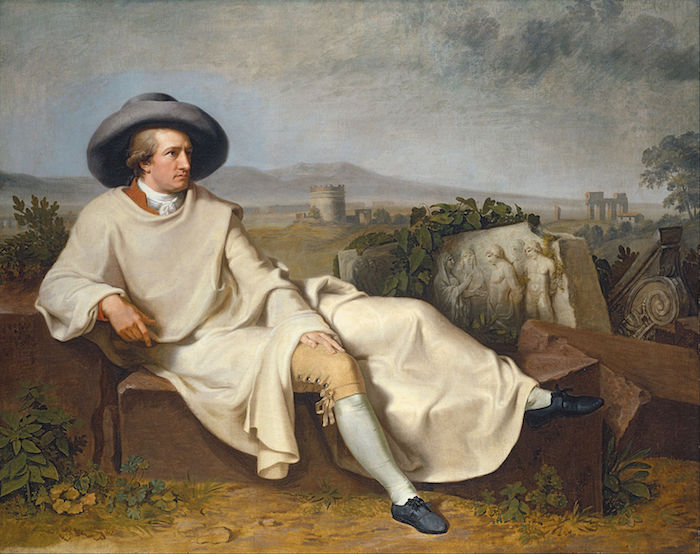
Johann Heinrich Wilhelm Tischbein: Goethe in the Roman Campagna Rome, 1787. Oil on canvas,164 × 206 cm (64.6 × 81.1 in). Städel
Locations
People
- Alessandro Cagliostro
- Angelika Kauffmann
- Johann Heinrich Wilhelm Tischbein
- Johann Wolfgang von Goethe
Topics
Subjects
Regions
Subregions
Related Events
Filter results
Showing 10 events out of 24567 total
Kōdayū and the eight other surviving Japanese castaways, stranded in the Aleutian Islands for the past five years, have sailed their driftwood craft for one and a half months to arrive in Kamchatka, where Russian officials at first cannot believe the castaways had sailed from Amchitka in a "hand-made boat".
Kōdayū meets Barthélemy de Lesseps, a French diplomat, who will later write about the castaways in his Journal historique du voyage de M. de Lesseps, published in 1790.
Six of the fifteen Japanese castaways had died within three years of their arrival on Amchitka.
Kōdayū's people escape from the island by building a new ship of driftwood with sails made of otter fur.
He is devoted to the arts—Beethoven and Mozart will enjoy his patronage, and his private orchestra has a Europe-wide reputation.
He also is a talented cellist, but an artistic temperament is hardly what is required of a king of Prussia on the eve of the French Revolution, and Frederick the Great, who had employed him in various services (notably in an abortive confidential mission to the court of Russia in 1780), had openly expressed his misgivings as to the character of the prince and his surroundings.
For his part, Frederick William, who has never been properly introduced to diplomacy and the business of rulership, resents his uncle for not taking him seriously.
The misgivings of Frederick II appear justified in retrospect.
Frederick William′s accession to the throne (August 17, 1786) has, indeed, been followed by a series of measures for lightening the burdens of the people, reforming the oppressive French system of tax-collecting introduced by Frederick, and encouraging trade by the diminution of customs dues and the making of roads and canals.
This gives the new king much popularity with the masses; the educated classes are pleased by his removal of Frederick's ban on the German language, with the admission of German writers to the Prussian Academy, and by the active encouragement given to schools and universities.
Frederick William has also terminated his predecessor's state monopolies for coffee and tobacco and the sugar monopoly.
Hungary's nobles and Catholic clergy resist Joseph's reforms, and the peasants soon grow dissatisfied with taxes, conscription, and forced requisition of military supplies. (Faced with broad discontent, Joseph will rescind many of his initiatives toward the end of his life.)
Franz Karl Achard develops a practical method for extracting sugar from beets in 1787.
A student o the late German chemist Andreas Sigismund Marggraf, who had earlier discovered that the sucrose in beets has the same chemical composition as that in sugarcane, Achard had revived the discovery by Marggraf in 1747 that sugar beets contained sugar, and devised a process to produce it.
Born in Berlin, the son of preacher Max Guillaume Achard, descendant of Huguenot refugees and his wife Marguerite Elisabeth (Rouppert), Achard had studied physics and chemistry in his home city and became interested in sugar refining through his stepfather.
At the age of twenty, Achard had entered the "Circle of Friends of Natural Sciences" and met Marggraf, then director of the physical classes at the Royal Academy of Sciences.
Achard has studied many subjects, including meteorology, evaporation chillness, electricity, telegraphy, gravity, lightning arresters, and published in German and French.
A favorite of King Frederick II of Prussia, Achard had reported directlyto the King on his research twice a week.
About a study on the influence of electricity on mental capabilities, Frederick II was reported to have said: If he is able to provide reason for the half wits in my Prussian states using electricity, then he is worth more than his own weight in gold.
Elected to the Royal Academy of Sciences at Berlin in 1776, Archard went on to become the director of the physical classes of the academy following the death of Marggraf in 1782.
In 1782 he was elected a foreign member of the Royal Swedish Academy of Sciences.
For his discoveries in the acclimatization of tobacco to Germany, the king had granted him a lifetime pension of five hundred taler.
Achard is also esteemed by Frederick William II of Prussia.

Russia's annexation of the Crimea and desire to make Georgia a protectorate, plus the Turks' attempts to foment a Tatar revolt, leads to a renewal of Catherine's war (it is rumored that she desires to absorb the Ottoman Empire).
Ottoman Sultan Abdülhamid, confronted with Russian designs, declares war on the Russian empire in 1787.
Abdul Aziz, in a large public gathering in 1787 chaired by Muhammad ibn 'Abd al-Wahhab, forms a new type of inherited authority (Wilayat ul-A'hed) based on the Wahhabi views and, in direct opposition to the Khaleef, or Caliph, in Istanbul, declares himself leader of the Muslims.
'Abd al-'Aziz then appoints his son Saud as the Khalifah designate after him.
Muhammad ibn 'Abd al-Wahhab agrees to this authority and passes a Fatwah of Jihad against the Ottomani Khilafah.
The Russo–Turkish War of 1787–1792 involves an unsuccessful attempt by the Ottoman Empire to regain lands lost to Russian Empire in the course of the previous Russo-Turkish War (1768–74).
It takes place concomitantly with the Austro-Turkish War of 1787–91.
Russian general Aleksandr Vasilyevich Suvorov repels a Turkish effort to seize the Crimea, winning a victory over the Turks at Kinburn in October 1787 while the veteran general Count Pyotr Rumyantsev invades Moldavia, but a stalemate grips forces on all fronts.
Goethe's journey to the Italian peninsula and Sicily from 1786 to 1788 is of great significance in his aesthetic and philosophical development.
His father had made a similar journey during his own youth, and his example was a major motivating factor for Goethe to make the trip.
More importantly, however, the work of Johann Joachim Winckelmann has provoked a general renewed interest in the classical art of ancient Greece and Rome.
Thus Goethe's journey has something of the nature of a pilgrimage to it.
During the course of his trip Goethe meets and befriended the artists Angelica Kauffman and Johann Heinrich Wilhelm Tischbein, as well as encountering such notable characters as Lady Hamilton and Alessandro Cagliostro.
He also journeys to Sicily during this time, and writes intriguingly that "To have seen Italy without having seen Sicily is to not have seen Italy at all, for Sicily is the clue to everything."
While in Southern Italy and Sicily, Goethe encounters, for the first time, genuine Greek (as opposed to Roman) architecture, and is quite startled by its relative simplicity.
Winckelmann had not recognized the distinctness of the two styles.
Goethe's diaries of this period form the basis of the non-fiction Italian Journey.
Italian Journey only covers the first year of Goethe's visit.
The remaining year is largely undocumented, aside from the fact that he spent much of it in Venice. This "gap in the record" has been the source of much speculation over the years.
In the decades which immediately follow its publication in 1816, Italian Journey will inspire countless German youths to follow Goethe's example.
This is pictured, somewhat satirically, in George Eliot's Middlemarch.
Jacques Charles discovers his eponymous Law describing the relationship between the volume and temperature of a gas in 1787.
In 1787 also, Antoine Lavoisier identifies alumine as the oxide of the yet-undiscovered metal aluminum.
Years: 1787 - 1787
Johann Heinrich Wilhelm Tischbein: Goethe in the Roman Campagna Rome, 1787. Oil on canvas,164 × 206 cm (64.6 × 81.1 in). Städel
Locations
People
- Alessandro Cagliostro
- Angelika Kauffmann
- Johann Heinrich Wilhelm Tischbein
- Johann Wolfgang von Goethe