
Gobekli Tepe (Turkish for "Potbelly hill"), a …
Years: 9549BCE - 7822BCE
Gobekli Tepe (Turkish for "Potbelly hill"), a site six miles from the site of Urfa featuring massive carved stones, may be the world’s oldest temple, erected by hunter-gatherers on the highest point of an elongated mountain ridge some fifteen kilometers northeast of the town of Sanliurfa (formerly Urfa/Edessa) in southeastern Turkey.
Construction begins in the tenth millennium BCE (around 11,500 years ago), before the advent of sedentism.
Together with Nevali Çori, the site, currently undergoing excavation by German and Turkish archaeologists, has revolutionized understanding of the Eurasian Neolithic.
Göbekli Tepe is the oldest human-made place of worship yet discovered.
At the main excavation site, standing stones are arranged in circles; on the hillside beyond are four other rings of pillars, only partially excavated.
In the center are two large, T-shaped pillars surrounded by slightly smaller stones facing The monoliths are decorated with carved reliefs of animals and of abstract pictograms.
The pictograms may represent commonly understood sacred symbols, as known from Neolithic cave paintings elsewhere.
Erected around 9000 BCE, the tallest pillars are sixteen feet high and weigh between seven and ten tons.
Some are elaborately carved; their broad faces featuring foxes, lions, snakes, boars, and scorpions.
The carefully carved figurative reliefs depict lions, bulls, boars, foxes, gazelles, asses, snakes and other reptiles, insects, arachnids, and birds, particularly vultures and waterfowl.
Vultures also feature in the iconography of the Neolithic sites of Çatalhöyük and Jericho; it is believed that in the early Neolithic culture of Anatolia and the Near East the deceased were deliberately exposed in order to be excarnated by vultures and other birds of prey. (The head of the deceased was sometimes removed and preserved—possibly a sign of ancestor worship.)
At the time the shrine was constructed the surrounding country was much more lush and capable of sustaining this variety of wildlife, before millennia of settlement and cultivation resulted in the near–Dust Bowl conditions prevailing today.
Archaeologists, led by German Klaus Schmidt, have found abundant remains of wild game here —gazelles, boars, sheep, and red deer, together with vultures, cranes, ducks, and geese—suggesting that those who frequented the site had not yet domesticated animals or farmed.
Moreover, there are none of the telltale signs of settlement for contemporaneous sites in the region, such as cooking hearths, houses, trash pits, or the clay fertility figurines so ubiquitous elsewhere, indicating the site’s function as solely a religious center.
To carve, erect, and bury rings of multi-ton stones would have required hundreds of workers, all needing to be fed and housed.
Schmidt has theorized that the extensive, coordinated effort to build the monoliths literally laid the foundation for the development of complex society.
Indeed, at a prehistoric village site only twenty miles away, geneticists have found evidence of the world’s oldest domesticated strains of wheat; radiocarbon dating indicates that agriculture developed there about 8500 BCE, or just five centuries after Gobekli Tepe‘s construction.
Few humanoid forms have surfaced at Göbekli Tepe, but include a relief of a naked woman, posed frontally in a crouched position, that Schmidt likens to the Venus accueillante figures found in Neolithic north Africa; and of at least one decapitated corpse surrounded by vultures.
Some of the pillars, namely the T-shaped ones, have carved arms, which may indicate that they represent stylized humans (or anthropomorphic gods).
Another example is decorated with human hands in what could be interpreted as a prayer gesture, with a simple stole or surplice engraved above; this may be intended to represent a temple priest.
While the structures are primarily temples, smaller domestic buildings have been uncovered more recently.
Despite this, it is clear that the primary use of the site was cultic and not domestic.
Schmidt believes this "cathedral on a hill" was a pilgrimage destination attracting worshipers up to a hundred miles distant.
Butchered bones found in large numbers from local game such as deer, gazelle, pigs, and geese have been identified as refuse derived from hunting and food prepared for the congregants.
Through the radiocarbon method, the end of stratum IIII can be fixed at c. 9000 BCE; its beginnings are estimated to 11,000 BCE or earlier.
Thus, the structures not only predate pottery, metallurgy, and the invention of writing or the wheel; they were built before the so-called Neolithic Revolution, i.e., the beginning of agriculture and animal husbandry around 9000 BCE.
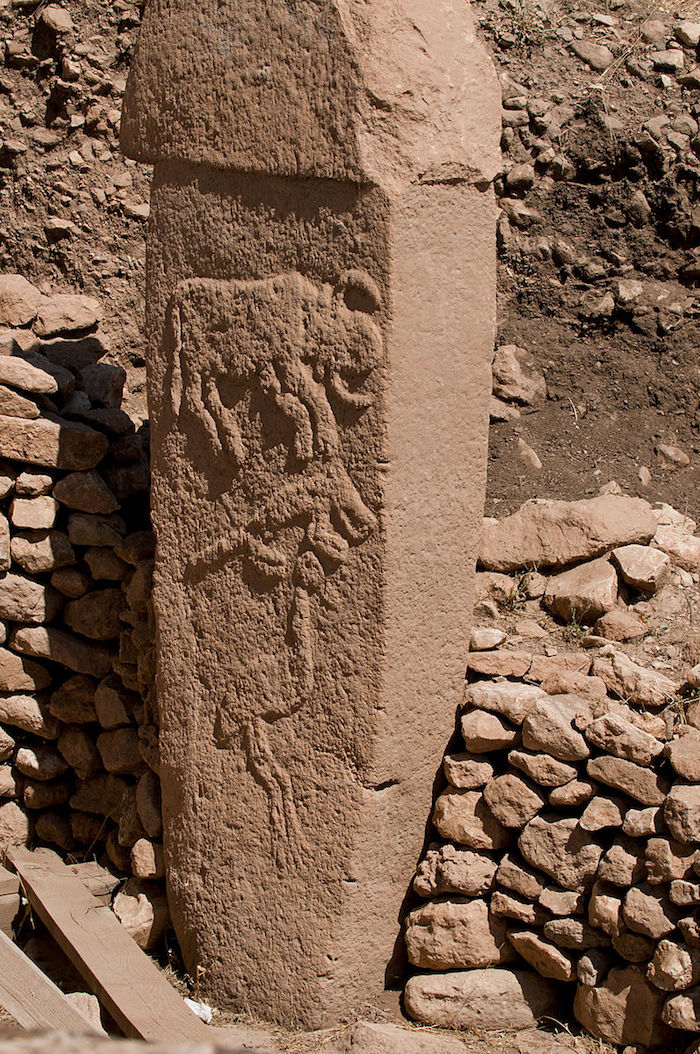
Gobekli Tepe, Urfa. Pillar 2 from Enclosure A (Layer III) with low reliefs of what are believed to be a bull, fox, and crane. Photo taken 6 September 2011 by Teomancimit
Locations
Topics
Commodoties
Subjects
Regions
Subregions
Years: 9549BCE - 7822BCE
Gobekli Tepe, Urfa. Pillar 2 from Enclosure A (Layer III) with low reliefs of what are believed to be a bull, fox, and crane. Photo taken 6 September 2011 by Teomancimit
Locations
Topics
Commodoties
Subjects
Regions
Subregions