Go-Sanjō had wished for Shirakawa's younger half-brother …
Years: 1085 - 1085
Go-Sanjō had wished for Shirakawa's younger half-brother to succeed him to the throne.
In 1085, this half-brother died of an illness; and Shirakawa's own son, Taruhito-shinnō becomes Crown Prince.
On the same day that Taruhito is proclaimed as his heir, Shirakawa abdicates, and Taruhito becoms Emperor Horikawa.
Thcontinue to exercise power, ruling indirectly from the Shirakawa-in (lit. "White River Mansion/Temple"); nevertheless, nominal sesshō and kampaku offices will continue to exist for a long time.
Locations
Groups
Subjects
Regions
Subregions
Related Events
Filter results
Showing 10 events out of 50447 total
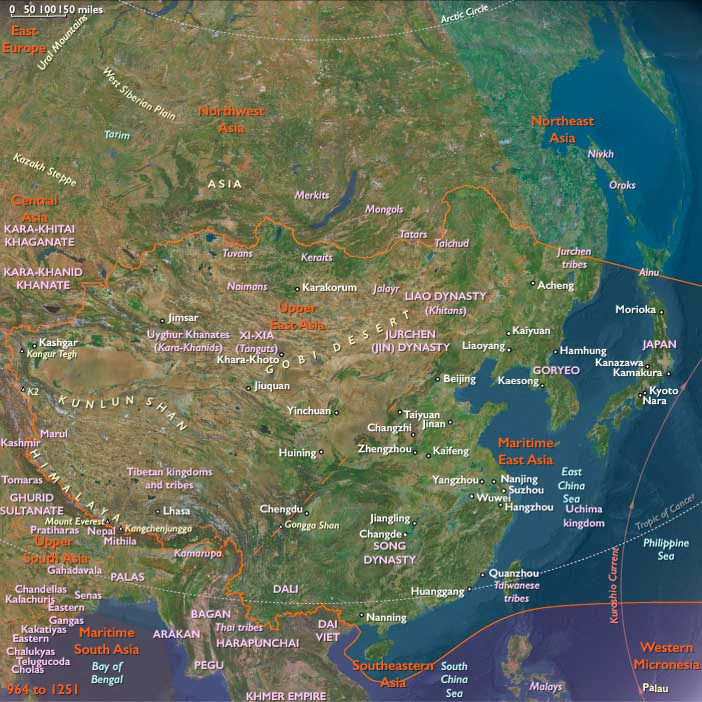
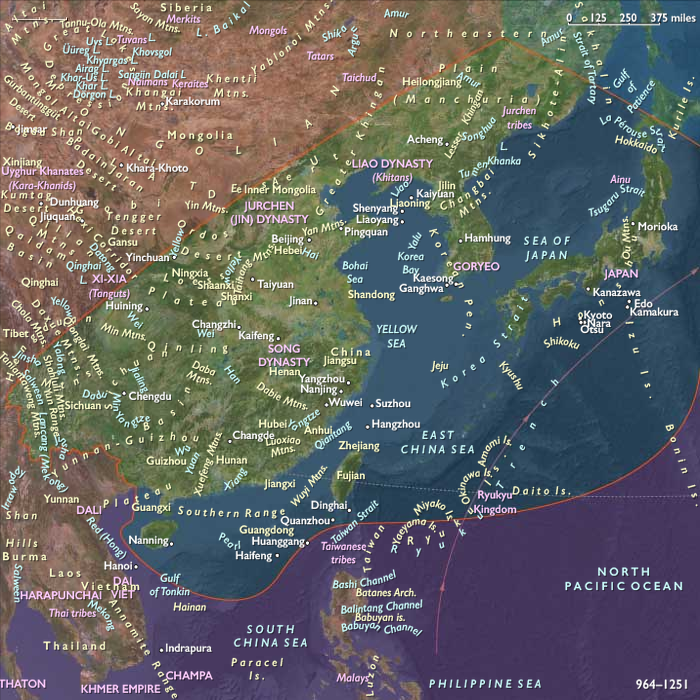
Shenzong dies in 1085 at the age of thirty-six and is succeeded by his son.
His temple name means "Divine Ancestor".
Zhezong ascends the throne at age nine under the supervision of Empress Dowager Gao, who cancels all the reforms packages and dismisses pro-reform chancellor Wang Anshi, appointing in his stead the conservative Sima Guang.
The annual output of copper currency for the Chinese Song Dynasty reaches six billion coins by this year.
This circumstance will prompt the Chinese government to adopt the world's first paper-printed money later in the 1120s.
Yaropolk had aided his father Grand Prince Iziaslav and his uncle Vsevolod in 1078, when Oleg Svyatoslavich (and his brother Boris) had attempted to gain the throne of Chernigov from Vsevolod.
Oleg had been allied to the Polovtsy, and with their help had defeated Vsevolod in battle.
Izyaslav and Yaropolk, as well as Vsevolod's son Vladimir Monomakh, had been able to reverse this result, and Oleg had been forced to retreat to Tmutorokan.
Izyaslav had died as a result of the battle.
The Primary Chronicle records that in 1078 before the death of Izyaslav, Yaropolk was "ruling in Vyshhorod", a city north of Kiev, while his brother Svyatopolk ruled as Prince of Novgorod, and Vladimir Monomakh ruled as Prince of Smolensk.
After his uncle Vsevolod became Grand Prince, Yaropolk had been given Vladimir-in-Volhynia and Turov, while Monomakh had received Chernigov.
Little is known for the following eight years, but by 1085, Vsevolod and Yaropolk are reported to have become entrenched against each other.
The laconic account of these developments in the Primary Chronicle makes the course of events far from transparent.
Vasilko and Vladimir Rostislavich, two Galcia-based princes unhappy with territorial settlement under Vsevolod, are said to have attempted to expel Yaropolk in 1084, but Grand Prince Vsevolod's son Vladimir Monomakh had driven away these Rostislavchi.Following this, a gift made by the Grand Prince to Davyd Igorevich, which includes land in Volhynia and control of trade with Constantinople, is said to have made Yaropolk hostile to the Grand Prince.
Vsevolod orders Vladimir to march against Yaropolk.
Lacking confidence in his own resources, Yaropolk flees Volhynia to Poland, leaving his followers (and mother) at Lutsk.
Vladimir captures Lutsk and Yaropolk's family, attendants and treasure, and assigns his whole principality to Davyd Igorevich.
Canute IV had quickly proved himself to be a highly ambitious king as well as a devout one.
He has enhanced the authority of the church, and demanded austere observation of church holidays.
He has given large gifts to the churches in Dalby, Odense, Roskilde, and Viborg, and especially to Lund.
Ever a champion of the Church, he seeks to enforce the collection of tithes.
His aggrandizement of the church serves to create a powerful ally, who in turn supports Canute's power position.
Canute writes a letter of donation in May 1085 to Lund Cathedral, which is under construction, granting it large tracts of lands in Scania, Zealand, and Amager.
He founds Lund Cathedral School at the same time.
Canute has gathered the land largely as pay for the pardon of outlawed subjects.
The clerics at Lund receive extended prerogatives of the land, being able to tax and fine the peasantry here.
However, Canute keeps his universal royal rights to pardon the outlaws, fine subjects who fail to answer his leding call to war, and demand transportation for his retinue.
His reign is marked by vigorous attempts to increase royal power in Denmark, by stifling the nobles and keeping them to the word of the law.
Canute issues edicts arrogating to himself the ownership of common land, the right to the goods from shipwrecks, and the right to inherit the possessions of foreigners and kinless folk.
He also issues laws to protect freed thralls as well as foreign clerics and merchants.
These policies lead to discontent among his subjects, who are unaccustomed to a king claiming such powers and interfering in their daily lives.
A Reichstag convenes in Mainz to suppress the Moravian see after the death of Bishop John of Olomouc in 1085, reuniting it to Prague at the insistence of Jaromír, Bishop of Prague.
His brother Vratislaus, newly crowned king of Bohemia, falls out with Henry over the loss of Meissen and raises his chaplain Wecel to Olomouc as Bishop Andrew I.
Jaromír goes to Rome to protest to Pope Urban II.
Henry IV, feeling secure of his success in Italy, had returned to Germany and had spent 1084 in a show of power here, advancing up to Magdeburg in Saxony.
To quench any sedition, he also declares the Peace of God in 1085, granting immunity from violence to noncombatants who cannot defend themselves, in all the territories of the Holy Roman Empire.
The coronation of Vratislav II as King of Bohemia in 1085, and his alignment with Ladislaus I, King of Hungary, threatens the position of the Polish ruler, Prince Wladyslaw I Herman.
Therefore, this same year Wladyslaw I is forced to recall from Hungarian banishment the only son of Boleslaw II the Bold and a rightful heir to the Polish throne, Mieszko Boleslawowic.
Upon his return, young Bolesławowic accepts the overlordship of his uncle and gives up his hereditary claim to the crown of Poland in exchange for becoming first in line to succeed him.
In return, Prince Wladyslaw I Herman grants his nephew the district of Kraków.
The situation is further complicated for Wladyslaw I Herman by a lack of a legitimate male heir, as his first-born son Zbigniew comes from a union not recognized by the church.
With the return of Mieszko Boleslawowic to Poland, Wladylaw I normalizes his relations with the kingdom of Hungary as well as Kievan Rus (the marriage of Mieszko Boleslawowic to a Kievan princess will be arranged in 1088).
These actions allow Herman to strengthen his authority and alleviate further tensions in international affairs.
The nearly thirty-seven year reign of Alexios I Komnenos will be full of struggle.
At the outset, he had faced the formidable attack of the Normans, led by Robert Guiscard and his son Bohemund, who had taken Dyrrhachium and Corfu and laid siege to Larissa in Thessaly.
Alexios had suffered several defeats before he was able to strike back with success.
He had enhanced his resistance by bribing the German king Henry IV with three hundred and sixty thousand gold pieces to attack the Normans in Italy, which had forced the Normans to concentrate on their defenses at home in 1083–84.
He has also secured the alliance of Henry, Count of Monte Sant'Angelo, who controls the Gargano Peninsula and dates his charters by Alexios' reign.
Henry's allegiance will be the last example of Constantinople’s political control on peninsular Italy.
Several thousand Paulicians had served in the army of Alexios against the Normans but, deserting the emperor in 1085, many of them had been thrown into prison.
The Norman danger had subsided with the death of Guiscard in 1085, and Constantinople has recovered most of its losses.
Imperial general Gregory Pakourianos, former governor of the now-defunct Iberian theme, is also known as a noted patron and promoter of Christian culture.
He together with his brother Abas (Apasios) had made, in 1074, a significant donation to the Eastern Orthodox Holy Monastery of Iviron on Mount Athos.
He had signed the official Greek version of the Typikon in Armenian.
He also signed his name in Georgian and Armenian characters rather than Greek.
It is assumed that Pakourianos did not know Greek.
Pakourianos had been involved in the coup that removed Nikephoros III.
Alexios had appointed him "megas domestikos of All the West" and has given him many more properties in the Balkans.
He possesses numerous estates in various parts of the Byzantine Empire and is afforded a variety of privileges by the emperor, including exemption from certain taxes.
In 1081, he had commanded the left flank against the Normans at the Battle of Dyrrachium.
A year later, he had evicted the Normans from Moglena, the present day Greece.
With the retreat of the Norman menace, Constantinople's reconquest of Asia Minor from the Seljuq Turks may now seem possible for Alexios, but he is desperately short of manpower, and dependent on foreign mercenaries, mostly barbarians or occasional Western soldiers of fortune, and on his largely Anglo-Saxon Varangian Guard.
He has barely sufficient resources to guard his long frontiers to west and north while watching for further Norman attacks from South Italy, but not enough for a campaign against the Seljuqs, whose further western encroachments had been halted temporarily by an agreement made in 1081 with the Seljuq sultan of Rüm, Suleiman ibn Qutalmïsh of Iznik.
Seljuq expansion southward continues, however, and Suleiman’s capture of Antioch in 1085 is another blow to imperial prestige.

Suleiman, Sultan of Rûm, had left Nicaea in 1084 to expand his holdings to the east and to the south, leaving his kinsman Abu'l Qasim in charge.
In 1085, he captures Antioch and proceeds to massacre its inhabitants.
Moreover, the treasures of the church of St. Cassianus are stolen and the church is converted into a mosque.
Badr al-Jamali, appointed Commander of the Armies in 1074, will serve as vizier to his death in 1094, during which time he is the de facto ruler of the Fatimid empire, his authority being over everything except the Caliph himself.
Al-Jam`e Al-Juyushi (Arabic: The Mosque of the Armies), or Juyushi Mosque, us built by Badr al-Jamali, completed in 1085 under the patronage of Caliph and Imam Ma'ad al-Mustansir Billah, and built on an end of the Mokattam Hills, ensuring a view of Cairo city.
As the military vizier has effectively become head of state, the Caliph himself is reduced to the role of a figurehead.
Canute's ambitions are not purely domestic: he considers the crown of England to be rightfully his.
As the grandnephew of Canute the Great, who ruled England, Denmark and Norway until 1035, he regards William I of England as a usurper.
With the support of his father-in-law Count Robert and Olaf III of Norway, Canute plans an invasion of England in 1085 and calls his fleet in leding at the Limfjord.
The fleet never sets sail, as Canute is preoccupied in Schleswig due to the potential threat of Henry IV, Holy Roman Emperor, with whom both Denmark and Flanders are on unfriendly terms.
Canute fears the invasion of Henry, whose late enemy Rudolf of Rheinfelden had sought refuge in Denmark.
The warriors of the fleet, mostly made up of peasants who need to be home for the harvest season, grow weary of waiting, and elect Canute's brother Olaf to argue their case.
This raise the suspicion of Canute, who has Olaf arrested and banished to Flanders.
The leding is eventually dispersed and the peasants tend to their harvests, but Canute intends to reassemble within a year.