
Giulio Alberoni was born near Piacenza, probably …
Years: 1714 - 1714
Giulio Alberoni was born near Piacenza, probably at the village of Fiorenzuola d'Arda in the Duchy of Parma.
His father was a gardener, and he himself became first connected with the church in the humble position of a bellringer and verger in the Duomo of Piacenza; he was twenty-one when the judge Ignazio Gardini, of Ravenna, was banished, and he followed Gardini to Ravenna where he met the vice-legate Giorgio Barni, who was made bishop of Piacenza in 1688 and appointed Alberoni chamberlain of his household.
Alberoni took priest's orders, and afterwards accompanied the son of his patron to Rome.
During the War of the Spanish Succession Alberoni had laid the foundation of his political success by the services he rendered to Louis-Joseph, duc de Vendôme, commander of the French forces in Italy, to whom the duke of Parma had sent him.
That a low-ranking priest is used as envoy is due to the duke's rude manners: the previous envoy, the bishop of Parma, had quit because the duke had wiped his buttocks in front of him: Saint-Simon in his Mémoires relates that Alberoni gained Vendôme's favor when he was received in the same way, but reacted adroitly by kissing the duke's buttocks and crying "O culo di angelo!".
The duke was amused, and this joke started Alberoni's brilliant career.
When the French forces were recalled in 1706, he accompanied the duke to Paris, where he had been favorably received by Louis XIV.
He had followed Vendôme into Spain as his secretary ion 1711, and had been very active in furthering the accession of the French candidate for the throne of Spain, Philip V. Two years later, Vendôme having died in the interval, Alberoni had been appointed consular agent for Parma at Philip's court, where he was the royal favorite, being raised at the same time to the dignity of count.
On his arrival at Madrid, he found the princesse des Ursins (Orsini, born de la Trémoille) all but omnipotent with the king, and for a time he judged it expedient to use her influence in carrying out his plans.
Upon the death of the Queen (Maria Luisa of Savoy), Alberoni in concert with La Trémoille arranges for a marriage in 1714 between the widowed King and Elisabetta Farnese, daughter of the Duke of Parma.
Locations
People
Groups
Subjects
Regions
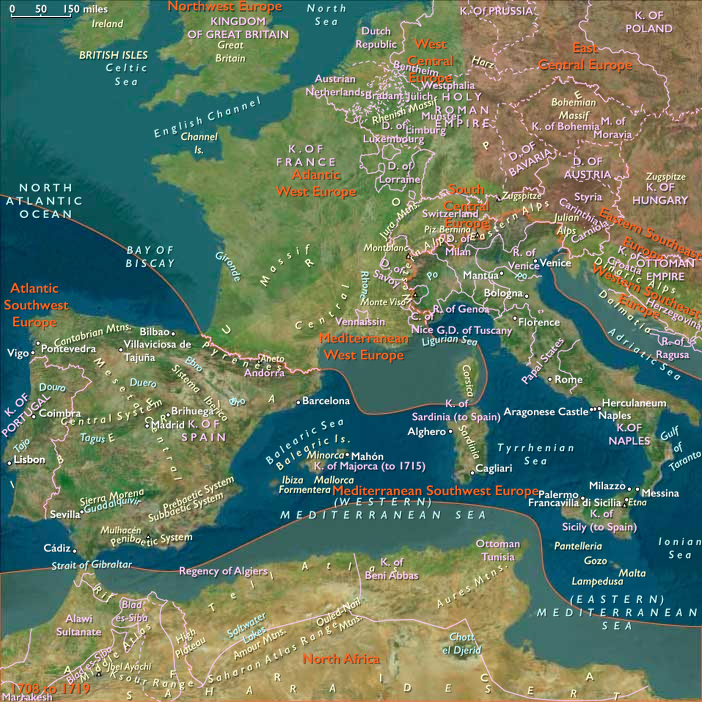
Subregions
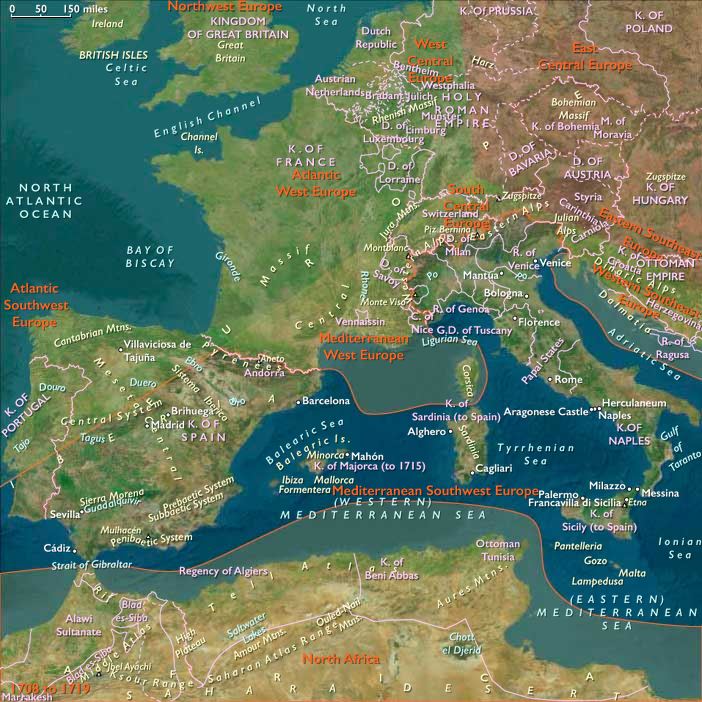
Years: 1714 - 1714
Locations
People
Groups
Subjects
Regions
Subregions