Giuliano da Maiano designs Poggio Reale, the …
Years: 1482 - 1482
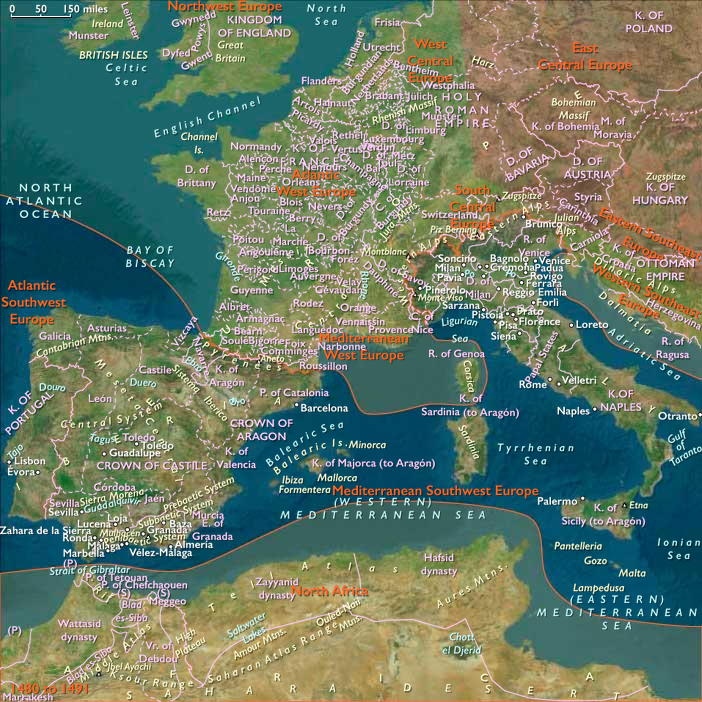
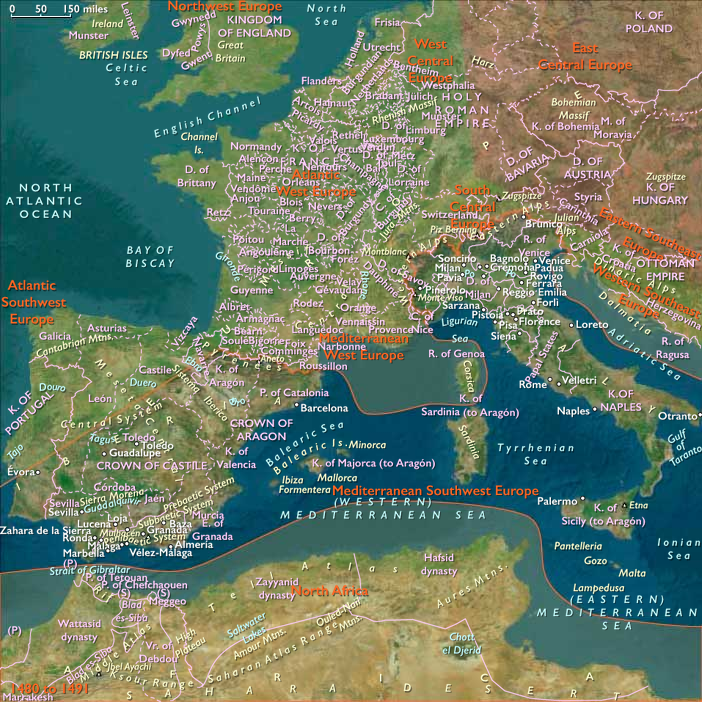
Giuliano da Maiano designs Poggio Reale, the royal villa in Naples, in about 1487-8.
Locations
People
Groups
Topics
Subjects
Regions
Subregions
Related Events
Filter results
Showing 10 events out of 79 total
The Peace of Westphalia largely settles German affairs for the next century and a half.
It ends religious conflicts between the states and includes official recognition of Calvinism.
Its signatories alter the boundaries of the empire by recognizing that Switzerland and the Netherlands have become sovereign states outside the empire.
Portions of Alsace and Lorraine go to France.
Sweden receives some territory in northern Germany, which in the long run it cannot retain.
Brandenburg becomes stronger, as do Saxony and Bavaria.
In addition, states within the empire acquire greater independence with the right to have their own foreign policies and form alliances, even with states outside the empire.
As a result of these changes, the Holy Roman Empire loses much of what remains of its power and will never again be a significant actor on the international stage.
The Habsburgs will continue to be crowned emperors, but their strength will derive from their own holdings, not from leadership of the empire.
Germany is less united in 1648 than in 1618, and German particularism has been strengthened once again.
The Thirty Years' War results from a local rebellion, but the admixture of religion transforms it into a European conflict that lasts for more than a generation and devastates Germany.
In 1618 Bohemian nobles oppose the decision of Emperor Matthias (r. 1608-19) to designate his Catholic cousin Ferdinand king of Bohemia.
Instead, the nobles elect Frederick of the Palatinate, a German Calvinist, to be their king.
In 1620, in an attempt to wrest control from the nobles, imperial armies and the Catholic League under General Johann von Tilly defeat the Protestant Bohemians at the Battle of White Mountain near Prague.
The Protestant princes, alarmed by the strength of the Catholic League and the possibility of Roman Catholic supremacy in Europe, decide to renew their struggle against Emperor Matthias.
They are aided by France, which, although Roman Catholic, is opposed to the increasing power of the Habsburgs, the dynastic family to which Matthias and Ferdinand belong.
Despite French aid, by the late 1620s imperial armies of Emperor Ferdinand II (r. 1619-37) and the Catholic League, under the supreme command of General Albrecht von Wallenstein, have defeated the Protestants and secured a foothold in northern Germany.
Ferdinand, in his time of triumph, overreaches himself by publishing in 1629 the Edict of Restitution, which requires that all properties of the Roman Catholic Church taken since 1552 be returned to their original owners.
The edict renews Protestant resistance.
Catholic powers also begin to oppose Ferdinand because they fear he is becoming too powerful.
Invading armies from Sweden, secretly supported by Catholic France, march deep into Germany, winning numerous victories.
The Catholic general Tilly and Sweden's Protestant king, Gustavus Adolphus, are killed in separate battles.
Wallenstein is assassinated on Emperor Ferdinand's orders because he fears his general is becoming too powerful.
After the triumph of the Spanish army over Swedish forces at the Battle of Nordlingen in 1634, a truce is arranged between the emperor and some of the German princes under the Treaty of Prague.
France now invades Germany, not for religious reasons but because the House of Bourbon, the dynastic family of several French and Spanish monarchs, wishes to ensure that the House of Habsburg does not become too powerful.
This invasion is illustrative of the French axiom that Germany must always remain divided into small, easily manipulated states. (Indeed, preventing a united Germany will remain an objective of French foreign policy even late in the twentieth century.)
Because of French participation, the war continues until the Peace of Westphalia is signed in 1648.
Farnese has made himself master of many towns in the southern part of the Netherlands after a series of sieges, and on August 17, 1585, finally recaptures Antwerp, which had closed its gates to rebels and government forces alike.
Among Farnese’s officers is the Bavarian soldier Johann Tserclaes, Graf von Tilly, who had begun his military career in a Spanish regiment, and who will end it as a major figure in the Thirty Years War.
Antwerp's surrender at the end of thirteen months, concluding one of the most celebrated sieges of military history, incites the still resisting northern provinces to close the Scheldt River to foreign shipping.
From this time onward, the whole of the southern part of the Netherlands once more recognizes Philip II as its sovereign.
The capture of Antwerp is the climax of Farnese's career: the construction of a solid line of defense against the United Provinces consolidates the union of the Catholic Netherlands, which will eventually become Belgium.
The German kingdom, after the death of Matthias, Holy Roman Emperor and king of Bohemia, had deprived his successor, Ferdinand II, of the Bohemian crown in 1618, and elect Frederick V, Elector Palatine, as King on August 26 and 27, 1619.
Ferdinand confers with the spiritual electors at Frankfurt after his election as Emperor, asking for the support of the League.
The formation of a confederate army begins.
Bavaria’s seven thousand-man contingent is the largest contribution to the League’s army, whose strength is fixed at Würzburg in December 1619, as twenty-one thusand infantry and four thousand cavalry.
Johann Tserclaes, Count of Tilly, a descendant of a Catholic Brabantine family, is commander in chief.
The Catholic League's army (which includes in its ranks René Descartes ), under Tilly’s command, pacifies Upper Austria while ...
...the Emperor's forces pacify Lower Austria.
The Catholic League’s two armies have united and moved north into Bohemia, where on November 8, 1620, Tilly decisively defeats Elector Frederick V at the Battle of White Mountain, near Prague, (to which Bethlen had sent three thousand troops, which had arrived too late).
Half of Frederick’s forces are killed or captured, Tilly losing only seven hundred men.
The Emperor regains control over Bohemia, ending the first stage of the League's activity during the Thirty Years War.
In addition to becoming Catholic, Bohemia is to remain in Habsburg hands for nearly three hundred years.
This defeat leads to the dissolution of the League of Evangelical Union and the loss of Frederick's holdings.
Frederick is outlawed from the Holy Roman Empire and his territories, the Rhenish Palatinate, are given to Catholic nobles.
His title of elector of the Palatinate is given to his distant cousin Duke Maximilian of Bavaria.
Frederick, now landless, is to make himself a prominent exile abroad in attempts to curry support for his cause in Sweden, Netherlands and Denmark.
This is a serious blow to Protestant ambitions in the region.
As the rebellion collapses, the widespread confiscation of property and suppression of the Bohemian nobility ensures that the country will return to the Catholic side after more than two centuries of Hussite and other religious dissent.
The Spanish, seeking to outflank the Dutch in preparation for renewal of the Eighty Years' War, take Frederick's lands, the Rhine Palatinate.

Christian's military actions begin in 1622 when Ernst von Mansfeld begins organizing his forces and expresses interest in linking up with his army, especially after his ally Georg Friedrich, Margrave of Baden-Durlach, is crushingly defeated at the Battle of Wimpfen.
After participated in a number of plunderings and burnings along the France-Germany border and throughout the Netherlands, Christian fights alongside the Count of Mansfeld in the Battle of Höchst, June 22, 1622, and although Christian is arguably defeated by Tilly, he is able to escape with much of his army despite crossing a river under heavy fire and losing all of his baggage.