
Giovanni Bellini, famous for his portraiture, helps …
Years: 1501 - 1501
Giovanni Bellini, famous for his portraiture, helps make this art form especially popular in Venice, perhaps inaugurating what is to be a tradition of painting formal portraits of its rulers dressed in state robes.
His 1501 portrait of Leonardo Loredan, Doge of Venice from 1501 to 1521, is painted in the style of the sculpted portrait busts popular at the time and often inspired by Roman sculpture.
Bellini portrays the doge in his ceremonial garments.
Shown here wearing his robes of state for this formal portrait, the hat and ornate buttons are part of the official wardrobe.
The sitter can be identified as Doge Loredan by comparing his features with portrait medals of him.
The shape of the hat comes from the hood of a doublet; called a 'corno', it is worn over a linen cap.
Alsus Manutius has designed a celebrated roman typeface and is, in 1501, the first to introduce an italic typeface, which he bases on Italian cursive hand.
Venetian publisher Ottaviano Petrucci, born in Fossombrone (Pesaro), and probably educated at Urbino, had gone to Venice around 1490 to learn the art of printing, and in 1498 he had petitioned the Doge for the exclusive right to print music for the next twenty years.
The right was very probably granted, since no examples of printed music from other Venetian printers are known before 1520.
In 1501, Petrucci publishes his first collection, ninety-six chansons in his “Odhecaton,” the first book of polyphonic music to be printed.
The contents show the chanson changing from a treble-dominated piece to one with equality of voices in imitative counterpoint, increasing from three voices to four.
Petrucci also prints more than fifty volumes of secular and sacred vocal music as well as a few volumes of music for the lute.
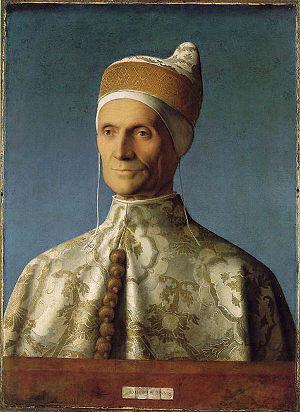
Giovanni Bellini: Portrait of Doge Leonardo Loredan (1501), Oil on panel, 61.6 cm × 45.1 cm (24.3 in × 17.8 in), National Gallery, London
Locations
People
Groups
Topics
Subjects
Regions
Subregions
Years: 1501 - 1501
Giovanni Bellini: Portrait of Doge Leonardo Loredan (1501), Oil on panel, 61.6 cm × 45.1 cm (24.3 in × 17.8 in), National Gallery, London
Locations
People
Groups
Topics
Subjects
Regions
Subregions