
Giorgio Vasari writes the important Lives of …
Years: 1550 - 1550
Giorgio Vasari writes the important Lives of the Most Eminent Painters, Sculptors, and Architects in 1550, a thorough history of Italian Renaissance and early Mannerist art through biographies of its principal practitioners.
Lives, modeled on the ancient Greek and Roman biographies of famous men, is the first book in Western history to concentrate exclusively on art and artists.
Vasari emphasizes artistic personalities and technical progress as the measure of art, the pinnacle of which he sees in the genius of Michelangelo.
Vasari, whose concept of genius is Neoplatonic, regards art as an intellectual discipline practiced by individualistic geniuses, rather than a craft pursued by anonymous workers, and holds that the inspired artist creates earthly beauty as a reflection of the Absolute.
Vasari, himself a noted Mannerist painter as well as an architect, names “maniera” (“style) as the distinguishing mark of the arts of his own time.
Vasari expands on Giovanni Boccaccio’s fourteenth-century use of the concept of rinascita (“rebirth”) to describe contemporary Italian efforts to imitate the poetic style of the ancient Romans.
He employs the word to describe the return to the ancient Roman manner of painting by Giotto di Bondone about the beginning of the fourteenth century.
(Vasari’s text, as it turns out, contains many lacunae and errors, particularly in the biographical data supplied, and his treatment of pre-fifteenth century artists is unreliable.)
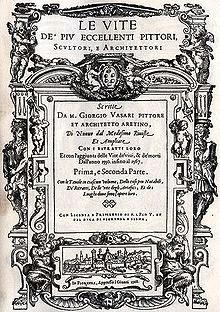
A cover of the Lives
Locations
People
Groups
Topics
Subjects
Regions
Subregions
Related Events
Showing 10 events out of 36365 total
Years: 1550 - 1550
A cover of the Lives
Locations
People
Groups
Topics
Subjects
Regions
Subregions