
Ghibelline rule had ended in Cremona after …
Years: 1441 - 1441
Ghibelline rule had ended in Cremona after its commander relinquished control to a consortium of citizens.
In 1271 the position of Capitano del Popolo ("People's Chieftain") was created.
In 1276 the Signoria passed to marquis Cavalcabò Cavalcabò; in 1305 he was succeeded by his son Guglielmo Cavalcabò, who held power until 1310.
During this period many edifices were created or restored including the belfry of the Torrazzo, the Romanesque church of San Francis, the Cathedral's transepts and the Loggia dei Militi.
Moreover, agriculture was boosted with a new network of canals.
After some foreign invasions (notably that of Emperor Henry VII in 1311), the Cavalcabò lasted until November 29, 1322, when a more powerful family, the Visconti of Galeazzo I, came to prominence that in Cremona is to last for a century and a half.
The Visconti's signore had been interrupted in 1327 by Ludwig the Bavarian, in 1331 by John of Bohemia, and in 1403 by a short-lived return of the Cavalcabò.
On July 25, 1406, captain Cabrino Fondulo had killed his employer Ubaldo Cavalcabò along with all the male members of his family, and assumed control over Cremona.
However, he was unable to face the task, and had ceded the city back to the Visconti for a payment of forty thousand golden florins.
Thus Filippo Maria Visconti made his signoria hereditary.
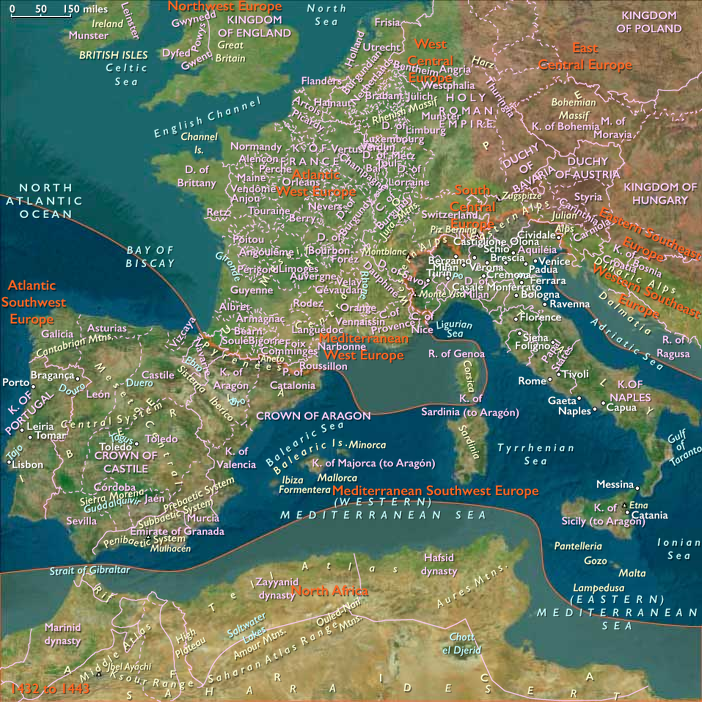
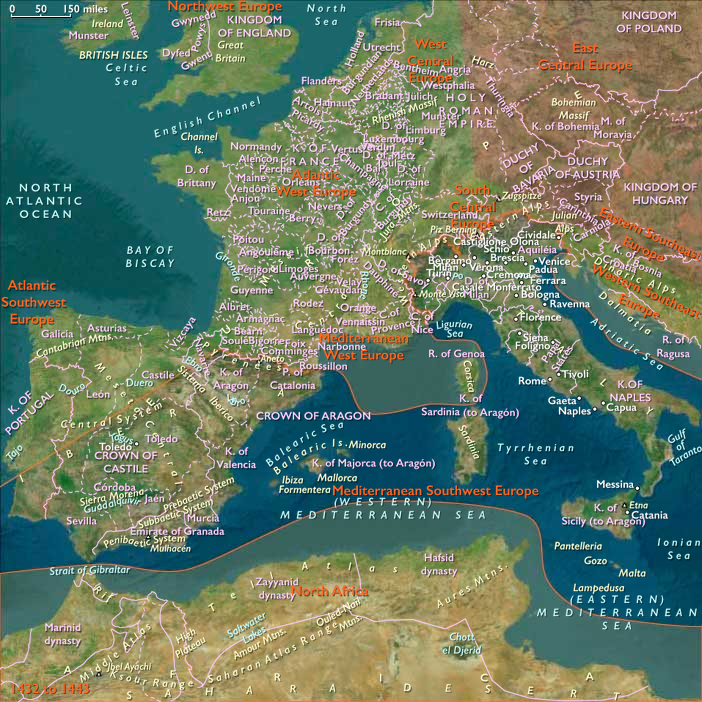
Cremona has become part of the Duchy of Milan, and will follow its fate until the unification of Italy.
Under the Visconti and later the Sforza Cremona has undergone high cultural and religious development.
In 1411 Palazzo Cittanova had become the seat of the University of fustian merchants.
In 1441, the city hosts the marriage of Francesco I Sforza and Bianca Maria Visconti in the temple built by the Benedictines, which today is the church of Saint Sigismund.
For this occasion a new sweet is devised, which evolves into the famous torrone.
Locations
People
Groups
Topics
Subjects
Regions
Subregions
Years: 1441 - 1441
Locations
People
Groups
Topics
Subjects
Regions
Subregions