
German literature reaches impressive heights during its …
Years: 1220 - 1220
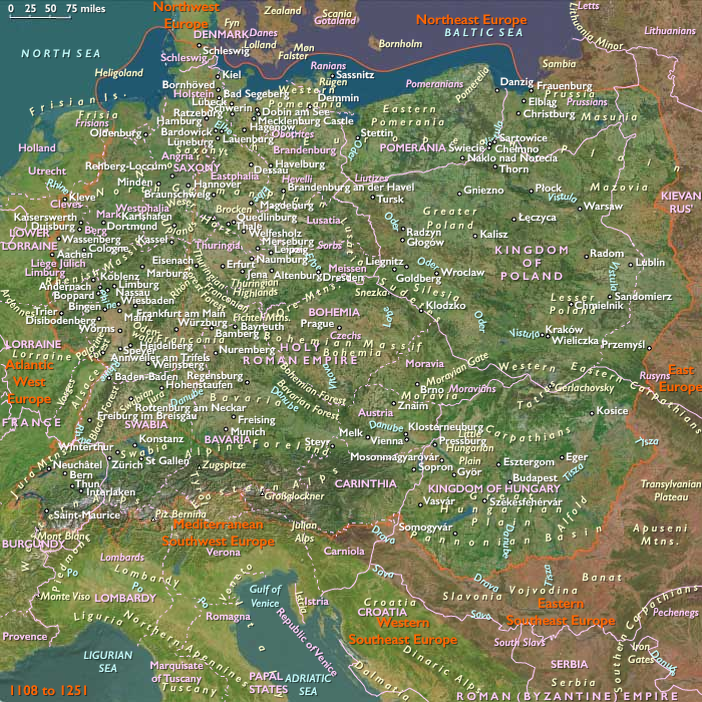
German literature reaches impressive heights during its first so-called Golden Age from about 1180 to 1220, as secular culture becomes the concern of the knights who celebrate courtly love in complex lyrics.
Walther von der Vogelweide attains a unique position among the German lyric poets, or minnesingers, who, influenced by Provençal troubadours, produce an abundance of songs.
Born to noble but impoverished parents in southern Germany, perhaps in the Tyrol mountains, Walther passes most of his life wandering in Bavaria and Austria, supporting himself with his poems and songs.
In his famous love poem, “Unter den Linden” (“Under the Linden”), he overcomes literary convention by turning away from empty gallantry to express powerful emotions of love.
He is also celebrated for is political and satiric poems, in which he transforms the short poem of proverbial wisdom into a political weapon of satire and patriotism.
In these, Walther attacks the papacy and supports Holy Roman Emperor Frederick II, who grants him a small estate, apparently near Würzburg. (His “Spruche,” or maxims, survive, as do many of the melodies for his lyrics.)
Locations
People
Groups
Topics
Subjects
Regions
Subregions
Related Events
Filter results
Showing 10 events out of 47201 total
The shah of Khwarezm had fled after the Battle of Khojend, and the Mongols have pursued him to a Khwarizmian defensive line established near Bukhara in the region of present central Uzbekistan.
Arranging ten Mongol cavalry divisions into four columns, Genghis Khan has three of them converge to collapse the shah’s right (southern) flank near the city of Samarkand, while he personally leads the forty-thousand-man fourth column against the rear flank, approaching Bukhara from the west.
The shah abandons Bukhara to concentrate on the larger force, enabling the Mongols, after a brief siege, to capture and sack the city.
According to Juvaini, when Genghis Khan conquered Bukhara "he contented himself with looting and slaughter only once and did not go to the extreme of a general massacre" as he did in Khorasan, although most of the city accidentally burns.
He chooses a moderate path between mercy and punishment because the population readily submits while the garrison in the citadel resists.
Although he spares most adults, Genghis Khan kills thirty thousand Kankali Turks who are "taller than the butt of a whip" on account of their loyalty to Sultan Muhammud, then conscripts all remaining able-bodied men into service.
Genghis Khan’s column now converges with the others on Samarkand.
After five days of siege, traitors admit the Mongols into the city.
Although Genghis Khan "did not disturb the inhabitants [of the city] in any way", according to Juvaini he killed all who took refuge in the citadel and the mosque.
He also pillages the city completely and conscripts thirty thousand young men along with thirty thousand craftsmen.
The shah escapes, to be pursued northwestward; his son, Jalal ad-Din, flees south to Afghanistan.
Karelia is bitterly contested by the Swedes and the Novgorod Republic for a period starting in the thirteenth century during the Swedish-Novgorodian Wars.
The Novgorod Republic takes Karelia in 1220.
The city state controls most of Europe's northeast, from lands east of today's Estonia to the Ural Mountains, making it one of the largest states in medieval Europe, although much of the territory north and east of Lakes Ladoga and Onega is sparsely populated and never organized politically.
Danish historian and poet Saxo, awarded the honorific title Grammaticus, meaning "the learned," because of his great knowledge, writes the Gesta Danorum, or Historia Danica, a sixteen-volume history of the Danes.
Written in Latin for his patron, Archbishop Absolon of Copenhagen, the book contains songs, Danish traditions of kings and heroes—including the story of Amleth, or Hamlet—and Icelandic legends.
Saxo dies in about 1220 at around age seventy.
Leonardo Pisano, or Fibonacci, gives a compilation of the geometry of the age and introduces some trigonometry in his “Mis practica geometriae” (“Practice of Geometry”), written in 1220.
The Fibonacci sequence, a sequence discovered by Leonardo in which each term is the sum of the two terms immediately preceding it, is named for him.
Afonso II of Portugal and His Legal Reforms (1212–1220)
Upon ascending the throne in 1212, Afonso II of Portugal distinguished himself from his predecessors by shifting his focus from military conquest to legal and administrative governance. Deeply concerned with legal matters, he prioritized the compilation and codification of Portuguese law, particularly regarding personal and property rights, in an effort to create a more structured and centralized legal system.
Conflict with the Church and Excommunication (1220)
Afonso II’s efforts to curtail the power of the Church placed him in direct conflict with the papacy. Determined to regulate and scrutinize ecclesiastical privileges, he launched investigations into the legal titles of church properties, challenging their ownership claims and seeking to reassert royal authority over lands held by the clergy.
Additionally, he took measures to curb abuses by both aristocrats and the clergy, provoking fierce opposition from the Portuguese bishops and the Holy See. As a result, in 1220, Pope Honorius III excommunicated Afonso II, marking a severe escalation in tensions between the Portuguese monarchy and the Catholic Church.
Despite his excommunication, Afonso II’s legal reforms laid the foundation for a more centralized and bureaucratic state, influencing the future governance of Portugal. However, his defiance of papal authority would have lasting consequences for his reign and the kingdom’s relationship with the Church.
The Construction of Amiens Cathedral Begins (1220 CE): A Masterpiece of High Gothic Architecture
In 1220, construction began on the west end of the nave of Notre-Dame d'Amiens (Cathedral of Our Lady of Amiens), one of the greatest achievements of French High Gothic architecture. Designed to be both monumental in scale and structurally innovative, the cathedral’s soaring 138-foot (42-meter) vault and total length of 476 feet (145 meters) closely followed the plan of Reims Cathedral.
Origins of the Cathedral: The Relic of John the Baptist
- The initial impetus for constructing Amiens Cathedral came with the installation of a highly revered relic—the reputed head of John the Baptist—on December 17, 1206.
- The relic had been looted during the Fourth Crusade, when Crusaders sacked Constantinople in 1204 instead of fighting the Turks.
- A sumptuous reliquary was crafted to house the skull, and the relic drew large numbers of pilgrims to Amiens, necessitating the construction of a grander cathedral to accommodate them.
Architectural Ambitions and Innovations
- French High Gothic in style, the cathedral aimed to surpass its predecessors in height, luminosity, and spatial harmony.
- The work was supervised by master mason Robert de Luzarches, one of the most renowned Gothic architects of his time.
- Key design elements included:
- A soaring vaulted ceiling reaching 138 feet (42 meters), one of the tallest of any medieval cathedral.
- A vast interior space, with a total length of 476 feet (145 meters).
- A highly refined elevation, emphasizing light and verticality, drawing from the structural innovations of Reims Cathedral.
Legacy and Significance
- Amiens Cathedral would become one of the largest and most perfected examples of Gothic architecture, surpassing many of its predecessors in scale and elegance.
- The cathedral’s grandeur was deeply tied to its role as a pilgrimage site, further reinforcing its spiritual and cultural importance.
- Over the next decades, Amiens would emerge as a leading model for later Gothic cathedrals, influencing architectural advancements across France and beyond.
The construction of Amiens Cathedral in 1220, driven by the arrival of the relic of John the Baptist, symbolized the height of medieval Gothic ambition, blending religious devotion, architectural innovation, and the wealth generated from the Crusades into one of the most magnificent cathedrals ever built.
The Rebuilding of Notre-Dame de Reims (1211–1220 CE): The Coronation Cathedral of France
Following the destruction of an earlier church by fire in 1210, construction of the present Notre-Dame de Reims began in 1211. This cathedral would become one of the most important religious and political structures in medieval France, serving as the traditional site of French royal coronations.
The new cathedral was built on a site of immense historical significance, where:
- Clovis I, the first Christian king of the Franks, was baptized by Saint Remi in 496.
- A basilica, founded around 400 under St. Nicaise, once stood.
- The site was originally a Roman bath complex, highlighting its continuous use as a place of importance for centuries.
Expansion and Architectural Evolution
- The fire of 1210 provided an opportunity to construct a larger, grander Gothic cathedral.
- Construction began at the eastern end, gradually extending westward.
- Documentary evidence from 1218 shows land acquisitions to the west, suggesting that:
- The new cathedral was substantially larger than its predecessors.
- The nave was extended, likely to accommodate the massive crowds attending royal coronations.
The “Annunciation” Sculpture and the Evolution of Gothic Art (c. 1220)
- The west façade of the cathedral was adorned with sculptural masterpieces, including the "Annunciation" group, completed around 1220.
- This sculpture marks a key transition in Gothic art, characterized by:
- Supple, flowing drapery, creating a sense of movement.
- More naturalistic facial expressions, departing from earlier rigid Romanesque forms.
- A heightened emotional quality, reflecting the growing humanization of sacred figures in Gothic art.
Legacy of Notre-Dame de Reims
- The cathedral became the official site of French royal coronations, reinforcing the divine right of kings.
- Its Gothic architectural innovations influenced later cathedrals across France, particularly in Amiens and Chartres.
- The Annunciation sculpture exemplifies the refinement of High Gothic art, demonstrating a shift toward greater naturalism and emotional depth.
The reconstruction of Reims Cathedral (1211–1220) transformed it into one of the most significant Gothic structures in Europe, embodying both religious devotion and the grandeur of French monarchy.
The Death of Theobald I of Lorraine and the Turmoil of His Succession (1220 CE)
Theobald I, Duke of Lorraine, never recovered the lands and prestige he lost following his defeat and capture by Emperor Frederick II in 1218. His imprisonment and forced concessions significantly weakened his rule, and he died in February 1220, leaving Lorraine in a precarious state.
Theobald’s Marriage and Lack of Heirs
- In 1206, Theobald married Gertrude of Dagsburg, the only child and heir of Albert II, Count of Dagsburg and Metz.
- Their marriage produced no children, meaning there was no direct heir to his title.
- His death created a succession crisis, as power now passed to his brother, Matthias II of Lorraine.
Gertrude’s Controversial Second Marriage (May 1220)
- Just three months after Theobald’s death, Gertrude remarried—this time to his former rival, Theobald IV of Champagne, who was only nineteen years old.
- The marriage was highly controversial, as it was arranged without the approval of Emperor Frederick II, who opposed the union.
- Frederick II likely saw the marriage as a political threat, as it strengthened Champagne’s position in Lorraine and increased the influence of the Capetian-aligned nobility in the empire.
Consequences of Theobald I’s Death and Gertrude’s Remarriage
-
Matthias II Becomes Duke of Lorraine
- Matthias inherited a weakened duchy, still recovering from Frederick II’s occupation and intervention.
- His rule would be overshadowed by external pressures from both the Holy Roman Emperor and French-aligned nobility.
-
Gertrude’s Marriage to Theobald IV of Champagne Deepens Political Tensions
- Frederick II’s opposition to the marriage set the stage for further imperial interference in Lorraine and Champagne.
- Theobald IV of Champagne gained influence in the region, complicating relations between the French and the Holy Roman Empire.
The death of Theobald I in 1220 marked the end of his troubled rule and set off a chain of political conflicts in Lorraine, Champagne, and the Holy Roman Empire, influencing the balance of power between France and the empire.
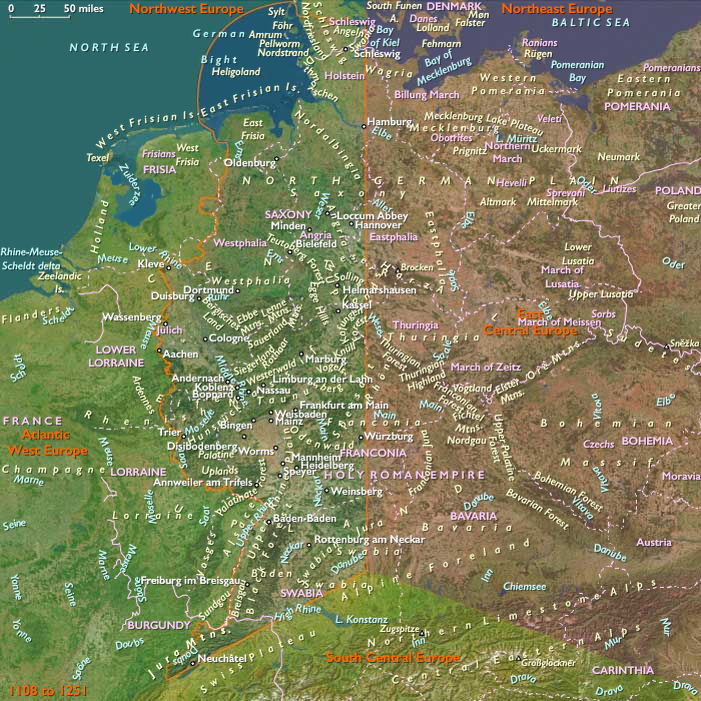
A small village at the location of Dortmund was mentioned in official documents from 880 to 885 as Throtmanni.
After it was destroyed by a fire, the Holy Roman Emperor Frederick I (Barbarossa) had the town rebuilt in 1152 and resided there for two years.
It becomes an Imperial Free City in 1220.
