George had not arrived in Britain until …
Years: 1714 - 1714
October
George had not arrived in Britain until September 18, partly due to contrary winds, which had kept him in The Hague awaiting passage.
He is crowned on October 20 at Westminster Abbey.
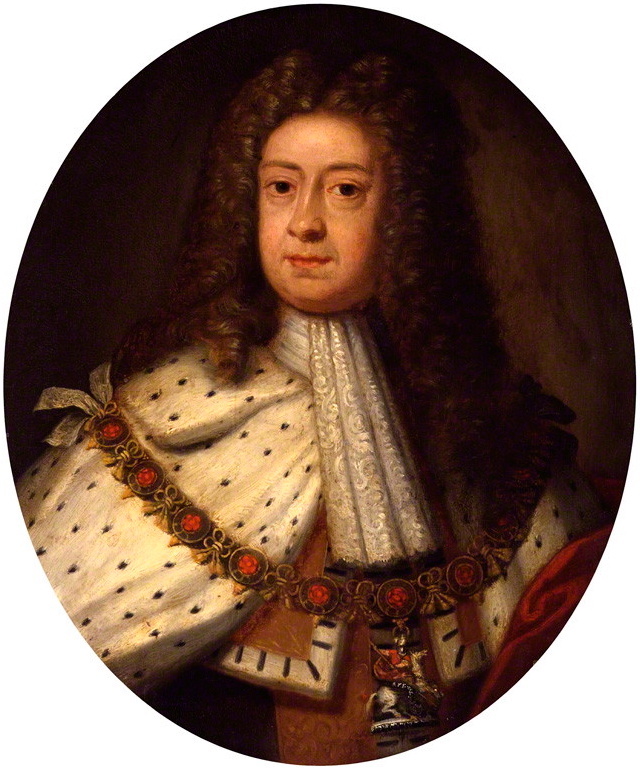
George ca. 1714, the year of his succession, as painted by Sir Godfrey Kneller.
Locations
People
Groups
- Christians, Roman Catholic
- Welf, House of
- Protestantism
- Anglicans (Episcopal Church of England)
- Brunswick-Lüneburg, Electorate of (Electorate of Hanover)
- Britain, Kingdom of Great
Subjects
Regions
Subregions
Related Events
Filter results
Showing 10 events out of 28365 total
A major outbreak of plague hits Prague one last time in 1713–14, killing twelve thousand to thirteen thousand people.
Giulio Alberoni was born near Piacenza, probably at the village of Fiorenzuola d'Arda in the Duchy of Parma.
His father was a gardener, and he himself became first connected with the church in the humble position of a bellringer and verger in the Duomo of Piacenza; he was twenty-one when the judge Ignazio Gardini, of Ravenna, was banished, and he followed Gardini to Ravenna where he met the vice-legate Giorgio Barni, who was made bishop of Piacenza in 1688 and appointed Alberoni chamberlain of his household.
Alberoni took priest's orders, and afterwards accompanied the son of his patron to Rome.
During the War of the Spanish Succession Alberoni had laid the foundation of his political success by the services he rendered to Louis-Joseph, duc de Vendôme, commander of the French forces in Italy, to whom the duke of Parma had sent him.
That a low-ranking priest is used as envoy is due to the duke's rude manners: the previous envoy, the bishop of Parma, had quit because the duke had wiped his buttocks in front of him: Saint-Simon in his Mémoires relates that Alberoni gained Vendôme's favor when he was received in the same way, but reacted adroitly by kissing the duke's buttocks and crying "O culo di angelo!".
The duke was amused, and this joke started Alberoni's brilliant career.
When the French forces were recalled in 1706, he accompanied the duke to Paris, where he had been favorably received by Louis XIV.
He had followed Vendôme into Spain as his secretary ion 1711, and had been very active in furthering the accession of the French candidate for the throne of Spain, Philip V. Two years later, Vendôme having died in the interval, Alberoni had been appointed consular agent for Parma at Philip's court, where he was the royal favorite, being raised at the same time to the dignity of count.
On his arrival at Madrid, he found the princesse des Ursins (Orsini, born de la Trémoille) all but omnipotent with the king, and for a time he judged it expedient to use her influence in carrying out his plans.
Upon the death of the Queen (Maria Luisa of Savoy), Alberoni in concert with La Trémoille arranges for a marriage in 1714 between the widowed King and Elisabetta Farnese, daughter of the Duke of Parma.
The Spectator, a daily publication founded by Joseph Addison and Richard Steele in England after they met at Charterhouse School, lasts from 1711 to 1712.
Each "paper", or "number", is approximately 2,twenty-five hundred words long, and the original run consists of five hundred and fifty-five numbers, beginning on March 1, 1711.
These are collected into seven volumes.
The paper is revived in 1714 without the involvement of Steele, appearing thrice weekly for six months, and these papers when collected form the eighth volume.
Eustace Budgell, a cousin of Addison's, also contributes to the publication.
The stated goal of The Spectator is "to enliven morality with wit, and to temper wit with morality...to bring philosophy out of the closets and libraries, schools and colleges, to dwell in clubs and assemblies, at tea-tables and coffeehouses" (No. 10).
It recommends that its readers "consider it part of the tea-equipage" (No. 10) and not leave the house without reading it in the morning.
One of its functions is to provide readers with educated, topical talking points, and advice in how to carry on conversations and social interactions in a polite manner.
In keeping with the values of Enlightenment philosophies of their time, the authors of The Spectator promote family, marriage, and courtesy.
Despite a modest daily circulation of approximately three thousand copies, The Spectator is widely read; Joseph Addison estimates that each number is read by sixty thousand Londoners, about a tenth of the capital's population at this time.
Contemporary historians and literary scholars, meanwhile, do not consider this to be an unreasonable claim; most readers are not themselves subscribers but patrons of one of the subscribing coffeehouses.
These readers come from many stations in society, but the paper caters principally to the interests of England's emerging middle class—merchants and traders large and small.
St. Denis, soon after founding Natchitoches, had traveled to the lands of the Hasinai Confederacy and from there to Spanish outposts on the Rio Grande.
At San Juan Bautista, Coahuila, Commander Diego Ramón places St. Denis under house arrest and confiscates his goods while awaiting instructions from Mexico City on what to do with the foreigner charged with violating Spanish trade restrictions.
In the meantime, St. Denis, claiming that his intention had been merely to establish trade, courts and wins the promise of marriage from Ramón's beautiful step-granddaughter, Manuela Sanchez.
St. Denis is ordered to Mexico City and defends himself well enough to be appointed the commissary officer of the Ramón expedition charged with founding Spanish missions in East Texas.
The French traded with the Wichita primarily for their horses during the sixteenth century.
The Wichita had sensed that trading with the French would be ideal, and their migration in 1714 is partly motivated by their desire to move closer to European traders.
The Anglo-Scottish Stuarts have steadfastly refused to convert to Protestantism.
The Electress Sophia of Hanover predeceases the last Protestant Stuart ruler in Britain, Queen Anne, by a few months.
She had collapsed after rushing to shelter from a shower of rain in Herrenhausen gardens, dying on May 28, 1714, at the age of eighty-three.
Her son George is now Anne's direct heir, as the Queen's second cousin.
He swiftly revises the membership of the Regency Council that will take power after Anne's death, as it is known that Anne's health is failing and politicians in Britain are jostling for power.
Parliament votes in July 1714 "to offer a reward for such person or persons as shall discover the Longitude." (Ten thousand pounds for any method capable of determining a ship's longitude within one degree; fifteen thousand pounds within forty minutes, and twenty thousand pounds within half a degree).
The government announces that a quarter of profits of the South Sea Company will be reserved for the queen and a further seven and a half percent for a financial advisor.
Some members of company board refuse to accept the contract on these terms, and the government is obliged to reverse its decision.
Despite these setbacks, the company persists, having raised two hundred thousand pounds to finance the operations.
The company is heavily dependent on the goodwill of government, and when government changes, so too does the company board.
One of the directors who had been sponsored by Harley, Arthur Moore, had in 1714 attempted to send sixty tons of private goods on board the company ship.
He is dismissed as a director, but the result was the beginning of Harley's fall from favor with the company.
Harley is on July 27 replaced as Lord High treasurer as a result of disagreement that had broken out within the Tory faction in parliament.
The Russian Tsar Peter I had begun his offensive in Finland in the spring of 1713.
The Russian armies had quickly advanced all the way to Turku on the southwestern coast of Finland, but naval advances had been blocked by a strong Swedish naval presence.
The Russian governor in Finland, Prince Mikhail Galitzine, with his headquarters in Turku, is unable to receive support by sea, which is at this time far more important than land-based support.
Admiral Apraksin's fleet has been sent by the Tsar to open these service lines.
When the Russian ships arrive near the Hanko Peninsula, they are met by a strong Swedish naval fleet under the command of Admiral Wattrang.
Apraksin decides to move his ships farther away to the other side of the peninsula and call for reinforcements.
The majority of the troops in Turku are moved according to his request to the peninsula.
A plea for help is also sent to the Tsar, who is with the rest of the Baltic Fleet in Reval (now Tallinn).
Admiral Apraksin specifically lets the tsar know that he should come personally to lead the attack.
The first attempt in breaking through the Swedish lines wais made by attempting to pull the galleys over the peninsula.
The friction is reduced using oxskins between the ground and the ships.
The first galley is successfully pulled over with much trouble, but the second is damaged, and the attempt is subsequently abandoned.
However, Admiral Wattrang had been informed of the Russians' attempt, and he sends a small naval detachment consisting of eleven ships led by Schoutbynacht (equivalent of a Rear Admiral) Nils Ehrenskiöld to intercept the Russians.
The second attempt by the Russians is to try to take advantage of the calm weather on the morning of July 26, the day of Saint Pantaleon.
The small galleys are easily maneuvered, whereas it is exceedingly difficult to try to turn the heavy Swedish battleships in such a weather.
Apraksin initially sends twenty small galleys and when it became obvious that the Swedish fleet can't stop them, he sends fifteen more.
Wattrang's fleet is moving outwards trying to block the Russian breakthrough, when Apraksin issues an order at midnight 26/27 July (O.S.) for the remaining ships to break through the Swedish lines.
Only one galley is lost when it runs aground.
Ehrenskiöld's detachment becomes encircled after the breakthrough, , and he ordered his vessels in a defensive line between two islands.
The largest Swedish ship, the pram Elefant, is positioned broadside-on to the approaching Russian vessels.
Three galleys were stationed end-on on each side, with the two boats behind each end of Elefant.
After Ehrenskiöld refuses to surrender, the Russian fleet attacks.
The Russian galleys, commanded by the tsar, attack twice (first with thirty-five, second with eighty galleys) but are thrown back.
The third time, when attacking with reinforcements and a combined force of about ninety-five galleys, the Russians manage to capture the Swedish ships.
During the capture, the galley Tranan capsizes and sinks, and admiral Ehrenskiöld himself is taken prisoner of war on the deck of his own flagship.
The Russians substantially outnumber the Swedish, according to some sources fifteen to one.
The Russian superiority in the battle is such that there isn't even enough room for all the Russian vessels to fight at once.
The battle is the first major victory of the Russian galley fleet, and can be as such compared with the Battle of Poltava.
Due to the victory, Russia is able to prevent Swedish ships from entering the waters east of the Sea of Åland and thus prolonging the occupation of Finland up to 1721, when the Treaty of Nystad ends the war.

The Fable of The Bees: or, Private Vices, Public Benefits is a book by Bernard Mandeville, consisting of the poem The Grumbling Hive: or, Knaves turn’d Honest and prose discussion of it.
The poem had been published in 1705 and the book first appears in 1714.
The poem suggests many key principles of economic thought, including division of labor and the invisible hand, seventy years before these are more thoroughly elucidated by Adam Smith.
John Maynard Keynes cites Mandeville to show it is "no new thing ... to ascribe the evils of unemployment to ... the insufficiency of the propensity to consume", a condition also known as the paradox of thrift, and central to his own theory of effective demand (Keynes, John Maynard (1964 [reprint of 1936 edition]), The General Theory of Employment, Interest and Money, Macmillan & Co Ltd) At the time, however, it is considered scandalous.
Roger Cotes publishes his only scientific paper, Logometrica, in the Philosophical Transactions of the Royal Society.
He provides the first proof of what is now known as Euler's formula and constructs the logarithmic spiral.
Henry Mill, a waterworks engineer for the New River Company, submits two patents during his lifetime.
One is for a coach spring, while the other is for a "Machine for Transcribing Letters".
The machine that he invents appears, from the patent, to have been similar to a typewriter, but nothing further is known.
Other early developers of typewriting machines include Pellegrino Turri.
Many of these early machines, including Turri's, are developed to enable the blind to write.
Anne has suffered a stroke, leaving her unable to speak; she dies on August 1.
The list of regents is opened, the members sworn in, and George is proclaimed King of Great Britain and Ireland.
Years: 1714 - 1714
October
George ca. 1714, the year of his succession, as painted by Sir Godfrey Kneller.
Locations
People
Groups
- Christians, Roman Catholic
- Welf, House of
- Protestantism
- Anglicans (Episcopal Church of England)
- Brunswick-Lüneburg, Electorate of (Electorate of Hanover)
- Britain, Kingdom of Great