
Georg von Peuerbach had enrolled at the …
Years: 1461 - 1461
Georg von Peuerbach had enrolled at the University of Vienna in 1446 and received his Bachelor of Arts in 1448.
His curriculum was most likely composed primarily of humanities courses, as is usual at this time.
His knowledge of astronomy probably derived from independent study, as there were no professors of astronomy at the University of Vienna during Peuerbach's enrollment.
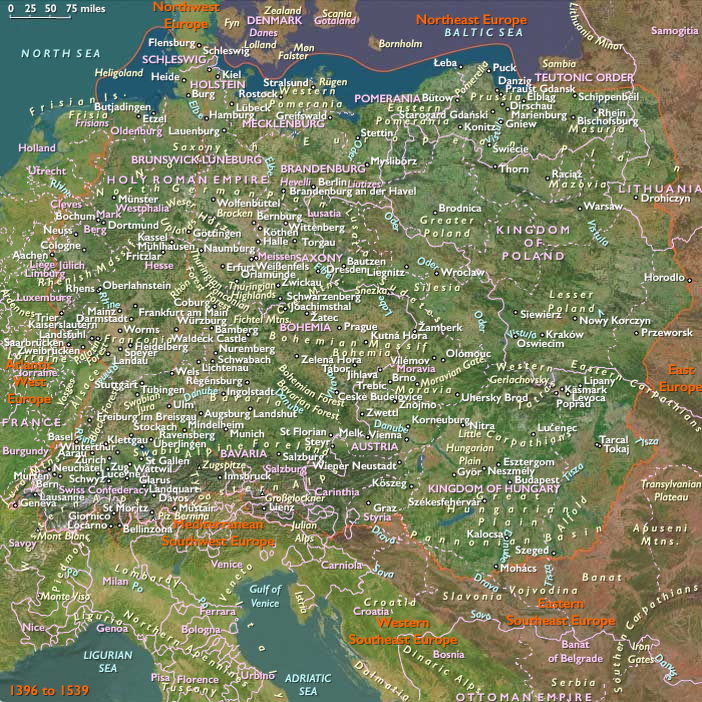
Peuerbach had traveled from 1448 to 1451 through central and southern Europe, most notably in Italy, giving lectures on astronomy.
His lectures led to offers of professorships at several universities, including those at Bologna and Padua.
During this time he also met Italian astronomer Giovanni Bianchini of Ferrara.
He returned to the University of Vienna in 1453, earned his Masters of Arts, and began lecturing on Latin poetry.
Peuerbach had in 1454 been appointed court astrologer to King Ladislas V of Bohemia and Hungary.
It was in this capacity that Peuerbach had first met Ladislas' cousin Frederick, who was then serving as guardian to the fourteen-year-old king and who would later become Frederick III, Holy Roman Emperor.
Ladislas resided primarily in Prague and Vienna, allowing Peuerbach to maintain his position at the University of Vienna.
Peuerbach auring this time met Johannes Müller von Königsberg, better known as Regiomontanus.
Müller was currently a student at the university and, after he graduated in 1452 at the age of fifteen, began collaborating extensively with Peuerbach in his astronomical work.
Following the assassinations in 1457 of two notable political figures, Ladislas had fled Vienna and died of Leukemia later that year.
Peuerbach, rather than taking of service with either of Ladislas' successors, had accepted an appointment as court astrologer to Frederick III.
One of Peuerbach's best known works, his Theoricae Novae Planetarum, had begun as a series of lectures transcribed by Regiomontanus.
The Theoricae Novae is an attempt to present Ptolemaic astronomy in a more elementary and comprehensible way.
The book is very successful, replacing the older Theoricae Planetarum Communis as the standard university text on astronomy and will be studied by many later-influential astronomers including Nicolaus Copernicus and Johannes Kepler.
Peuerbach in 1457 observed an eclipse and noted that it had occurred eight minutes earlier than had been predicted by the Alphonsine Tables, the best available eclipse tables at the time.
He then computed his own set of eclipse tables, the Tabulae Eclipsium.
Widely read in manuscript form beginning around 1459 (and formally published in 1514), these tables will remain highly influential for many years.
Peuerbach has written various papers on practical mathematics, and constructed various astronomical instruments.
Most notably, he has computed sine tables based on techniques developed by Arabian mathematicians.
Cardinal Basilios Bessarion, while visiting Frederick's court seeking assistance in a crusade to reclaim Constantinople from the Turks, had proposed in 1460 that Peuerbach and Regiomontanus create a new translation of Ptolemy's Almagest from the original Greek.
Bessarion thought that a shorter and more clearly written version of the work would make a suitable teaching text.
Peuerbach had accepted the task and works on it with Regiomontanus until his death in 1461, at which time six volumes have been completed.
Regiomontanus will complete the project, the final version containing thirteen volumes.
Locations
People
Groups
Topics
Subjects
- Commerce
- Writing
- Labor and Service
- Conflict
- Faith
- Theory
- Government
- Technology
- Astrology
- Mathematics
- Astronomy
Regions
Subregions
Related Events
Showing 10 events out of 41234 total
Years: 1461 - 1461
Locations
People
Groups
Topics
Subjects
- Commerce
- Writing
- Labor and Service
- Conflict
- Faith
- Theory
- Government
- Technology
- Astrology
- Mathematics
- Astronomy
Regions
Subregions