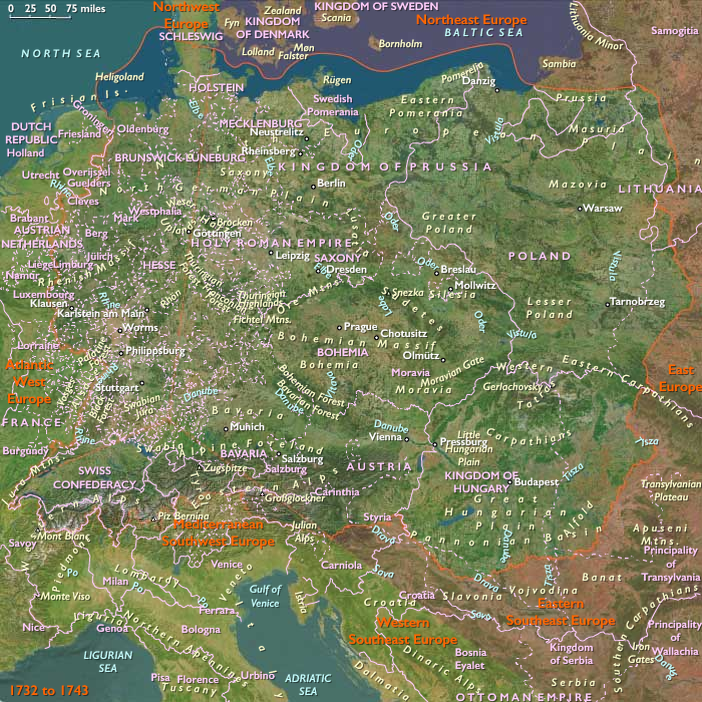
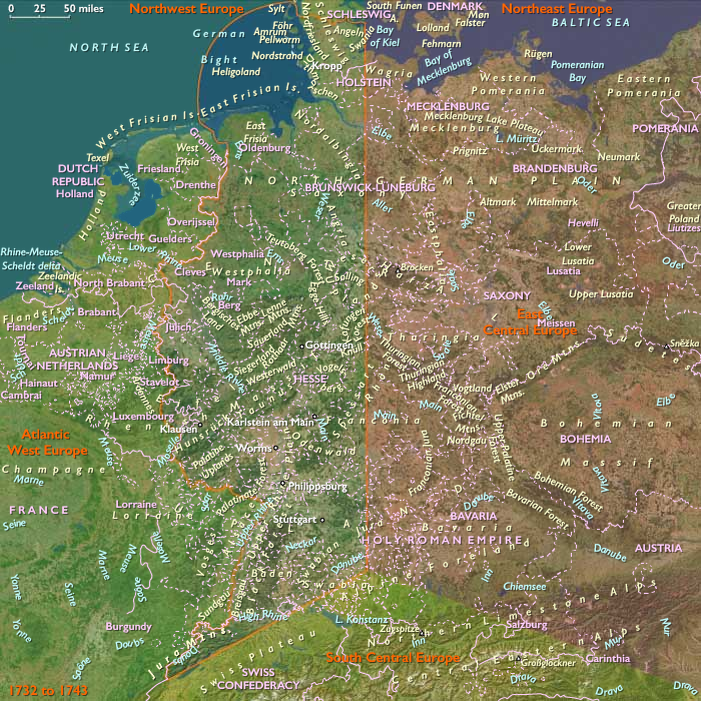
Göttingen's Georg-August-Universität, established to propagate the ideas …
Years: 1737 - 1737
November
Göttingen's Georg-August-Universität, established to propagate the ideas of academic freedom and enlightenment at the times of the European Enlightenment. opens for classes in 1737.
Founded in 1734 by George II, King of Great Britain and Elector of Hanover, the University of Göttingen will soon grow in size and popularity.
Locations
People
Groups
Topics
Subjects
Regions
Subregions
Related Events
Filter results
Showing 10 events out of 27475 total
Okhotsk is ill-suited to be a permanent port, but things are little better for the second Bering expedition than they had been at Yakutsk; the expedition’s administrator, Grigory Skornyakov-Pisarev, despite having been resident here for four years, has been slow to construct the buildings needed.
Bering’s lieutenant and fellow Dane Martin Shpanberg is, however, able to ready the ships the expedition needed.
The Gabriel has been refitted by the end of 1737; in addition, two new ships, the Archangel Michael and the Nadezhda, have been constructed and are rapidly readied for a voyage to Japan, a country with which Russia has never had contact.
Bering in the same year takes up residence in Okhotsk.
It is the fifth year of the expedition, and the original cost estimates now look naive compared to the true costs of the trip.
The additional costs (three hundred thousand rubles compared to the twelve thousand that had been budgeted) bring poverty to the entire region.
An earthquake with an estimated magnitude of 9.3 occurs off the shore of Russia's Kamchatka Peninsula on October 16, 1737.
Tsunamis up to sixty meters (two hundred feet) high follow in the Pacific Ocean.
Russian and Turkish armies in the Turkish Ukraine, fight for possession of Azov, Ochakov, and other cities, capturing, losing, and recapturing them.
Vienna's Karlskirche is completed in 1737.
Charles VI, Holy Roman Emperor, had in 1713, one year after the last great plague epidemic, pledged to build a church for his namesake patron saint, Charles Borromeo, who was revered as a healer for plague sufferers.
An architectural competition was announced, in which Johann Bernhard Fischer von Erlach had prevailed over, among others, Ferdinando Galli-Bibiena and Johann Lukas von Hildebrandt.
Construction begun in 1716 under the supervision of Anton Erhard Martinelli.
After J.B. Fischer's death in 1723, his son, Joseph Emanuel Fischer von Erlach, completes the construction in 1737 using partially altered plans.
The church originally possesses a direct line of sight to the Hofburg and is also, until 1918, the imperial patron parish church.
As a creator of historic architecture, J.B. Fischer has united the most diverse of elements.
The façade in the center, which leads to the porch, corresponds to a Greek temple portico.
The neighboring two columns, crafted by Lorenzo Mattielli, find a model in Trajan's Column in Rome.
Next to those, two tower pavilions extend out and show the influence of the Roman baroque (Bernini and Borromini).
Above the entrance, a dome rises up above a high drum, which the younger J. E. Fischer has shortened and partly altered.
The iconographical program of the church originates from the imperial official Carl Gustav Heraeus and connects St. Charles Borromeo with his imperial benefactor.
The relief on the pediment above the entrance with the cardinal virtues and the figure of the patron on its apex point to the motivation of the donation.
This sculpture group continues onto the attic story as well.
The attic is also one of the elements which the younger Fischer has introduced.
The columns display scenes from the life of Charles Borromeo in a spiral relief and are intended to recall the two columns, Boaz and Jachim, that stood in front of the Temple at Jerusalem.
They also recall the Pillars of Hercules and act as symbols of imperial power.
The entrance is flanked by angels from the Old and New Testaments.
This program continues in the interior as well, above all in the dome fresco by Johann Michael Rottmayr of Salzburg and Gaetano Fanti (pseudoarchitecture) which displays an intercession of Charles Borromeo, supported by the Virgin Mary.
Surrounding this scene are the cardinal virtues.
The frescos in a number of side chapels are attributed to Daniel Gran.
The Yarubid family eventually calls in an army under Persia’s new ruler Nader Shah, whose invasion of the country in 1737 reestablishes Iranian influence on the Omani coast.
Austria, Russia's ally since 1726, enters the Russian war against the Ottoman Empire in July 1737, but is defeated a number of times, among others in the Battle of Banja Luka on August 4, 1737.
The (Belfast) News Letter, the oldest existing English language newspaper in the world, is founded in Ireland in 1737, printed in Joy's Entry in Belfast.
The Joys are a family of Huguenot descent who have added much to eighteenth-century Belfast, noted for their compiling materials for its history.
Francis Joy, the father of Henry and Robert, had come to Belfast early in the century from the County Antrim village of Killead.
In Belfast, he had married the daughter of the town sovereign, and set up a practice as an attorney.
He obtains a small printing-press in settlement of a debt, and in 1737 uses it to publish the town’s first newspaper at the sign of ‘The Peacock’ in Bridge Street.
The family will later buy a paper mill in Ballymena, and are able to produce enough paper not only for their own publication but for the whole province of Ulster.
Princess Augusta of Saxe-Gotha, sixteen and speaking virtually no English, had arrived in Great Britain in order to marry twenty-eight-year old Frederick, Prince of Wales, eldest son of King George II and Queen Caroline.
The wedding ceremony had taken place almost immediately, on April 27, 1736, at the Chapel Royal in St. James's Palace, London.
The marriage seems to have been a happy one.
Augusta and Frederick will have nine children, the last born after Frederick's death.
The birth of their first daughter, Princess Augusta, on August 31, 1737, takes place at St. James's after Princess Augusta is forced by Frederick to travel from Hampton Court Palace while in labor, simply to prevent his hated parents from being present at the birth.
Augusta was born in Gotha to Frederick II, Duke of Saxe-Gotha-Altenburg (1676–1732) and Magdalena Augusta of Anhalt-Zerbst (1676–1740).
Her paternal grandfather was Frederick I, Duke of Saxe-Gotha-Altenburg, eldest surviving son of Ernest I, Duke of Saxe-Coburg-Altenburg.
The planet Venus passes in front of Mercury on May 28, 1737, an event is witnessed during the evening hours by the amateur astronomer John Bevis at the Royal Greenwich Observatory.
As of 2006, it was still the only such planet/planet occultation that has been directly observed.
The most active members of the Georgia Trust, in terms of their attendance at council, corporation, or committee meetings, are, in order of frequency, James Vernon, the earl of Egmont, Henry L'Apostre, Samuel Smith, Thomas Tower, John LaRoche, Robert Hucks, Stephen Hales, James Oglethorpe, and Anthony Ashley Cooper, 4th Earl of Shaftesbury.
The number of meetings attended over the twenty-year span of Trustee Georgia will range from Vernon's seven hundred and twelve to Shaftesbury's two hundred and sixty-six.
Sixty-one Trustees will attend fewer meetings.
James Vernon, one of the original Associates of Dr. Bray and an architect of the charter, will maintain an interest in Georgia throughout the life of the Trust.
He had arranged the Salzburger settlement and has negotiated with the Society for the Propagation of the Gospel in Foreign Parts for missionaries.
He differs from Egmont and Oglethorpe in his willingness to respond to the colonists' complaints.
When Oglethorpe becomes preoccupied with the Spanish war after 1740, Vernon will propose the plan of dividing the colony into two provinces, Savannah and Frederica, each with a president and magistrates.
The Trustees had named William Stephens president in Savannah, and he will serve until 1751, when he is replaced by Henry Parker in the final year of the Trust's tenure.
Oglethorpe neglects to name a president for Frederica, and the magistrates there are instructed to report to Stephens.
The Trustees do not want to appoint a single governor because the king in council has to approve the appointment of governors, and the Trustees prefer to keep control in their hands.
After Egmont's retirement in 1742, Vernon will become the indispensable man.
He will miss only four of one hundred and fourteen meetings during the last nine years of the Trust and supervise the removal of restrictions on land tenure, rum, and slavery.
Egmont, the first president of the Common Council and the dominant figure among the Trustees until his retirement, acts as Georgia's champion in Parliament.
He strongly opposes Walpole's attempts to conciliate Spain at the expense of Georgia.
He has to walk a careful line, however, because the Trustees depend upon Walpole for their annual subsidies.
Other Trustees contribute According to their abilities.
Henry L'Apostre advises on finances, Samuel Smith on religion, and Thomas Tower on legal matters, particularly on instructions to Georgia officials.
Stephen Hales's closeness to the royal family and his standing as a scientist lends prestige to the body of Trustees.
Shaftesbury, a political opponent of Walpole, had joined the Common Council in 1733 and, except for a brief resignation, will remain faithful to the end, leading the negotiations to convert Georgia to a royal colony.
For the entire twenty years, the Trustees will employed only two staff members, Benjamin Martyn as secretary and Harman Verelst as accountant.
Oglethorpe returns in 1637 to England to demand a regiment of regulars from a reluctant Walpole.
Not only does he get his regiment and a commission as colonel, but Egmont persuades Walpole to pay for all military expenses.