
Geometry has so far consisted of rules …
Years: 597BCE - 586BCE
Geometry has so far consisted of rules that produce useful, approximate, but not always accurate results.
Greek philosophers from about 600 BCE begin developing general theorems for geometry (although ancient reports that Thales of Miletus developed the first theorems are now in dispute).
Greek philosophers such as Thales are aware of the peculiar electrical properties of amber and silk.
Amber, when rubbed with a piece of fur, acquires resinous electricity and develops the ability to attract small pieces of material such as feathers.
Thales used silk in similar experiments with static electricity. (The word electricity is derived from the Greek word “elektron,” meaning "amber.”
Thales, a student of Egyptian astronomy, in 586 BCE reportedly predicts the solar eclipse that occurs the following year.
One effect of the eclipse will be the cessation of the war between Lydians and Medians.
Locations
People
Groups
Topics
- Younger Subboreal Period
- Iron Age, Near and Middle East
- Iron Age Cold Epoch
- Classical antiquity
- Median-Lydian War of 590-585 BCE
Commodoties
Subjects
- Commerce
- Environment
- Labor and Service
- Conflict
- Faith
- Theory
- Government
- Technology
- Mathematics
- Astronomy
- Philosophy and logic
Regions
Subregions
Related Events
Filter results
Showing 10 events out of 65939 total
Mesembria, originally a Thracian settlement known as Menebria, becomes a Greek colony when settled by Dorians from Megara at the beginning of the sixth century BCE, and is to be an important trading center from this point forward and a rival of Antheia, later to be known as Apollonia (present Sozopol).
It remains the only Doric colony along the Black Sea coast, as the rest are typical Ionic colonies.
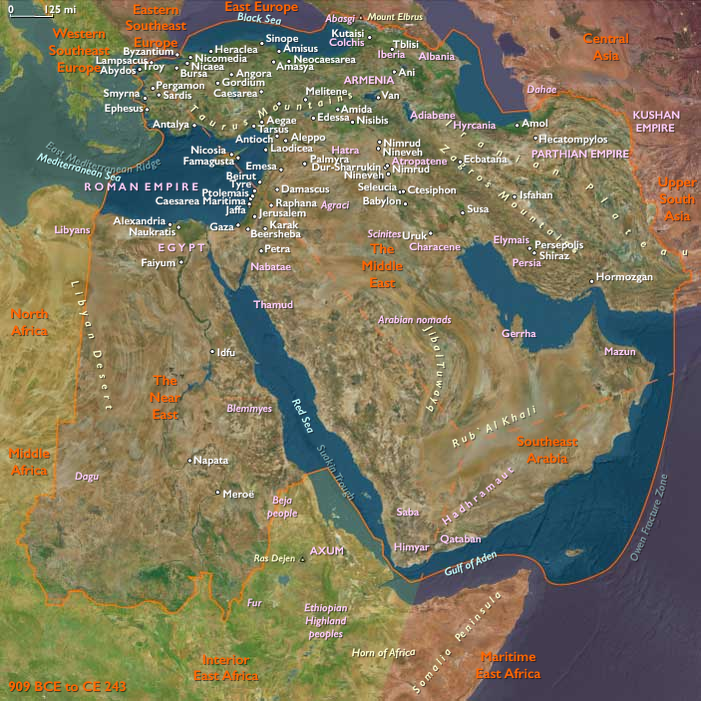
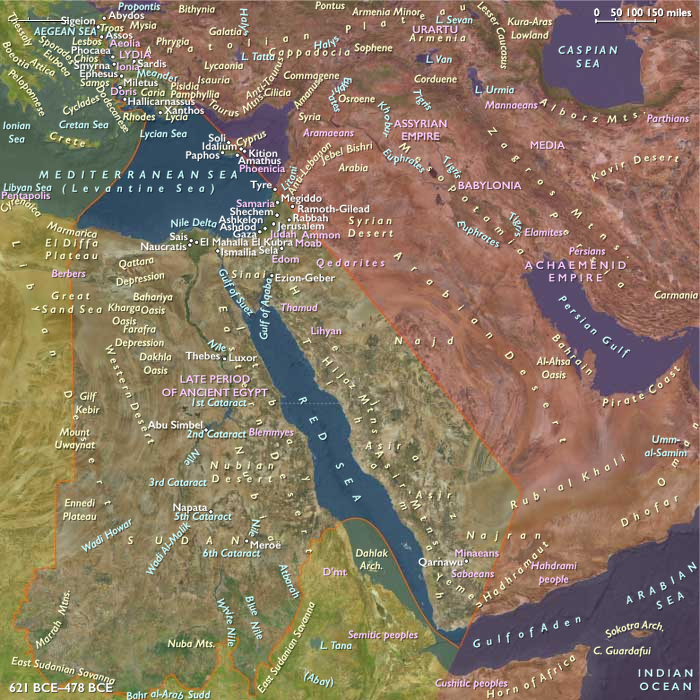
The Middle East: 597–586 BCE
Babylonian Consolidation under Nebuchadnezzar II
During this critical decade, Nebuchadnezzar II decisively asserts Babylonian dominance throughout the territories once ruled by the Neo-Assyrian Empire, effectively reshaping the political landscape of western Asia. Through relentless military campaigns, he systematically suppresses resistance among smaller kingdoms and vassal states, solidifying Babylonian hegemony.
One of his most notable acts occurs in 587 BCE when he conquers the Hebrew Kingdom of Judah. After a prolonged siege, Jerusalem is captured, the Temple is destroyed, and many of Judah’s leaders, intellectual elite, and skilled artisans are forcibly relocated to Babylon. Despite the harshness of this displacement—known historically as the Babylonian Captivity—the surviving documents indicate that the exiled Judahites are relatively well-treated, permitted to establish communities and practice their religion and traditions within Babylonia.
Median Empire under Cyaxares
In parallel to Babylonian expansion, Cyaxares, ruler of the Median Empire, has solidified his control over significant portions of the fallen Assyrian Empire. His territories now encompass western Iran, northern Mesopotamia, and parts of eastern Anatolia, forming a substantial rival empire to that of Babylonia. From his capital at Ecbatana (modern-day Hamadan), Cyaxares governs a diverse and expansive realm, bringing stability and promoting trade and cultural interactions throughout his domains.
Thus, the period from 597 to 586 BCE sees the consolidation of two dominant powers—Babylonia and Media—who divide and administer the vast territories of the former Assyrian Empire, setting the geopolitical stage for future conflicts and alliances.
Nebuchadnezzar, asserting Babylonian claims to all the area previously dominated by the Neo-Assyrians in the southern half of western Asia, has eliminated many kingdoms in the west, including, in 587, the Hebrew southern kingdom of Judah, whose leaders and prominent citizens he has deported to Babylonia.
Those Judahites deported to Babylon are treated well there, according to the documents.
Cyaxares had eventually divided the former Assyrian Empire with Babylonia.
From his capital at Ecbatana (modern Hamadan), the King of the Medes rules an empire that includes western Iran, northern Mesopotamia, and part of Anatolia.
Near East (597–586 BCE): Siege, Subjugation, and Cultural Realignment
Miletus, Smyrna, and Ionian Decline
The Ionian city of Smyrna, having flourished in the previous century, suffers a devastating setback when Lydian King Alyattes captures and sacks the city around 600 BCE. Smyrna's inhabitants are forced into the countryside, dismantling their political unity and relegating the city to a mere collection of villages. This event highlights the peak of Lydian dominance under Alyattes, who also subjugates cities like Clazomenae, marking the decline of Ionian political autonomy despite continued cultural and commercial significance.
Egyptian Endeavors and Necho II’s Legacy
Pharaoh Necho II, having abandoned attempts at Asian conquest after the defeats against Babylon, redirects Egyptian efforts toward internal stabilization and maritime expansion. According to Herodotus, Necho commissions a pioneering circumnavigation of Africa by Phoenician sailors, a voyage reportedly lasting three years. Though debated by modern historians, this expedition underscores Egypt’s intensified interest in maritime exploration and trade. Necho’s reign concludes in 595 BCE, succeeded by his son Psamtik II, who notably removes Necho's inscriptions from monuments for unclear reasons.
Psamtik II and Egyptian Military Revival
Psamtik II undertakes a significant military campaign against Nubia around 592 BCE, decisively crushing the Kingdom of Kush. His forces sack Napata, destroy royal statues, and loot temples, compelling the Nubians to move their capital further south to the safer and iron-rich region of Meroë. Psamtik II’s aggressive strategy effectively eliminates Nubian aspirations to reconquer Egypt, solidifying Egypt’s southern frontier. The Pharaoh's reign also witnesses extensive temple construction, notably at Hibis in El-Kharga Oasis, marking his short but impactful rule.
Babylonian Siege and Fall of Jerusalem
Nebuchadrezzar II, King of Babylon, asserts dominion over Judah, responding decisively to Zedekiah’s rebellion incited partly by Egyptian intervention under Psamtik II in 589 BCE. Jerusalem endures an intense siege beginning in 588 BCE. The prophet Jeremiah advocates surrender, interpreting Babylonian dominance as divinely ordained, yet Jerusalem resists. In 586 BCE, Nebuchadrezzar breaches the city, destroys the Temple, and razes Jerusalem’s walls. King Zedekiah is captured, forced to witness his sons' execution, blinded, and exiled to Babylon along with Judah’s elite.
Lachish Letters and Regional Collapse
The Lachish Letters, a poignant archaeological discovery, vividly describe the last days before Lachish falls to Babylonian forces around 588–586 BCE. Written on pottery shards, these communications reveal the desperation of Judah’s defenders and underscore the widespread chaos preceding Jerusalem’s fall. The Edomites, historical adversaries of Judah, align themselves with Babylon, exacerbating Judah's collapse.
Cultural and Scientific Developments
The period also marks significant advancements in Greek philosophy and early science. Notably, Thales of Miletus, recognized for his studies in geometry and astronomy, is traditionally credited with predicting a solar eclipse in 585 BCE. His explorations into static electricity, observing amber's unique properties, exemplify early scientific curiosity that foreshadows later Hellenic intellectual achievements.
Legacy of the Era
This era signifies a profound reshaping of Near Eastern political and cultural landscapes. The destruction of Jerusalem by Babylonian forces dramatically alters the historical trajectory of the Hebrew people, marking the beginning of the Jewish exile. Egypt, under the Saite dynasty, experiences a brief military resurgence, while Greek cultural influence continues to grow despite setbacks, laying the foundation for future intellectual and scientific breakthroughs.
The Ionian city of Smyrna has grown in the seventh century from modest beginnings into a stately city, with massive fortifications and blocks of two-storied houses.
When the Mermnad kings raised the Lydian power and aggressiveness, Smyrna had been one of the first points of attack.
Gyges, who regned from about 687 to 652 BCE,was, however, defeated on the banks of the Hermus, the situation of the battlefield showing that the power of Smyrna extended far to the east.
A strong fortress was built probably by the Smyrnaean Ionians to command the valley of Nymphi, the ruins of which are still imposing, on a hill in the pass between Smyrna and Nymphi.
According to Theognis, who will flourish around 500 BCE, it was pride that destroyed Smyrna.
Mimnermus laments the degeneracy of the citizens of his day, who could no longer stem the Lydian advance.
Finally, Alyattes of Lydia conquers the city and sacks it, with its inhabitants forced to move into the countryside.
Although Smyrna does not cease to exist, the Greek life and political unity are destroyed, and the polis is reorganized on the village system.
Lydia reaches its commercial and political zenith under Alyattes, who attacks Clazomenae and subjects many inland regions to Lydian rule.
Egypt’s Pharaoh Necho II had abandoned Asia after 601 BCE, strengthening the Egyptian navy for strategic and trading purposes and maintaining close links with the Greeks.
According to Herodotus (4.42), Necho engages a crew of Phoenician mariners to undertake the first known circumnavigation of Africa.
The expedition departs Egypt by way of the Red Sea and travels south past Ethiopia, reportedly expecting to turn west shortly after that point, as conventional theory has the continent as roughly rectangular in shape.
Finding that it is not, the sailors journey for three years, during which the sailors, each autumn, establish long-term encampments to sow, grow, and harvest grain that they carry with them.
They finally enter the Pillars of Hercules and sail through the Mediterranean to reappear in Egypt.
Some current historians tend to believe Herodotus' account, primarily because he stated with disbelief that the Phoenicians "as they sailed on a westerly course round the southern end of Libya (Africa), they had the sun on their right—to northward of them" (The Histories 4.42)—in Herodotus' time it was not known that Africa extended south past the equator; however, Egyptologists also point out that it would have been extremely unusual for an Egyptian Pharaoh to carry out such an expedition.
Necho II dies in 595 BCE and is succeeded by his son, Psamtik II, as the next pharaoh of Egypt.
Psamtik II, however, will later remove Necho's name from almost all of his father's monuments for unknown reasons.
Psamtik II is succeeded in 589 BCE by Apries, his son by Queen Takhut, a Princess of Athribis.
Th royal couple were also the parents of Menekhubaste, a Priestess of Atum at Heliopolis, and Ankhnesneferibre, a God's Wife of Amun who is to be served in this powerful office in Upper Egypt through to the remainder of the Saite period.
Apries is the name by which Herodotus (ii. 161) and Diodorus (i. 68) designate Wahibrea, pharaoh of Egypt (589 BC-570 BCE), the fourth king (counting from Psammetichus I) of the Twenty-sixth dynasty of Egypt.
Apries continues his father’s poor military record.
Unsuccessful attempts to intervene in the kingdom of Judah are followed by a mutiny of soldiers at Aswan.
The Chaldean (or Neo-Babylonian, as some historians call it) Empire that has replaced the Assyrian Empire insists, like its predecessor, on control of Judah.
Nebuchadnezzar II, with Syrian and Ammonite allies, attacks Judah and on March 16, 597 BCE captures Jerusalem, deporting the newly installed teenage King Jehoiachin (whose father Jehoiakim had died during the siege) to Babylon, together with ten thousand of his subjects.
Nebuchadnezzar installs Mattaniah, a grandson of Josiah and the uncle of Jehoiachin, as regent under the name Zedekiah.
Nebuchadrezzar's further military activities are known not from extant chronicles but from other sources, particularly the Bible, which records another attack on Jerusalem.
Psamtik II in 591 BCE, during the fourth year of his reign, launches an expedition into Palestine "to foment a general Levantine revolt against the Babylonians" that involves, among others, Zedekiah.
The Egyptian invasion pushes as far as Sidon.
Nebuchadrezzar, thus provoked, invades Judah in 589, the ninth year of Zedekiah's rule.
Zedekiah and the citizens of Jerusalem defy the Assyrians, leading to a siege of the city in 588.
The prophet Jeremiah urges the Jerusalemites to surrender the city to prevent its destruction, but the citizens hold out, hoping for Egyptian relief.
During the siege, the prophet Jeremiah, according to the Bible, urges patient submission to the dominion of the Babylonians, which he regards as the will of God.
The Israelites, he says, do not need a state to carry out the mission given to them by God, but royal officials and Judahite notables denounce him and he is accused of desertion and imprisoned.
Nebuchadrezzar after eighteen months breaches the walls of a starving Jerusalem, then burns the Temple and destroys the city, leveling its walls.
Zedekiah and others flee by night toward Jericho, hoping to regroup, but are captured.
Zedekiah and his leaders are taken before Nebuchadrezzar at Riblah, in Syria, where Zedekiah's sons are slain in his presence and he, a disloyal vassal, is blinded.
Nebuchadnezzar, in standard Near Eastern practice, now deports him, along with the rest of Judah’s royalty, nobility, and skilled artisans, to various Babylonian cities, leaving only the poor, who number about twenty thousand, to inhabit Judah.
The Edomites, long-standing enemies of the Jews, cooperate with Judah’s Babylonian conquerors.
Napata has remained the center of the Kingdom of Kush for another two generations following the Saite dynasty’s consolidation of Upper Egypt in 656 BCE.
Its economy is essentially based on gold, with Twenty-sixth Dynasty Egypt an important economic ally.
The people of Napata at this time are culturally Egyptianized.
Napatan architecture, paintings, writing script, and other artistic and cultural forms are in the Egyptian style.
Egyptian burial customs are practiced, including the resurrection of pyramid building.
The Napatan dynasty and their successors had built the first pyramids the Nile Valley had seen since the Middle Kingdom.
Also, several Egyptian gods are worshiped.
The most important god is Amun, a Theban deity, whose temple is the most important at Napata, located at the foot of Jebel Barkal.
After the Persian conquest of Egypt, Napata loses its economic influence.
The Napatan region itself is desiccating, leading to less cattle and agriculture.
Finally, Napata is losing its role of economic capital to Meroë.
The Island of Meroë, the peninsula formed by the Nile and the Atbara courses, is an area rich in iron, which is becoming an essential source of wealth.
A Kushite king named Anlamani had revived the power of the kingdom of Napata.
Psamtik II's campaign was likely initiated to destroy any future aspirations the Kushites may have had to reconquer Egypt.
The Egyptian army advances to Pnubs (Kerma) and the capital city of Napata in a series of fierce battles, where they loot its temples and destroy the royal Kushite statues.
The Kushite capital is sacked under the reign of the native Kushite king Aspelta, who was the younger brother of Anlamani and the son of Senkamanisken.
The Year Three Karnak stela is dated to II Shemu day 10 of Psamtik II's reign and states, “The army that your Majesty sent to Nubia has reached the land of Pnubs....Nubians from all parts [of Kush] had arisen against him, their hearts full of anger when he attacked those who had rebelled against him there; because he was furious at those who had arisen against him.
His Majesty took part in the combat as soon as he reached the battle.
The rebels capitulated before a single arrow was unleashed against them....Those who tried to flee did not succeed and were brought back as prisoners: four thousand two hundred men.
As a result of Psamtik's devastating campaign, Kush's power is crushed, and its kings from Aspelta onward lose any opportunity of ever regaining control of Egypt.
Instead, the Nubian rulers decide to shift their capital further south from Napata to the relative safety of Meroë.
Curiously, however, Psamtik II does not appear to have capitalized on his victory.
His troops retreat back to the First Cataract, and Elephantine continues to be the southern border of Egypt.
Years: 597BCE - 586BCE
Locations
People
Groups
Topics
- Younger Subboreal Period
- Iron Age, Near and Middle East
- Iron Age Cold Epoch
- Classical antiquity
- Median-Lydian War of 590-585 BCE
Commodoties
Subjects
- Commerce
- Environment
- Labor and Service
- Conflict
- Faith
- Theory
- Government
- Technology
- Mathematics
- Astronomy
- Philosophy and logic
