
Geoffrey III of Anjou: A Weak Ruler …
Years: 1060 - 1060
Geoffrey III of Anjou: A Weak Ruler and the Rise of Fulk le Réchin (1060–1068)
Geoffrey III of Anjou, born around 1040, was the eldest son of Geoffrey II of Gâtinais and Ermengarde of Anjou, making him the grandson of the formidable Fulk III ("Nerra"). Despite his noble lineage, Geoffrey III’s rule as Count of Anjou (1060–1068) was marked by incompetence, leading to his eventual overthrow by his younger brother, Fulk IV ("le Réchin").
Early Life and Rise to Power (1040–1060)
- Geoffrey and his younger brother, Fulk ("le Réchin"), were raised under the guidance of their uncle, Count Geoffrey Martel.
- Both were knighted by their uncle in 1060, the same year Geoffrey Martel died without heirs, leaving the countship to Geoffrey III.
- Although Geoffrey Martel had shown favoritism toward Fulk, he nonetheless designated Geoffrey III as his successor.
A Weak and Ineffective Ruler (1060–1068)
- From the outset, Geoffrey III struggled to assert authority over his vassals, who quickly lost confidence in his leadership.
- Unlike his capable predecessors, Geoffrey was perceived as indecisive, militarily ineffective, and politically weak.
- The once-powerful County of Anjou began to lose influence, leading to growing discontent among the Angevin nobility.
The Challenge from His Brother, Fulk IV ("le Réchin")
- Seeing his brother’s failings, Fulk IV began gathering support from dissatisfied Angevin lords.
- Fulk, known for his shrewdness and ambition, eventually rebelled against Geoffrey, aiming to remove him from power.
- In 1068, after years of ineffective rule, Geoffrey III was forcibly deposed by Fulk, who seized control of Anjou for himself.
Legacy and Consequences
- Geoffrey III’s rule marked the decline of Angevin power, but his overthrow by Fulk IV stabilized the county.
- Fulk IV worked to rebuild Angevin strength, ensuring that Anjou remained a key power in medieval France.
- Geoffrey’s deposition set the precedent for the later power struggles within the House of Anjou, which would eventually culminate in the Angevin Empire of the 12th century.
Though he inherited a powerful legacy, Geoffrey III lacked the political and military acumen to uphold it, leading to his downfall and the rise of his more capable brother, Fulk IV ("le Réchin").
Locations
People
Groups
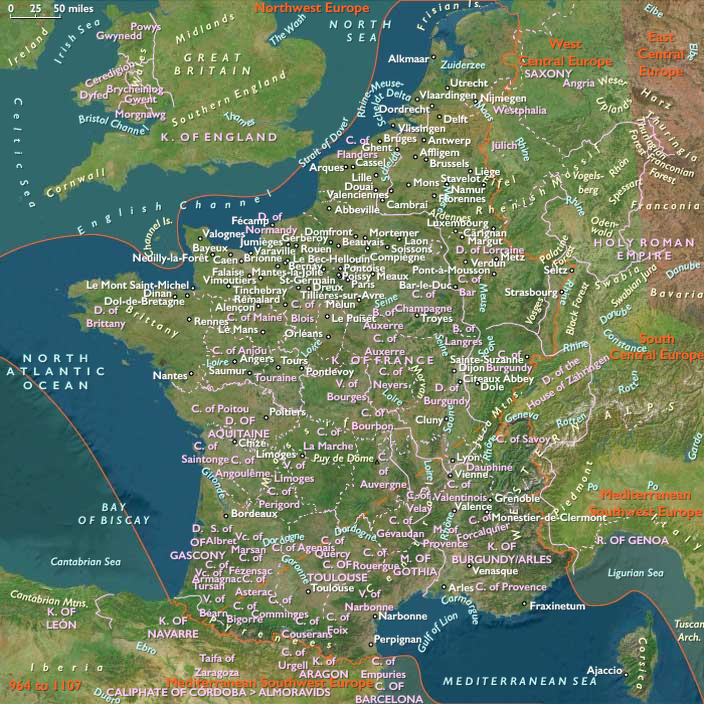
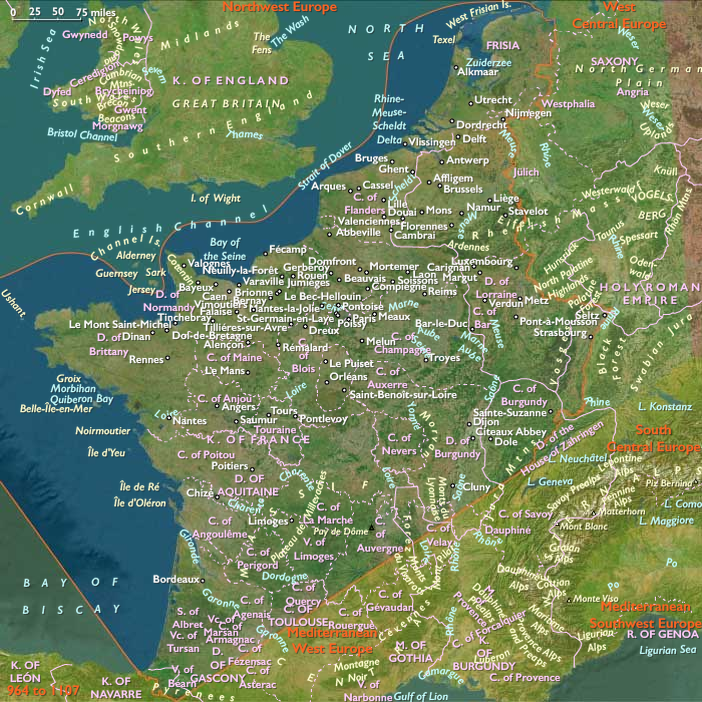
- Anjou, County of
- Normandy, Duchy of
- Brittanny, Duchy of
- Aquitaine, (Angevin) Duchy of
- France, (Capetian) Kingdom of
- Christians, Roman Catholic
Commodoties
Subjects
Regions
Subregions
Related Events
Filter results
Showing 10 events out of 51034 total
It is possible that a new giant crater is created on the Moon in 1065 (contemporary chronicles record sightings of this event).
The appearance of Halley's Comet, which reaches perihelion on March 20, 1066, is subsequently recorded in the Bayeux Tapestry.
East Central Europe (1048–1059 CE): Polish Restoration under Casimir I, Hungarian Stability under Andrew I, and Bohemia’s Growing Influence under Bretislav I
Between 1048 and 1059 CE, East Central Europe—comprising modern-day Poland, Czechia, Slovakia, Hungary, and the eastern parts of Germany and Austria east of 10°E and north of the defined southeastern boundary—experienced significant political restoration, stabilization, and regional realignment. Casimir I "the Restorer"revitalized and reunified Poland following decades of turmoil, King Andrew I brought renewed stability to Hungary, and the Přemyslid ruler Bretislav I firmly consolidated Bohemian power. These developments reshaped regional political structures, strengthened cultural identities, and restored economic stability, laying critical foundations for future medieval growth.
Political and Military Developments
Polish Restoration under Casimir I
-
Casimir I "the Restorer" (r. 1039–1058) restored Polish political unity and royal authority after decades of instability. Through successful diplomatic and military efforts, including crucial alliances with Hungary and the Holy Roman Empire, Casimir regained lost territories, restored the Polish Church’s authority, and reestablished effective governance throughout Poland.
Hungarian Stability under Andrew I
-
Following succession crises, King Andrew I (r. 1046–1060) stabilized Hungary by reinforcing royal authority, reestablishing internal peace, and strengthening Hungary’s military capabilities. His reign solidified Hungary’s internal structures and external diplomatic relations, notably with Poland and neighboring German states.
Bohemian Expansion under Bretislav I
-
Duke Bretislav I of Bohemia (r. 1034–1055) expanded and consolidated Přemyslid control, extending his influence into Silesia and Moravia, significantly enhancing Bohemia’s regional political and economic standing.
Imperial Influence under Henry III
-
Holy Roman Emperor Henry III (r. 1039–1056) maintained active involvement in East Central Europe, intervening diplomatically and militarily, influencing succession issues in Hungary and Bohemia, and shaping the regional political landscape through strategic alliances and assertive imperial policy.
Economic and Technological Developments
Restoration of Polish Economic Networks
-
Casimir’s reunification efforts revitalized Polish economic life, restoring trade routes and commerce, notably through rebuilding urban centers, reestablishing regional marketplaces, and renewing Poland’s economic integration into broader European networks.
Continued Urban Growth and Fortification
-
Bohemian and Hungarian towns, notably Prague, Esztergom, Székesfehérvár, and Veszprém, experienced continued urban expansion, robust fortification, and administrative improvements, reflecting renewed political stability and economic prosperity.
Cultural and Artistic Developments
Polish Ecclesiastical Renewal
-
Casimir I actively supported the renewal and rebuilding of ecclesiastical institutions, monasteries, and religious centers, significantly enhancing Polish Christian cultural and religious identity after a period of instability.
Hungarian Royal and Ecclesiastical Culture under Andrew I
-
King Andrew I promoted cultural renewal by supporting monasteries, churches, and ecclesiastical institutions, reinforcing Hungary’s Christian royal traditions and deepening the kingdom’s integration into broader European culture.
Bohemian Cultural Patronage under Bretislav I
-
Bretislav I’s rule witnessed extensive cultural patronage, including monastic foundations, church construction, and artistic patronage, significantly strengthening Prague’s role as a major cultural and ecclesiastical center.
Settlement and Urban Development
Polish Urban Reconstruction
-
Casimir I prioritized reconstruction of key Polish urban centers such as Kraków, Gniezno, and Poznań, reestablishing their roles as vibrant political, ecclesiastical, and economic hubs.
Hungarian Administrative Expansion
-
Andrew I continued urban and administrative expansions, especially in Esztergom and Székesfehérvár, strengthening royal authority, ecclesiastical organization, and economic vitality.
Bohemian Urban and Administrative Consolidation
-
Under Bretislav I, Prague and other Bohemian cities further expanded, fortifications improved significantly, and urban infrastructure advanced, solidifying Bohemia’s administrative coherence and economic growth.
Social and Religious Developments
Strengthening of Christian Identity
-
Throughout Poland, Hungary, and Bohemia, renewed stability reinforced Christian identity and institutional influence. Churches and monasteries were key centers of governance, education, and cultural life, deepening Christianity’s role in society.
Dynastic Consolidation and Aristocratic Power
-
Dynastic and aristocratic structures strengthened considerably in Poland, Hungary, and Bohemia, defining clear social hierarchies and governance models, stabilizing societal structures, and reinforcing royal authority.
Long-Term Consequences and Historical Significance
The era 1048–1059 CE marked a significant phase of restoration and stabilization across East Central Europe. Casimir’s Polish restoration, Andrew’s stabilization of Hungary, and Bretislav’s expansion and consolidation in Bohemia significantly reshaped regional political, cultural, and economic dynamics. These developments laid essential foundations for enduring medieval states and institutions, decisively influencing the future historical trajectory of East Central Europe.
East Central Europe (1060–1071 CE): Hungarian Succession Conflicts, Polish Stabilization under Bolesław II, and Přemyslid Authority under Vratislaus II
Between 1060 and 1071 CE, East Central Europe—covering present-day Poland, Czechia, Slovakia, Hungary, and eastern parts of Germany and Austria east of 10°E and north of the defined southeastern boundary—underwent significant political transformations driven by dynastic conflicts, territorial consolidations, and deepening regional interactions. Hungary experienced serious internal succession crises following King Andrew I’s death, while Bolesław II stabilized and expanded Polish power. In Bohemia, Vratislaus II strengthened Přemyslid authority, solidifying Bohemia’s political influence in alignment with imperial interests. These developments profoundly reshaped the medieval political landscape and regional stability.
Political and Military Developments
Hungarian Succession Conflict and Internal Strife
-
After the death of King Andrew I (1060), Hungary descended into a prolonged dynastic conflict between Andrew’s sons, Solomon (r. 1063–1074), supported by the Holy Roman Empire, and his rival Béla I (r. 1060–1063). This internal turmoil destabilized Hungary and involved neighboring powers, temporarily weakening royal authority.
Polish Consolidation and Expansion under Bolesław II
-
In Poland, Bolesław II "the Bold" (r. 1058–1079) strengthened central authority, expanded Polish territorial influence into parts of Ukraine and the Baltics, and reinforced royal power through strong diplomatic alliances and strategic military campaigns.
Přemyslid Power under Vratislaus II in Bohemia
-
Duke Vratislaus II of Bohemia (r. 1061–1092) consolidated Přemyslid authority, skillfully navigating imperial politics, maintaining close relations with the Holy Roman Empire, and securing greater autonomy and political stability for Bohemia within the broader regional landscape.
Imperial Influence under Henry IV
-
Holy Roman Emperor Henry IV (r. 1056–1106) actively intervened in East Central European dynastic disputes, supporting Solomon in Hungary and strengthening relations with Vratislaus II in Bohemia, reinforcing imperial influence throughout the region.
Economic and Technological Developments
Stability and Growth of Regional Trade
-
Despite dynastic conflicts, Bohemia and Poland experienced sustained economic prosperity. Trade networks flourished, exchanging goods such as precious metals, amber, textiles, and agricultural products, linking East Central Europe firmly with broader European commerce.
Continued Urban Development and Fortifications
-
Towns in Poland (Kraków, Gniezno), Hungary (Esztergom, Székesfehérvár), and Bohemia (Prague) continued to expand and reinforce their urban fortifications, administrative structures, and market facilities, enhancing security, commerce, and governance.
Cultural and Artistic Developments
Polish Ecclesiastical Patronage under Bolesław II
-
Bolesław II actively promoted religious and cultural patronage, supporting monastic foundations, cathedral constructions, and artistic projects that significantly enriched Polish cultural and religious life, further integrating Poland into European cultural traditions.
Hungarian Cultural Continuity Amid Succession Crisis
-
Despite internal instability, Hungary maintained its ecclesiastical institutions, royal traditions, and cultural heritage. Ecclesiastical centers continued their scholarly and cultural activities, preserving Hungary’s Christian identity and traditions.
Bohemian Artistic Flourishing under Vratislaus II
-
Under Vratislaus II, Bohemia experienced significant cultural patronage, exemplified by cathedral expansions, illuminated manuscripts, and monastic institutions, reinforcing Prague’s role as a vibrant cultural and religious hub.
Settlement and Urban Development
Polish Urban Expansion and Royal Patronage
-
Bolesław II significantly expanded urban centers like Kraków and Gniezno, strengthening their roles as political, ecclesiastical, and economic centers, promoting urban prosperity and administrative effectiveness.
Hungarian Administrative Centers Amid Conflict
-
Despite succession disputes, Hungarian urban centers such as Esztergom and Székesfehérvár remained crucial royal, ecclesiastical, and commercial hubs, sustaining urban growth and administrative coherence.
Bohemian Urban Growth and Infrastructure
-
Under Vratislaus II, Prague and other Bohemian towns saw notable urban expansion, fortification improvements, and infrastructure development, solidifying Bohemia’s administrative cohesion and economic vitality.
Social and Religious Developments
Strengthening of Christian Institutions
-
Christianity solidified its dominant role in Poland, Hungary, and Bohemia, shaping societal governance, educational systems, and cultural identities. Ecclesiastical structures reinforced regional cohesion amid political uncertainty.
Aristocratic Consolidation and Dynastic Authority
-
Dynastic and aristocratic structures further strengthened throughout the region, clearly defining social hierarchies, political authority, and governance models crucial for medieval societal stability and administrative efficiency.
Long-Term Consequences and Historical Significance
The era 1060–1071 CE significantly impacted East Central Europe’s historical trajectory. Hungary’s succession crisis demonstrated the fragility of dynastic stability, while Poland under Bolesław II experienced renewed political strength and territorial expansion. In Bohemia, Vratislaus II solidified Přemyslid authority and regional influence. These developments reshaped regional politics, cultural identities, and economic structures, laying essential foundations for the enduring medieval kingdoms and states of East Central Europe.
The Seljuq Turks, riding south and west from the steppes of Central Asia, replicate tactics practiced by the Huns hundreds of years earlier against a similar Roman opponent but now combined these with newfound Islamic zeal; in many ways, the Seljuq Turks have resumed the conquests of the Muslims in the Byzantine-Arab Wars initiated by the Rashidun, Umayyad and Abassid Caliphate in the Levant, North Africa and Asia Minor.
The Byzantine-Seljuq wars are a series of decisive battles that shift the balance of power in Asia Minor and Syria from the East Roman Empire to the Seljuq Turks.
Alp-Arslan, the second sultan of the Turkish Great Seljuq empire, successfully fights off the challenge of the Ghaznavids of Afghanistan and other dynasties that have arisen after the decline of the Abbasid caliphate and, after restoring unity to Iran and Iraq, asserts his authority to the borders of Fatimid Egypt and Greek Anatolia.
The Battle of Manzikert is widely seen as the moment when the Greeks lost the war against the Turks; however the imperial military had been of questionable quality before 1071, with regular Turkish incursions overrunning the failing theme system.
The Turkmens, with the frontier completely shattered after the Battle of Manzikert, are able to range over most of Anatolia virtually at will.
Constantinople’s rule over Asia Minor, even after Manzikert, does not end immediately, nor are any heavy concessions levied by the Turks on their opponents—it will take another twenty years before the Turks are in control of the entire Anatolian peninsula, and that will not last for long.
The Hungarians consolidate their rule in western and central Transylvania.
Under Ibn Tashfm, the Berbers capture Morocco and found Marrakech as their capital in 1062.
Hausa people, who had been slowly moving west from Nubia and mixing in with the local Northern and Central Nigerian population, had established a number of strong states between 500 CE and 700 CE in what is now Northern and Central Nigeria and Eastern Niger.
With the decline of the Nok and Sokoto, who had previously controlled Central and Northern Nigeria between 800 BCE and 200 CE, the Hausa had been able to emerge as the new power in the region.
Closely linked with the Kanuri people of Kanem-Bornu (Lake Chad), the Hausa aristocracy adopts Islam in the eleventh century CE and the Hausa emirates emerge in present northern Nigeria.
Their territory lies above the confluence of the Niger and Benue rivers (in present-day northern Nigeria), between the Songhai empire in the west and that of the Kanem-Bornu, or Bornu, in the east.
The seven true Hausa states, or Hausa Bakwai (Biram, Daura, Gobir, Kano, Katsina, Rano, and Zaria [Zazzau]), and their seven outlying satellites, or Banza Bakwai (Zamfara, Kebbi, Yauri, Gwari, Nupe, Kororofa [Jukun], and Yoruba), have no central authority, will never combine in wars of conquest, and will therefore be frequently subject to domination from outside.
Mediterranean Southwest Europe (1060–1071 CE): Papal Reforms, Norman Expansion, and Early Crusading Efforts
The era 1060–1071 CE in Mediterranean Southwest Europe is marked by critical developments in papal reform and ecclesiastical independence, significant Norman military expansion in southern Italy and Sicily, and early international efforts against Muslim-held territories in Iberia, presaging the Crusades.
Papal Reform and Electoral Independence
In 1061 CE, following the death of Pope Nicholas II, a landmark papal election is conducted in accordance with Nicholas II’s earlier papal bull, In Nomine Domini. For the first time in the history of the Roman Catholic Church, the cardinal bishops exclusively elect the pope, marking a significant step towards papal electoral independence and institutional reform. Bishop Anselmo de Baggio of Lucca, not a cardinal himself but noted as one of the Pataria reform movement’s founders, is elected as Pope Alexander II. Due to strong opposition, Alexander II's coronation takes place at nightfall on October 1, 1061, in Rome's San Pietro in Vincoli Basilica, as St. Peter's Basilica remains inaccessible for the ceremony.
Norman Conquests in Southern Italy and Sicily
Norman adventurers intensify their conquests in southern Italy, further challenging Byzantine (Greek) and Lombard dominance in the region. Led notably by the Guiscard brothers, Robert and Roger, the Normans consolidate power in Apulia and Calabria, effectively terminating Byzantine rule. Their military campaigns soon extend into Sicily, initiating a prolonged conflict against Muslim control and laying the foundation for lasting Norman influence throughout southern Italy and Sicily.
Barbastro Campaign: A Prelude to the Crusades
In 1064 CE, Pope Alexander II sanctions a significant international military expedition targeting the Muslim-held city of Barbastro in northern Iberia. Comprising warriors from across Western Europe, this successful siege symbolizes a notable early effort within the broader Reconquista movement. Its explicitly papal sanction and international participation distinctly anticipate the character and methods of the subsequent Crusades of the late eleventh and twelfth centuries.
Political Realignments in Muslim Al-Andalus
In Muslim Iberia, significant political realignments occur as the emirate of Seville, dominated by Arabs, strategically asserts dominance over the Berber factions, expanding its influence to the Atlantic coast. Concurrently, the Emirate of Toledo emerges as the preeminent Muslim polity in Iberia, replacing the political primacy previously held by the defunct Umayyad Caliphate of Córdoba, reflecting continued fragmentation yet strategic reconsolidation among the taifa kingdoms.
Continued Cultural and Scholarly Vitality
Jewish and Mozarab scholarly activities remain robust, particularly in intellectual centers such as Lucena, sustaining their critical roles in intercultural dialogue, learning, and commerce across the Iberian Peninsula. These vibrant communities continue to preserve and enrich cultural traditions despite the region's shifting political landscape.
Legacy of the Era
The era 1060–1071 CE is distinguished by pivotal reforms in papal governance, aggressive Norman military expansion, and early international religiously motivated campaigns in Iberia. Collectively, these developments presage significant cultural, political, and religious transformations, shaping the historical trajectory of Mediterranean Southwest Europe well into subsequent centuries.
Mediterranean Southwest Europe (1060–1071 CE): Papal Reforms, Norman Expansion, and Early Crusading Efforts
The era 1060–1071 CE in Mediterranean Southwest Europe is marked by critical developments in papal reform and ecclesiastical independence, significant Norman military expansion in southern Italy and Sicily, and early international efforts against Muslim-held territories in Iberia, presaging the Crusades.
Papal Reform and Electoral Independence
In 1061 CE, following the death of Pope Nicholas II, a landmark papal election is conducted in accordance with Nicholas II’s earlier papal bull, In Nomine Domini. For the first time in the history of the Roman Catholic Church, the cardinal bishops exclusively elect the pope, marking a significant step towards papal electoral independence and institutional reform. Bishop Anselmo de Baggio of Lucca, not a cardinal himself but noted as one of the Pataria reform movement’s founders, is elected as Pope Alexander II. Due to strong opposition, Alexander II's coronation takes place at nightfall on October 1, 1061, in Rome's San Pietro in Vincoli Basilica, as St. Peter's Basilica remains inaccessible for the ceremony.
Norman Conquests in Southern Italy and Sicily
Norman adventurers intensify their conquests in southern Italy, further challenging Byzantine (Greek) and Lombard dominance in the region. Led notably by the Guiscard brothers, Robert and Roger, the Normans consolidate power in Apulia and Calabria, effectively terminating Byzantine rule. Their military campaigns soon extend into Sicily, initiating a prolonged conflict against Muslim control and laying the foundation for lasting Norman influence throughout southern Italy and Sicily.
Barbastro Campaign: A Prelude to the Crusades
In 1064 CE, Pope Alexander II sanctions a significant international military expedition targeting the Muslim-held city of Barbastro in northern Iberia. Comprising warriors from across Western Europe, this successful siege symbolizes a notable early effort within the broader Reconquista movement. Its explicitly papal sanction and international participation distinctly anticipate the character and methods of the subsequent Crusades of the late eleventh and twelfth centuries.
Political Realignments in Muslim Al-Andalus
In Muslim Iberia, significant political realignments occur as the emirate of Seville, dominated by Arabs, strategically asserts dominance over the Berber factions, expanding its influence to the Atlantic coast. Concurrently, the Emirate of Toledo emerges as the preeminent Muslim polity in Iberia, replacing the political primacy previously held by the defunct Umayyad Caliphate of Córdoba, reflecting continued fragmentation yet strategic reconsolidation among the taifa kingdoms.
Continued Cultural and Scholarly Vitality
Jewish and Mozarab scholarly activities remain robust, particularly in intellectual centers such as Lucena, sustaining their critical roles in intercultural dialogue, learning, and commerce across the Iberian Peninsula. These vibrant communities continue to preserve and enrich cultural traditions despite the region's shifting political landscape.
Legacy of the Era
The era 1060–1071 CE is distinguished by pivotal reforms in papal governance, aggressive Norman military expansion, and early international religiously motivated campaigns in Iberia. Collectively, these developments presage significant cultural, political, and religious transformations, shaping the historical trajectory of Mediterranean Southwest Europe well into subsequent centuries.
The cardinal bishops are the sole electors of the pope for the first time in the history of the Roman Catholic Church in the papal election following the death of Pope Nicholas II, held in San Pietro in Vincoli ("Saint Peter in Chains") in Rome on September 30, 1061, in accordance with Nicholas II's bull, In Nomine Domini.
Bishop Anselmo de Baggio of Lucca, a non-cardinal and one of the founders of the Pataria, is elected Pope Alexander II and crowned at nightfall on October 1, 1061, in San Pietro in Vincoli Basilica because opposition to the election makes a coronation in St. Peter's Basilica impossible.
Years: 1060 - 1060
Locations
People
Groups
- Anjou, County of
- Normandy, Duchy of
- Brittanny, Duchy of
- Aquitaine, (Angevin) Duchy of
- France, (Capetian) Kingdom of
- Christians, Roman Catholic
