
The Struggle for Maine: Geoffrey Martel vs. …
Years: 1051 - 1051
The Struggle for Maine: Geoffrey Martel vs. William of Normandy and King Henry I (1051–1053)
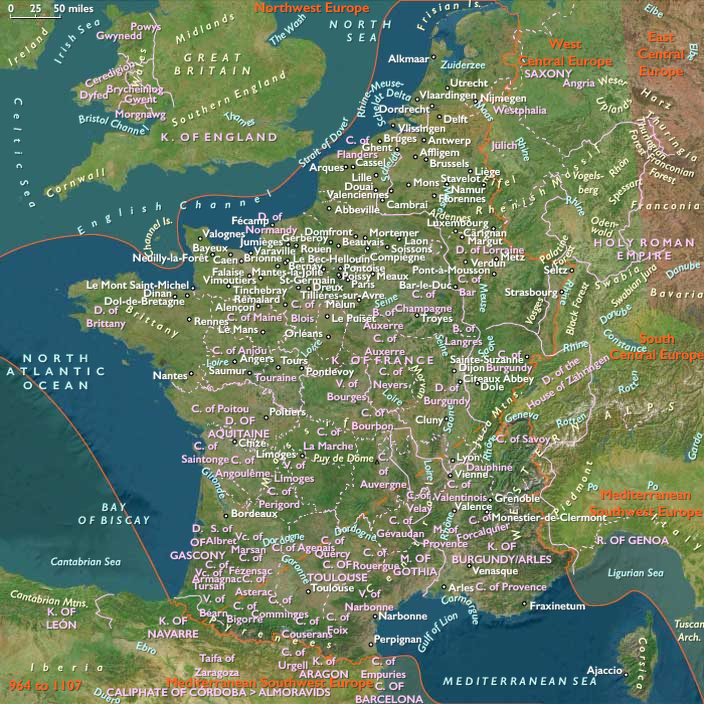
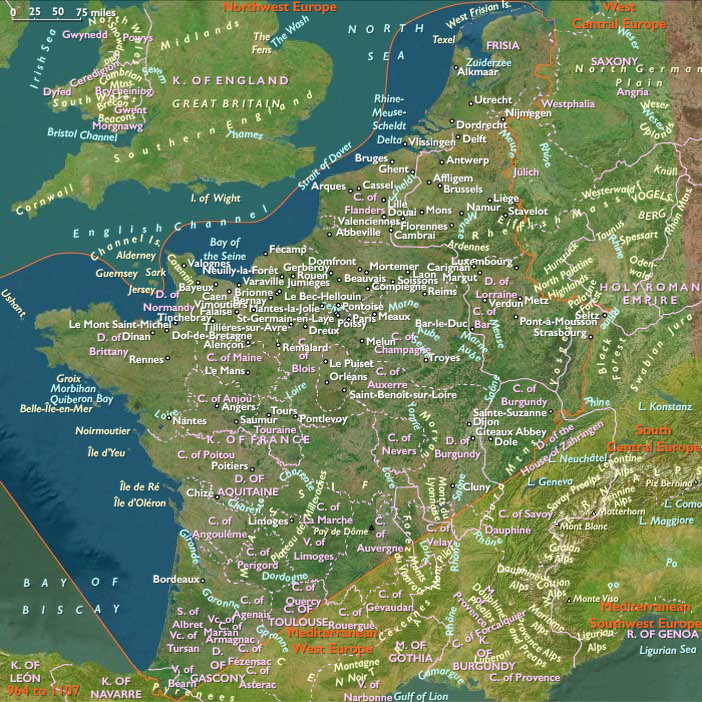
Following the death of Hugh IV of Maine in 1051, Geoffrey Martel, Count of Anjou, sought to expand his control over the county of Maine. His occupation of Le Mans, the county’s capital, brought him into direct conflict with Duke William of Normandy and King Henry I of France, leading to a complex three-way power struggle.
At the heart of this conflict was the strategically positioned Bellême family, whose holdings along the Maine–Normandy–Anjou frontier allowed them to manipulate their competing overlords and maintain de facto independence.
Geoffrey Martel’s Initial Success in Maine (1051–1052)
- Upon Hugh IV’s death, the citizens of Le Mans welcomed the Angevins, allowing Geoffrey Martel to occupy the city without resistance.
- Maine was of critical strategic importance, serving as a buffer state between Normandy, Anjou, and the French crown.
- Geoffrey’s expansion into Maine posed a serious threat to both Normandy and Capetian France, prompting William and King Henry to intervene.
The Role of the Bellême Family
- The Bellême family held key strongholds on the border of Maine and Normandy, including:
- Bellême, their ancestral seat, under the overlordship of the King of France.
- Domfort, under the overlordship of Geoffrey Martel of Anjou.
- Alençon, which was under William of Normandy’s suzerainty.
- Given their complex allegiances, the Bellêmes skillfully played their three overlords against one another, ensuring their own autonomy in the region.
- However, as the war over Maine escalated, they were eventually forced to align with one side—and William took advantage of this.
William and King Henry’s Counteroffensive (1052–1053)
- Recognizing the strategic necessity of preventing Angevin expansion, William and King Henry joined forces once more to expel Geoffrey Martel from Maine.
- In the course of their campaign, William was able to secure the Bellême family’s strongholds at Alençon and Domfort, reinforcing Norman influence on the Maine border.
- By asserting direct overlordship over the Bellême family, William eliminated a major source of instabilityand brought the key border fortresses firmly under Norman control.
Outcome and Aftermath
- Though William succeeded in taking key strongholds on the Maine–Normandy border, Geoffrey Martel retained effective control over most of the county of Maine.
- The conflict weakened Geoffrey Martel’s position, as he now had to contend with Norman expansion along his frontier while maintaining control of Maine’s rebellious nobility.
- The capture of Alençon and Domfort was a major victory for William, further consolidating Norman influence in the region and preparing the way for a future full-scale Norman invasion of Maine.
- The Bellême family, once an unpredictable force, was now compelled to act in Norman interests, removing a major source of instability on Normandy’s southern border.
Legacy and Significance
- The Norman-Angevin rivalry for Maine would continue for years, shaping the balance of power in northern France.
- William’s ability to gain control over the Bellême family strongholds demonstrated his growing influence and furthered his reputation as a military strategist.
- This victory solidified Normandy’s position as the dominant force in northern France, setting the stage for future campaigns into Maine and beyond.
Though Anjou still held much of Maine, William’s success in securing the Bellême fortresses and asserting control over key border regions was a critical step in his rise to power, proving his ability to outmaneuver rival lords and expand Norman authority.
Locations
People
Groups
- Breton people
- Anjou, County of
- Normandy, Duchy of
- Brittanny, Duchy of
- Normans
- France, (Capetian) Kingdom of
Commodoties
Subjects
Regions
Subregions
Related Events
Showing 10 events out of 10 total
Years: 1051 - 1051
Locations
People
Groups
- Breton people
- Anjou, County of
- Normandy, Duchy of
- Brittanny, Duchy of
- Normans
- France, (Capetian) Kingdom of
Commodoties
Subjects
Regions
Subregions