
Genoese privateers in 1197 occupy Corfu, an …
Years: 1197 - 1197
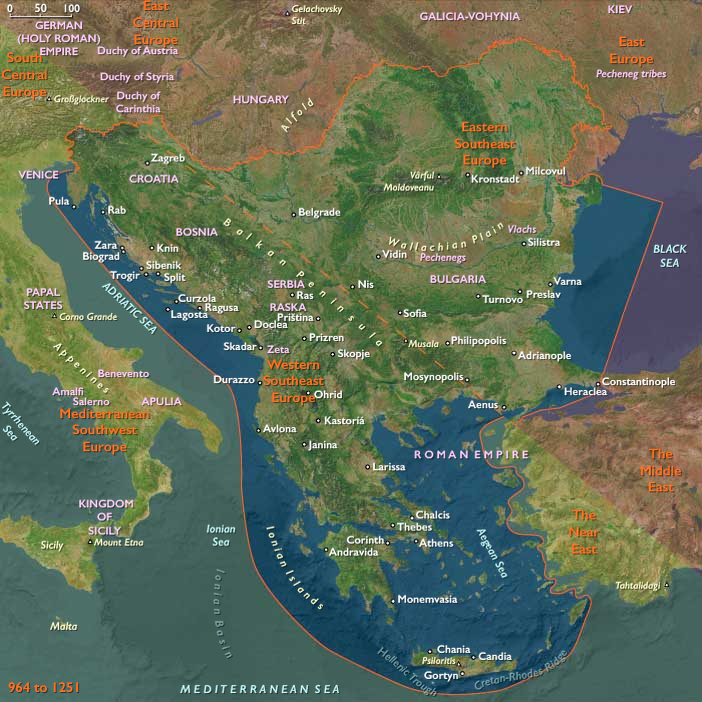
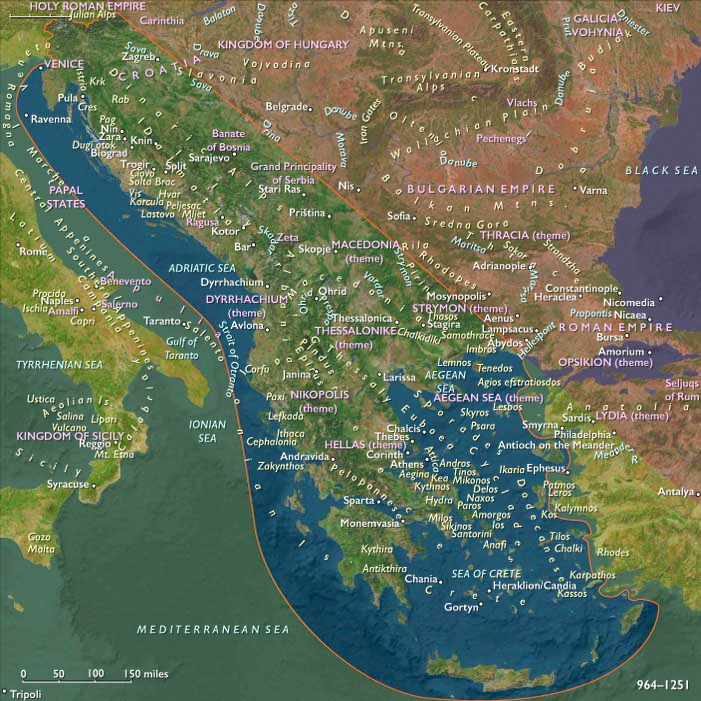
Genoese privateers in 1197 occupy Corfu, an imperial possession; they will hold the island for a decade before losing it to Venice.
Locations
Groups
- Slavs, South
- Greeks, Medieval (Byzantines)
- Genoa, (Most Serene) Republic of
- Italians (Latins)
- Venice, (Most Serene) Republic of
- Roman Empire, Eastern: Angelid dynasty
Commodoties
Subjects
Regions
Subregions
Related Events
Filter results
Showing 10 events out of 47739 total
Peter is killed by the boyars a year after he ascends the Bulgarian throne.
His younger brother Kaloyan is then crowned tsar.
The Pala Empire, which had eventually disintegrated in the twelfth century under the attack of the Sena dynasty, had been the last empire of India’s middle kingdoms whose capital was Patliputra (modern Patna).The Bihar region was largely in ruins when visited by Hsüan-tsang, the famous Buddhist monk from China, and had suffered further damage at the hands of Muslim raiders in the twelfth century.
With the advent of the foreign aggression and eventual foreign subjugation of India, Bihar passes through very uncertain times during the medieval period.
Muhammad of Ghor has attacked this region of the Indian subcontinent many times.
Muhammad’s armies have destroyed many Buddhist institutions, including the great Nalanda university.
The Buddhism of Magadha is finally swept away in 1197 by the Islamic invasion under Muhammad Bin Bakhtiyar Khilji, one of Qutb-ud-Din's generals, who destroys monasteries fortified by the Sena armies.
During this invasion, many of the viharas and the famed universities of Nalanda and Vikramshila are destroyed, and thousands of Buddhist monks are massacred.
The Kingdom of Jerusalem is now relatively secure, with its new capital at Acre, from which a narrow strip along the Mediterranean coast is ruled.
When the Muslims recaptured Jerusalem in 1187, the Hospitallers had removed their headquarters first to Margat and in 1197 to Acre.
Members continue to nurse the sick, guard the roads, and fight the Muslims.
On the accidental death of Henry of Champagne in 1197 (due to a fall from a first-floor window of his palace), Amalric succeeds to the throne of Jerusalem-Acre, accepting investiture as King Amalric II of Jerusalem from the chancellor of the Hohenstaufen emperor Henry VI.
A widower, Amalric is induced to marry Henry's widow, the thrice married, thrice widowed Queen Isabella I, because the emperor's German advisers are hoping to get the Latin kingdom of Jerusalem as a fief like Cyprus.
The outcome of the Battle of Alarcos had shaken the stability of the Kingdom of Castile; this situation will continue for several years.
All nearby castles had surrendered or been abandoned: Malagón, Benavente, Calatrava, Caracuel and Torre de Guadalferza, and the way to Toledo was wide open.
For the past two years, al-Mansur's forces have devastated Extremadura, the Tagus valley, La Mancha and even the area around Toledo; they have moved in turn against Montánchez, Trujillo, Plasencia, Talavera, Escalona and Maqueda.
Some of these expeditions had been led by the renegade Pedro Fernández de Castro.
Most significantly, however, these raids have not led to any territorial gains for the caliph, although Almohad diplomacy does obtain an alliance with King Alfonso IX of León (who had been enraged when the Castilian king had not waited for him before the battle of Alarcos) and the neutrality of Navarre.
These alliances prove to be temporary only.
The Excommunication of Alfonso IX and the End of the War Between Castile and León (1196–1197)
In 1196, as hostilities between Castile and León intensified, Pope Celestine III intervened in support of Castile, issuing a papal excommunication against King Alfonso IX of León. This act sought to pressure the Leonese monarch into ceasing his military campaigns against his cousin, Alfonso VIII of Castile.
Despite papal condemnation, Alfonso IX found allies among his nobility, including Pedro Fernández de Castro, a powerful noble who, along with other Leonese lords, had previously aided the Saracens against Castile. These nobles swore renewed oaths of loyalty to Alfonso IX, strengthening his position even as he faced ecclesiastical censure.
The Marriage of Alfonso IX and Berengaria of Castile (1197): A Diplomatic Resolution
The conflict between León and Castile came to an unexpected resolution in 1197, when Alfonso IX married Berengaria of Castile, daughter of Alfonso VIII of Castile. This strategic union brought peace between the rival kingdoms, as Berengaria’s dowry provided her husband with a legitimate claim to Castilian territory, effectively aligning their dynastic interests.
Although the marriage ended immediate hostilities, it soon faced papal opposition on the grounds of consanguinity, leading to further political and religious complications in the years to come.
Philip, the fifth and youngest son of Emperor Frederick I and Beatrice I, Countess of Burgundy, daughter of Renaud III, count of Burgundy, and brother of the emperor Henry VI, had entered the clergy, had been made provost of Aix-la-Chapelle, and in 1190 or 1191 had been chosen bishop of Würzburg.
Having accompanied his brother Henry to Italy in 1191, Philip had forsaken his ecclesiastical calling, and, traveling again to Italy, had been made duke of Tuscany in 1195 and received an extensive grant of lands.
In his retinue in Italy was the Minnesinger Bernger von Horheim.
Philip had become duke of Swabia on the death of his brother Conrad in 1196; in May 1197, he marries the Dowager Queen of Sicily, Irene Angelina, daughter of the Greek emperor Isaac II and widow of King Roger III of Sicily.
Irene had been captured on December 29, 1194, in the German invasion of Sicily.
In Germany, she is renamed Maria.
Her father, who had been deposed in 1195, urges her to get Philip's support for his reinstatement; her brother, Alexios, will subsequently spend some time at Philip's court during the preparations for the Fourth Crusade.
Henry VI is at this point the most powerful monarch in the Mediterranean and Europe, since the Kingdom of Sicily adds to his personal and imperial revenues an income without parallel in Europe.
Henry feels strong enough to send home the Pisan and Genoese ships without giving their governments the promised concessions in Southern Italy, and even forces Constantinople to collect a large tribute, which, however, is not paid before Henry's death.
He has secured his position in Italy, naming his friend Conrad of Urslingen as Duke of Spoleto and giving the Marche to Markward von Annweiler.
His next aim is to make the imperial crown hereditary.
At the Diet of Würzburg, held in April 1196, he had managed to convince the majority of the princes to vote for his proposal, but in the following one at Erfurt in October he had not achieved the same favorable result.
Emperor Henry VI is intent on dominating Constantinople’s beleaguered Empire and the East.
He is in southern Italy preparing a great expedition to Palestine, when a rebellion against his rule breaks out in the Sicilian kingdom; it is suppressed mercilessly by his German troops.
The thirty-two-year-old emperor dies of malaria on September 28, 1197, although it is also widely believed that he was poisoned.
His son Frederick II is to inherit both the Kingdom of Sicily and the Imperial crown.
The early years of Ottokar, a younger son of King Vladislav II of Bohemia, had passed amid the anarchy which prevailed everywhere in the country.
After several struggles in which he had taken part, he had been recognized as ruler of Bohemia by Holy Roman Emperor Henry VI in 1192.
He was, however, soon overthrown for joining a conspiracy of German princes to bring down the Hohenstaufen monarchy.
In 1197, Ottokar had forced his brother, Duke Vladislaus III Henry, to abandon Bohemia to him and to content himself with Moravia.
Taking advantage of the German civil war between the Hohenstaufen claimant Philip of Swabia and the Welf candidate Otto IV, Ottokar declares himself hereditary King of Bohemia in 1198.
This title is supported by Philip of Swabia, who needs Czech military support against Otto.
Constantinople and Venice patch up their relations again in 1198, but the Venetians remain embittered.
The Cilician state known as Lesser, or Little, Armenia, established in the eleventh century by Armenian nobles and their followers in flight from the Turks, attains the status of a kingdom in 1198.
The Armenians of Cilicia, who have allied themselves with the European crusaders, develop a culture strongly influenced by the West.
Years: 1197 - 1197
Locations
Groups
- Slavs, South
- Greeks, Medieval (Byzantines)
- Genoa, (Most Serene) Republic of
- Italians (Latins)
- Venice, (Most Serene) Republic of
- Roman Empire, Eastern: Angelid dynasty
