
The Eighth Crusade, a crusade launched by …
Years: 1264 - 1275
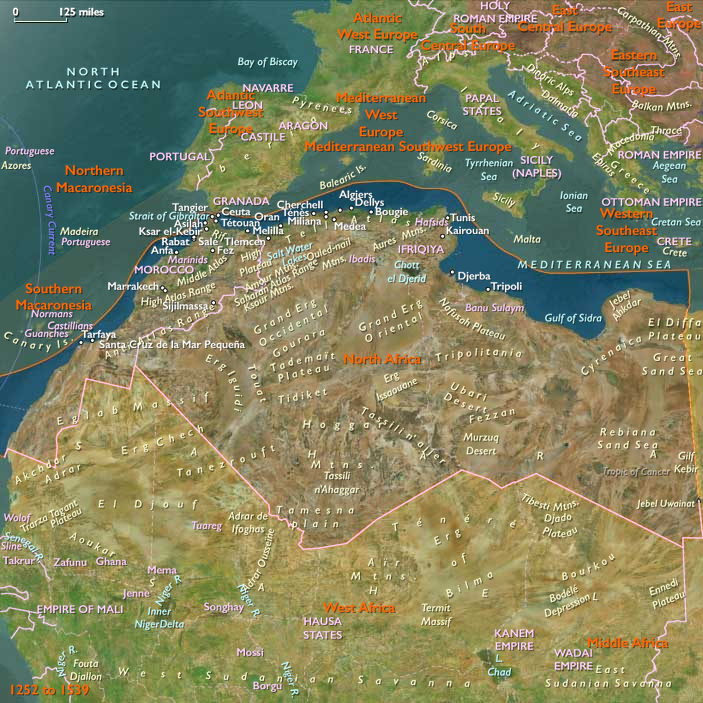
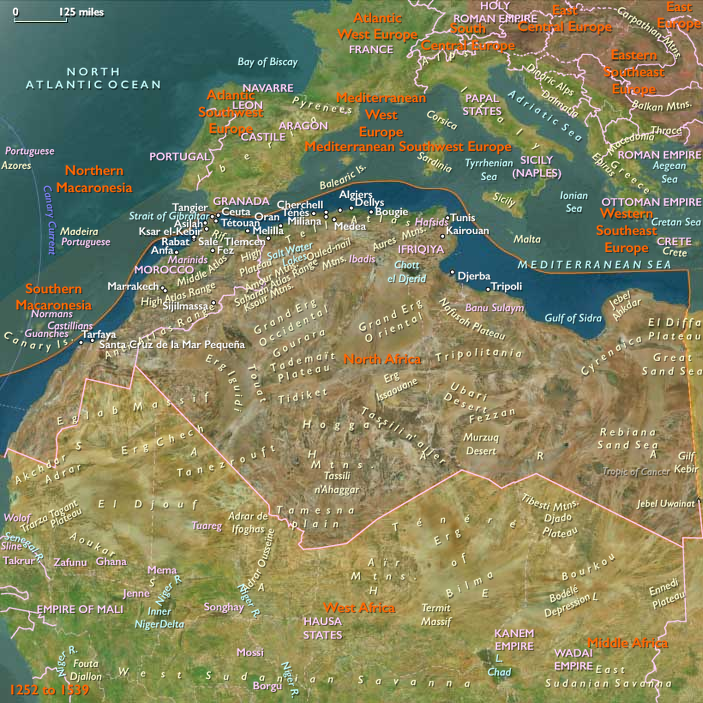
The Eighth Crusade, a crusade launched by Louis IX, King of France, in 1270, is sometimes counted as the Seventh, if the Fifth and Sixth Crusades of Frederick II are counted as a single crusade.
The failure of Louis IX of France to capture Tunis in the Eighth Crusade leads Prince Edward of England to sail to Acre in what is known as the Ninth Crusade, considered to be the last major medieval Crusade to the Holy Land, and sometimes also counted as part of the Eighth.
The Ninth Crusade fails largely because the Crusading spirit is nearly extinguished, and because of the growing power of the Mamluks in Egypt.
It also foreshadows the imminent collapse of the last remaining crusader strongholds along the Mediterranean coast.
People
Groups
- Muslims, Sunni
- French people (Latins)
- France, (Capetian) Kingdom of
- Christians, Roman Catholic
- England, (Plantagenet, Angevin) Kingdom of
- Ifriqiya, Hafsid (Banu Hafs) (first) Caliphate of
Topics
Subjects
Regions
Subregions
Related Events
Filter results
Showing 10 events out of 45902 total
A Korean rebellion against the Goryeo Dynasty occurs at the last stage of the Mongol invasions of Korea.
Although the Mongols have for decades ruled territories that include today's northern China, it is not until 1271 that Kublai Khan officially proclaims the Yuan dynasty in the traditional Chinese style.
His realm—the Great Yuan Empire—is by this point isolated from the other Mongol khanates and controls only most of present-day China and its surrounding areas including modern Mongolia.
It is the first foreign dynasty to rule all of China.
The southern Turkmen tribes, having weathered the Mongol invasions of the thirteenth century, become part of the Il-Khanid empire, and the northern Turkmen tribes belong to the Golden Horde.
Genoese power in the Black Sea is based on the republic’s alliance with the restored Roman Empire under the 1261 Treaty of Ninfeo.
Pera (modern Beyoglu), the Genoese independent suburb of Constantinople, will gradually outstrip the Greek capital in economic development, and Kaffa (modern Feodosiya) becomes the capital of a broad stretch of the Crimean coast ruled by the Genoese.
Many Aegean islands, including Thásos, Samothrace and Chios (given in fief to the Genoese family of Zaccaria), become independent Genoese principalities.
Much of Greece and the islands remain in French or Italian hands.
East Europe (1264–1275 CE): Strengthening Mongol Influence and Early Muscovite Growth
Political and Military Developments
Mongol Control and Local Governance
From 1264 to 1275 CE, the Golden Horde continued reinforcing its dominance over East European principalities, solidifying a governance system based on tributes and vassal relationships. Mongol administrative practices increasingly integrated with local governance structures.
Rise and Consolidation of Muscovite Authority
During this era, the principality of Moscow further solidified its position as a significant intermediary and administrative hub under Mongol oversight. Moscow's princes skillfully navigated Mongol politics, enhancing their local influence.
Economic and Technological Developments
Flourishing Eurasian Trade Networks
Trade between East Europe and broader Eurasian regions thrived, facilitated by the Pax Mongolica. Cities such as Moscow, Novgorod, and Vladimir prospered economically due to increased commerce, benefiting from access to luxury goods and commodities from the East.
Adoption of Mongol Military Innovations
Local principalities increasingly adopted Mongol military techniques, including sophisticated cavalry tactics and enhanced siege capabilities. These adaptations significantly improved Rus' military effectiveness and preparedness.
Cultural and Artistic Developments
Blending of Mongol and Rus' Artistic Traditions
Cultural exchanges continued to flourish, resulting in a rich synthesis of Mongol and local Rus' artistic styles. Architecture, decorative arts, and religious iconography reflected this unique cultural fusion.
Intellectual and Literary Preservation
Literary traditions persisted and grew, with chroniclers actively documenting historical events, genealogies, and religious texts. These intellectual efforts aimed at preserving Rus' heritage amidst foreign domination.
Settlement Patterns and Urban Development
Urban Growth and Stability
Cities under Mongol oversight experienced continued urban development, characterized by stable economic growth and increased population densities. Moscow, in particular, emerged prominently due to strategic political and economic positioning.
Expansion of Fortifications
Urban centers further enhanced their fortifications, responding to ongoing geopolitical threats and maintaining internal stability. The strengthening of defensive infrastructure was crucial for local governance and economic continuity.
Social and Religious Developments
Entrenchment of Local Aristocratic Power
Social hierarchies deepened as local aristocracies maintained and expanded their roles within the Mongol administrative structure. Aristocratic families leveraged their positions to consolidate power and influence.
Orthodox Church as Cultural Pillar
The Orthodox Church remained a cornerstone of social and cultural life, preserving religious traditions and providing stability amidst Mongol rule. The church’s influence extended into education, community organization, and cultural preservation.
Long-Term Consequences and Historical Significance
The period from 1264 to 1275 CE was significant in solidifying Mongol control and fostering Moscow's early growth. These developments profoundly influenced East Europe's subsequent political evolution, laying foundational structures for regional governance and cultural identity.
Northeast Europe (1264–1275 CE): Crusader Dominance, Baltic Resistance, and Regional Stabilization
Introduction
Between 1264 and 1275 CE, Northeast Europe witnessed the aftermath of significant uprisings, the further consolidation of crusader dominance, and persistent resistance from Baltic tribes. This era was characterized by the stabilization of Danish and German territories, renewed efforts by the Teutonic Knights to reassert authority in Prussia, and Sweden's continued expansion into Finland.
Aftermath of the Great Prussian Uprising
Following the dramatic peak of the Great Prussian Uprising, the Teutonic Knights began reasserting their control across the Prussian territories. The rebellion's suppression allowed the Knights to regain territories lost during earlier conflicts. They reinforced strongholds, notably Königsberg, consolidating their rule through aggressive military occupation, forced conversions, and the imposition of strict administrative structures.
Despite these advances, Prussian clans maintained sporadic resistance and conducted guerrilla operations, highlighting persistent tensions and the deep-seated resistance of local populations to Teutonic dominance.
Consolidation of Danish Estonia and the Livonian Confederation
Danish rule in Estonia continued to stabilize under the administration centered at Reval (Tallinn), marked by increased economic prosperity and urban growth. The fortress Castrum Danorum on Toompea Hill symbolized Danish sovereignty and facilitated tighter control over the region.
Similarly, the Livonian Confederation, anchored by the strategic city of Riga, experienced growing economic stability and political maturity. German ecclesiastical and secular authorities coordinated effectively, enabling steady governance despite occasional resistance from local populations.
Swedish Influence and Finnish Integration
Sweden sustained its colonization and missionary expansion into southern Finland, bolstering settlement infrastructure and ecclesiastical establishments. The Swedish crown increasingly integrated these Finnish territories administratively and culturally into the Scandinavian sphere, deepening the cultural division between Finnish regions and their Baltic neighbors.
Persistent Baltic Resistance and Lithuanian Ascendancy
Baltic resistance remained resilient despite increased pressure from crusader states. Tribes such as the Curonians, Semigallians, and especially the increasingly powerful Lithuanians mounted continuous opposition. Lithuania emerged as a formidable regional power, successfully resisting repeated crusader incursions and laying foundations for an independent, centralized state capable of opposing crusader advances.
Economic Prosperity and Urban Development
Economic growth flourished across crusader-held territories. Cities such as Reval (Tallinn), Riga, and Königsberg expanded as vital commercial and administrative hubs. Trade with the rest of Europe intensified, with Visby on Gotland continuing to prosper as a crucial maritime trading center, connecting the Baltic to wider European markets.
Ecclesiastical Authority and Cultural Consolidation
Ecclesiastical institutions, particularly the Teutonic Order, continued to embed their presence throughout Northeast Europe. Monastic communities and diocesan authorities fostered cultural integration, imposed Christian doctrine, and managed educational institutions, deeply influencing the social and cultural fabric of the region.
Emerging Geopolitical Tensions
This era saw increasing tensions between crusader states and regional powers, notably Lithuania and various Russian principalities. Borders became increasingly militarized, reflecting growing mutual distrust. These tensions set the stage for ongoing regional conflicts and shifting alliances, shaping Northeast Europe's geopolitical landscape for decades to come.
Legacy of the Era
The years 1264–1275 CE were a critical period in Northeast Europe's development. The suppression of Baltic uprisings, consolidation of crusader control, and the sustained emergence of Lithuania as a regional power profoundly influenced the political, cultural, and economic landscape. These developments shaped enduring historical patterns, setting the stage for future interactions, conflicts, and cultural exchanges in Northeast Europe.
East Central Europe (1264–1275 CE): Bohemian Dominance under Ottokar II, War of the Thuringian Succession, Hungarian Instability, Polish Fragmentation, and Austrian Consolidation
Between 1264 and 1275 CE, East Central Europe—encompassing modern-day Poland, Czechia, Slovakia, Hungary, and eastern parts of Germany and Austria east of 10°E and north of the defined southeastern boundary—experienced pivotal transformations. Characterized by significant territorial expansions of Bohemia under Ottokar II Přemysl, the turbulent War of the Thuringian Succession, continued internal instability in Hungary, persistent Polish fragmentation, and consolidation in Austrian lands, this era reshaped regional power dynamics. The influence of prominent duchies and principalities, notably in Silesia, Bavaria, Styria, Carinthia, and Mecklenburg, further defined regional politics.
Political and Military Developments
Bohemian Dominance under Ottokar II Přemysl
-
King Ottokar II Přemysl (r. 1253–1278) of Bohemia reached his territorial zenith, dominating Austria, Styria, and Carinthia. By 1270, his control extended significantly across Central Europe, bringing these lands under strong Přemyslid influence.
-
Ottokar’s assertive policies increasingly alarmed regional competitors, particularly the emerging Habsburg interests and neighboring duchies, laying foundations for future conflicts within the Holy Roman Empire.
War of the Thuringian Succession (1247–1264)
-
The protracted War of the Thuringian Succession, concluding in 1264, significantly reshaped political dynamics in eastern Germany. Following the extinction of the Ludovingian line, the conflict primarily involved the Houses of Wettin, Brabant, and Hesse, drastically realigning power structures in Thuringia.
-
By the war’s end, Thuringia largely fell under Wettin control, solidifying their authority and expanding their influence significantly within the eastern German territories.
Hungarian Aristocratic Conflicts under Béla IV and Stephen V
-
Hungary grappled with intense internal feudal strife. King Béla IV (d. 1270) faced persistent challenges from powerful aristocrats and from his son Stephen V (r. 1270–1272), whose brief reign perpetuated feudal fragmentation, undermining central royal authority.
-
The resultant weakening of Hungarian unity created vulnerabilities, exploited notably by Ottokar II and competing regional powers.
Polish Fragmentation and the Silesian Principalities
-
Poland remained politically fragmented into competing duchies, prominently in Silesia. Duchies such as Legnica (Leignitz), Wohlau, and Wrocław, under local Piast princes, continued developing independently, fostering regional prosperity despite persistent political divisions.
-
In southeastern Poland, the principality of Galicia-Volhynia solidified its autonomy, navigating diplomatically between regional powers, including Hungary, Bohemia, and Mongol-influenced Rus territories.
Austrian Consolidation under Přemyslid Rule
-
Austria solidified economically and politically under Bohemian authority. Přemyslid governance notably strengthened Vienna as an essential economic and administrative hub within the Holy Roman Empire.
Expansion and Consolidation in Brandenburg and Mecklenburg
-
The Margraviate of Brandenburg, under the House of Ascania, intensified its eastward territorial expansion, deeply embedding German settlement patterns (Ostsiedlung) in former Slavic territories.
-
The emerging Duchy of Mecklenburg, benefiting from economic integration with Hanseatic trade routes, solidified regional influence, setting foundations for future regional prominence.
Economic and Technological Developments
Flourishing Commerce and Hanseatic Trade
-
Economic prosperity continued through expanding trade networks connecting the Baltic region, Western Europe, and the Mediterranean. Key cities, notably Lübeck, Rostock, Toruń, and Gdańsk, prospered as critical centers of Hanseatic commerce.
-
Urban centers experienced significant economic and infrastructural growth, driven by intensified regional and long-distance trade.
Agricultural Productivity and Technological Advancements
-
Agricultural practices advanced notably, with improved plows, extensive use of crop rotation, and better livestock management. These innovations enhanced productivity, supporting population growth and urban expansion throughout East Central Europe.
Cultural and Artistic Developments
Bohemian and Austrian Cultural Flourishing
-
Under Ottokar II, Prague and Vienna emerged as significant cultural and intellectual centers, promoting Gothic architecture, illuminated manuscripts, and vibrant courtly culture.
-
The Přemyslid court actively patronized scholars and artists, elevating regional cultural prominence.
Polish and Silesian Regional Artistic Vitality
-
Despite political fragmentation, the Polish duchies, particularly in Silesia, maintained distinct regional cultural identities through vibrant monastic manuscript production, ecclesiastical architecture, and artistic patronage.
Hungarian Ecclesiastical Patronage
-
Hungarian instability contrasted notably with sustained cultural achievements fostered by ecclesiastical institutions, notably in Esztergom and Kalocsa, preserving continuity in artistic and religious traditions.
Settlement and Urban Development
Urban Expansion and Fortifications
-
Ottokar II significantly expanded urban infrastructure, particularly in Vienna and Prague, reinforcing their roles as major political and economic hubs. Towns throughout Austria, Styria, and Carinthia similarly benefited from Přemyslid governance and investment.
-
Polish duchies, notably in Silesia, continued urban expansion through the granting of town charters, facilitating regional economic prosperity and stability despite fragmented political authority.
Germanic Colonization (Ostsiedlung)
-
Significant Germanic eastward migration continued, profoundly shaping settlement patterns, urbanization, and economic life in Brandenburg, Mecklenburg, Lusatia, and Silesian regions, reinforcing demographic shifts and economic integration.
Social and Religious Developments
Ecclesiastical Influence and Institutions
-
Ecclesiastical institutions, including the Archbishopric of Salzburg and the bishoprics of Passau, Regensburg, and Bamberg, expanded regional influence through administrative, educational, economic, and cultural activities.
-
The Church significantly shaped regional governance and social identity, reinforcing Latin Christian cultural cohesion.
Aristocratic Consolidation and Feudal Structures
-
Aristocratic power strengthened across the region, especially in Hungary, Bohemia, Silesia, and Thuringia. The conclusion of the War of the Thuringian Succession significantly elevated aristocratic dominance in Thuringia, influencing feudal governance structures and political alliances throughout eastern Germany.
Long-Term Consequences and Historical Significance
The era 1264–1275 CE marked critical realignments in East Central Europe. The peak of Bohemian territorial dominance under Ottokar II reshaped regional geopolitics significantly. The resolution of the Thuringian Succession War realigned power in eastern Germany, strengthening the Wettin position in Thuringia. Hungarian internal conflicts undermined centralized royal authority, creating vulnerabilities exploited by neighboring powers. Continued Polish fragmentation fostered enduring regional identities. Economic prosperity accelerated through intensified trade and Germanic settlement, notably in Brandenburg and Mecklenburg, significantly influencing the region’s medieval trajecto
The Great Interregnum ends with the unanimous election of Rudolph I of Habsburg, a minor pro-Staufen count, as German king at Frankfurt.
A son of Austria’s Albert IV, Count of Habsburg, Rudolph cements his conquest of the ambitious Ottokar of Bohemia through strategic marriage contracts for his children, and grants his son Albrecht (Albert) the duchies of Austria and Styria, making these possessions hereditary fiefs that will constitute the territorial nucleus of the future Habsburg power.
Eastern Southeast Europe (1264–1275 CE): Byzantine Consolidation and Bulgarian Fragmentation
Settlement and Migration Patterns
Byzantine Stabilization and Territorial Consolidation
Following the recapture of Constantinople from Latin rule in 1261, Emperor Michael VIII Palaiologos (r. 1259–1282) continued stabilizing the restored Byzantine Empire, reinforcing control over urban and strategic locations across Thrace. The reestablishment of Byzantine authority encouraged moderate population growth and the stabilization of settlements within the region.
Bulgarian Fragmentation and Regional Instability
Bulgaria, weakened by internal boyar rivalries and fragmented leadership after Ivan Asen II, saw ongoing internal migrations and shifts in population distribution, as communities aligned themselves with competing local powers, further weakening the centralized authority of the Second Bulgarian Empire.
Political Dynamics and Regional Rivalries
Diplomatic Balancing by Byzantium
Michael VIII undertook careful diplomatic maneuvers, notably with maritime republics like Venice and Genoa, managing alliances and rivalries to secure economic and political stability. These relations were critical in strengthening the empire's position following the Latin period.
Bulgarian Political Decentralization
Intensifying divisions among Bulgarian nobles undermined the empire's cohesion. Various regional lords asserted greater autonomy, creating fragmented political entities susceptible to external interference from both Byzantine and Hungarian interests.
Economic and Technological Developments
Byzantine Economic Revival
Economic activities within the restored Byzantine Empire gradually revived, benefiting from enhanced trade routes facilitated by alliances with Italian city-states, particularly Genoa, which dominated commerce in the Black Sea region. Commercial recovery bolstered cities such as Constantinople and Adrianople as key economic centers.
Bulgarian Economic Difficulties
Continued internal instability impeded Bulgarian economic prosperity. Although trade persisted, especially with Italian merchants, political fragmentation restricted centralized economic policies, causing trade and commerce to become increasingly regionalized.
Cultural and Artistic Developments
Revival of Byzantine Culture
The era witnessed a Byzantine cultural renaissance under Michael VIII’s patronage, emphasizing restoration and new artistic expressions. Manuscript illumination, religious iconography, and monumental architecture flourished, reflecting renewed imperial pride and Orthodox identity.
Bulgarian Cultural Resilience
Despite political disruptions, Bulgaria maintained significant cultural vitality. Turnovo remained a critical cultural hub, continuing traditions in religious architecture, manuscript production, and literature, affirming a resilient Bulgarian identity amid political turmoil.
Social and Religious Developments
Strengthening of Orthodox Institutions
Orthodox Christianity remained central to regional society, providing stability and continuity. The Byzantine Orthodox Church, closely tied to imperial authority, and the Bulgarian Orthodox Patriarchate sustained their influential roles, stabilizing social and religious cohesion across their respective territories.
Ecclesiastical Diplomacy
Byzantine authorities actively navigated ecclesiastical diplomacy, particularly addressing tensions between Orthodox traditions and lingering Latin influences. These diplomatic efforts influenced internal religious dynamics and relations with Western powers.
Long-Term Consequences and Historical Significance
The period from 1264 to 1275 CE marked an essential phase of Byzantine territorial consolidation, cultural renaissance, and ongoing Bulgarian political fragmentation. The era set the stage for subsequent political and cultural dynamics, particularly the intensifying rivalries among Byzantium, Bulgaria, and emerging regional powers, thereby significantly influencing the historical trajectory of Eastern Southeast Europe.
The Middle East: 1264–1275 CE
Mongol Consolidation and the Il-Khanate
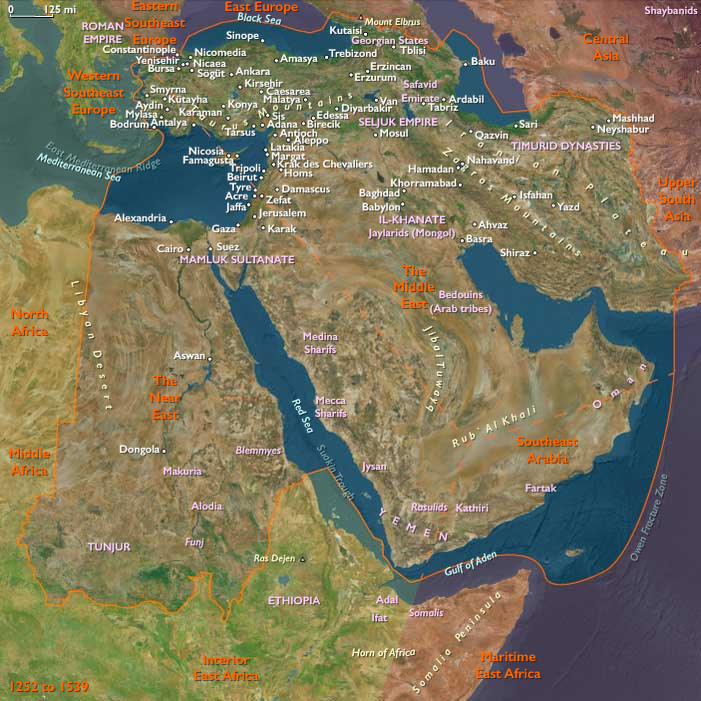
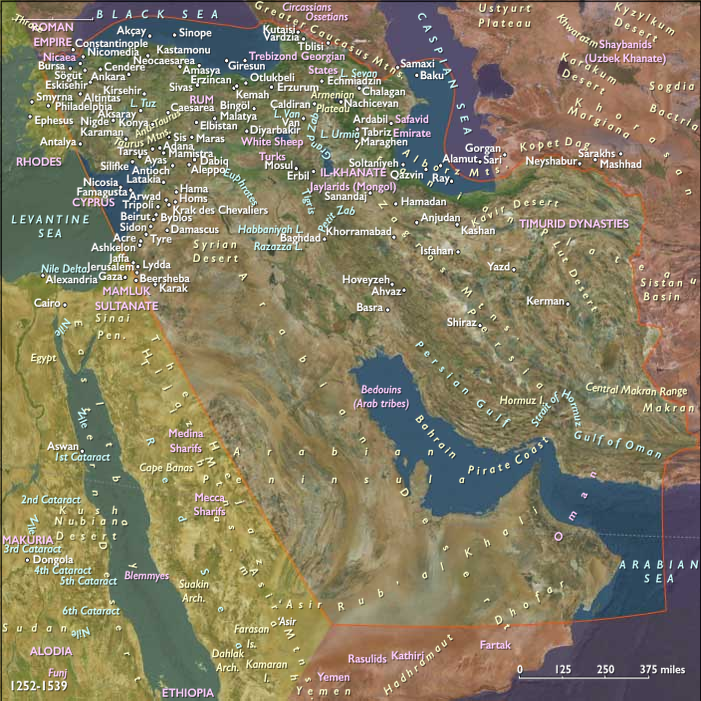
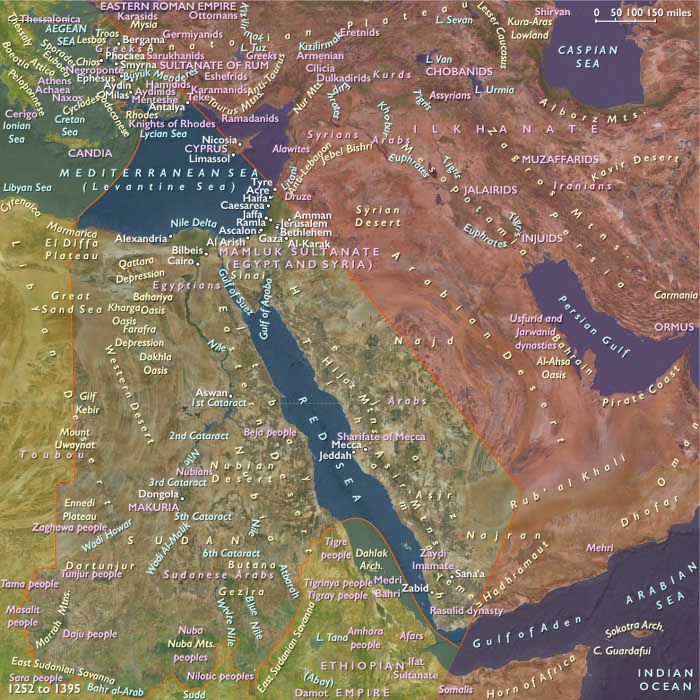
In the aftermath of the Mongol conquest of Baghdad, the Middle East from Iran through Mesopotamia continues to feel the heavy hand of Mongol rule. Hulagu Khan, who had established the Mongol Il-Khanate in Persia and Mesopotamia, dies in 1265, leading to a brief period of instability. His successor, Abaqa Khan (1265–1282), solidifies control over the vast territory stretching from eastern Anatolia to Afghanistan. Under his rule, the Il-Khanate remains closely aligned with Mongol interests in China and Central Asia, though it increasingly adopts Persian administrative traditions.
Fragmentation and Local Dynasties in Anatolia
In Anatolia, the weakened Seljuq Sultanate of Rûm, now effectively a vassal to the Il-Khanate, sees its territories further fragmented as local Turkish beyliks assert independence. Among these emerging states, the Karamanids, based in southern Anatolia, rise prominently. This fragmentation signals the decline of centralized authority and foreshadows the eventual emergence of Ottoman power later in the region.
The Mamluk Response in the Levant
Facing the ongoing Mongol threat, the Mamluk Sultanate in Egypt and Syria consolidates its power under the formidable leadership of Sultan Baibars I (1260–1277). Baibars skillfully fortifies his realm, restoring significant fortifications across Syria and Palestine and reorganizing the army. In 1268, he captures Antioch, extinguishing the crusader Principality of Antioch, significantly altering the balance of power in the Levant.
Cultural Flourishing Under Turmoil
Despite ongoing military and political turmoil, Persian culture continues its remarkable productivity. Rumi, the eminent Persian poet and mystic residing in Anatolia, dies in 1273 in Konya, leaving behind the extensive poetic collection known as the Masnavi, considered one of the greatest spiritual masterpieces of Islamic literature. His death marks a cultural high point, influencing Sufism profoundly across the Muslim world.
Crusader Decline and the Fall of Antioch
The Crusader states in the Levant, weakened by internal divisions and external threats, suffer critical setbacks. The fall of Antioch to Baybars marks a significant turning point, dramatically shrinking the territorial extent of the Crusader presence. The remaining strongholds, such as Acre and Tripoli, become increasingly isolated and vulnerable, with the Knights Hospitaller continuing a desperate defensive strategy from their fortified castles.
Byzantine Restoration of Constantinople
In a remarkable reversal of fortune in 1261, the exiled Byzantine Empire in Nicaea, under Michael VIII Palaiologos, recaptures Constantinople from the Latin Empire. This restoration revitalizes the East Roman (Byzantine) presence in the region, but the empire remains surrounded by hostile forces—the Turks in Anatolia and the Latins in the Mediterranean. Michael VIII, seeking stability, attempts diplomatic outreach to Western powers and initiates military reforms to secure his restored capital.
This era (1264–1275 CE) thus marks a significant transitional period in Middle Eastern history, characterized by Mongol consolidation, the strengthening of Mamluk power, the profound cultural influence of Persian mysticism, a dramatic decline of Crusader power, and a notable resurgence of Byzantine authority in Constantinople.
The Karanga rulers of Great Zimbabwe barter ivory, as well as copper and gold from mines under their control, with traders from the east African coast, trading in such goods as fine metal ornaments of African manufacture as well as imported glass beads and Chinese porcelain.
Years: 1264 - 1275
People
Groups
- Muslims, Sunni
- French people (Latins)
- France, (Capetian) Kingdom of
- Christians, Roman Catholic
- England, (Plantagenet, Angevin) Kingdom of
- Ifriqiya, Hafsid (Banu Hafs) (first) Caliphate of
Topics
Subjects
Regions
Subregions