Geng Gong, one of the deputies of …
Years: 75 - 75
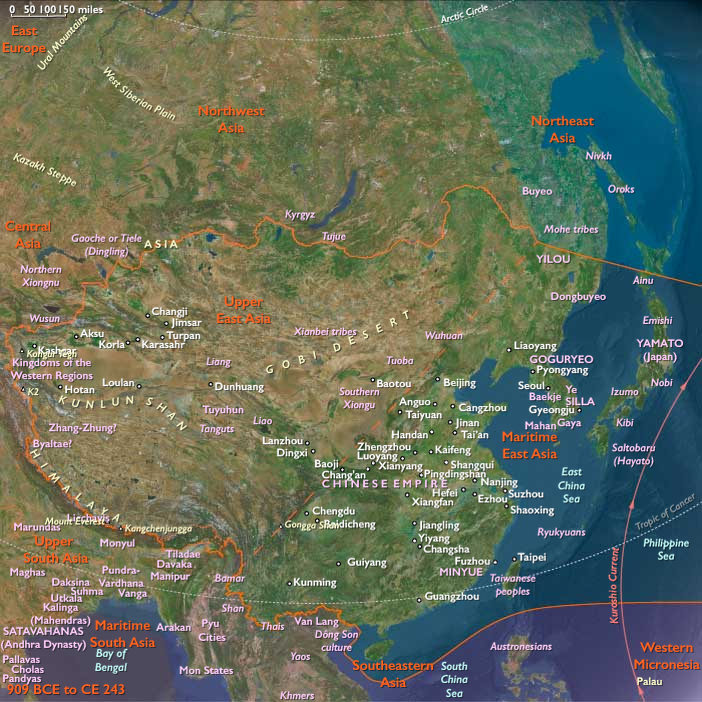
Geng Gong, one of the deputies of the protector general, repels a Northern Xiongnu expedition in 75 to recapture Cheshi.
Locations
People
Groups
Topics
Commodoties
Subjects
Regions
Subregions
Related Events
Filter results
Showing 10 events out of 61560 total
Emperor Ming dies in 75.
His will orders that no temple be built for him, and that he only be worshiped as part of the worship of his mother Empress Dowager Yin. (This is to become a systematic reform that the rest of the Eastern Han Dynasty emperors largely follow; they do not have separate temples built for themselves, but instead are worshiped along with Emperor Guangwu. This represents a major economy when compared to the Western Han system of building a separate temple for each emperor.)
His son Crown Prince Da succeeds to the throne as Emperor Zhang.
The garrison at Hami is withdrawn in 75 after allies of the Xiongnu in Karasahr and Kucha kill the new Protector General of the Western Regions Chen Mu.
Joseph ben Matthias, through the patronage of Vespasian, becomes a Roman citizen and changes his name to Flavius Josephus.
In 75, Josephus begins work on a firsthand account of the tragic events of the Jewish revolt.
The Jewish War, a description of Jewish history from the capture of Jerusalem by the Seleucid ruler Antiochus IV Epiphanes in 164 BCE to the fall and destruction of Jerusalem in the First Jewish–Roman War in CE 70, is an invaluable, if biased, eyewitness history of the failed rebellion.
The book was written originally in Josephus's "paternal tongue", probably Aramaic, though this version has not survived.
It will later be translated into Greek, probably under the supervision of Josephus himself.
During the Jewish war, Titus had begun a love affair with Berenice, sister of Agrippa II.
The Herodians had collaborated with the Romans during the rebellion, and Berenice herself had supported Vespasian upon his campaign to become emperor.
In 75, she returns to Titus and openly lives with him in the palace as his promised wife.
The Romans are wary of the Eastern Queen and disapprove of their relationship.
When the pair is publicly denounced by Cynics in the theater, Titus caves in to the pressure and sends her away, but his reputation further suffers.
Between 71 and 79, much of Vespasian's reign is a mystery.
Historians report that Vespasian ordered the construction of several buildings in Rome.
Additionally, he survived several conspiracies against him.
Vespasian has helped rebuild Rome after the civil war, adding the temple of Peace and the temple to the Deified Claudius.
In 75, he erects a colossal statue of Apollo, begun under Nero, and he dedicates a stage of the theater of Marcellus.
He also begins construction of the Flavian Amphitheater, situated between the Esquiline and Palatine hills, near the southeast end of the Forum.
The structure is popularly called the Colosseum because it stands next to a colossal one hundred and twenty foot- (37.2 meter-) high statue (now demolished) of Nero.
Vespasian also begins rebuilding the temple on the Capitoline Hill, destroyed—for the second time—in the civil strife of 69.

Isca Augusta (or Isca Silurum) becomes the headquarters of the Legio II Augusta in about CE 75, when Frontinus begins the conquest of Roman Wales.
They build a large "playing-card" shaped fort with initially a timber palisade which is later replaced in stone.
The interior is fitted out with the usual array of military buildings: a headquarters building, legate's residence, tribunes' houses, hospital, large bath house, workshops, barrack blocks, granaries and an amphitheater.
Frontinus extends Roman rule to all of South Wales, initiating exploitation of the mineral resources and constructing a network of smaller forts fifteen to twenty kilometers apart for his auxiliary units.
One of these forts would have been Luentinum, which controls the gold mines of Dolaucothi, worked by numerous aqueducts.
Vespasian’s Stabilization and Expansion of the Roman Empire (69–79 CE)
Following the chaos of the Year of the Four Emperors (69 CE), Emperor Vespasian (r. 69–79 CE) worked to stabilize and strengthen the Roman Empire through shrewd foreign policies and military expansion. His rule marked a return to stability, reinforcing imperial authority and securing Rome’s frontiers.
Romanization and Citizenship Policies
- Vespasian expanded Roman influence by granting citizenship to select towns, accelerating the Romanization of provincials.
- He focused on integrating conquered peoples into the empire, reinforcing local loyalty and economic stability.
- This policy helped transform Roman provinces into more stable and productive regions, ensuring long-term imperial cohesion.
Territorial Expansion and Military Campaigns
Vespasian’s reign saw several significant territorial expansions across the empire:
1. New Territories in Anatolia and Germany
- Vespasian annexed parts of Anatolia (modern Turkey), expanding Rome’s influence in the east.
- In Germany, he strengthened Roman control, securing the Rhine frontier and consolidating the province of Germania Superior.
2. Reinforcing Roman Rule in Britannia
- Vespasian reinforced Roman control in Wales, completing the conquest of the Silures and Ordovices.
- His governors launched new campaigns into Scotland, extending Rome’s northern frontier beyond the Hadrianic and Antonine Walls in later years.
- His policies laid the foundation for the later full-scale invasions of Caledonia (Scotland) under Agricola (78–84 CE).
Legacy of Vespasian’s Foreign Policy
- His pragmatic approach to provincial governance ensured loyalty and stability across the empire.
- His military expansions strengthened Rome’s borders, reducing the threat from external enemies.
- By the time of his death in 79 CE, Vespasian had restored order and set the stage for the stable rule of the Flavian dynasty, allowing Rome to thrive for another century.
Through careful diplomacy, military conquests, and Romanization, Vespasian solidified the empire’s dominance, ensuring Rome’s continued expansion and internal security.
Domitian's Dacian War is a conflict between the Roman Empire and the Dacian Kingdom, which has invaded the province of Moesia.
The war occurs during the reign of the Roman emperor Domitian, in the years 86–88.
The Middle East: 76–87 CE
Religious Foundations and Parthian Dynastic Changes
This era sees important developments in the religious and political realms of the Middle East, underscored by the formation of key religious texts and dynastic shifts within the Parthian Empire.
The Gospel of Matthew and Early Christianity
Around 80 CE (though scholarly estimates range between 65 and 100 CE), the Gospel According to Matthew is composed. Traditionally attributed to the Apostle Matthew, contemporary scholarship generally suggests that a later disciple or a collective school of followers authored the Gospel, incorporating earlier sources and teachings.
Despite appearing first in canonical order, the Gospel of Matthew is likely not the earliest Gospel. Its composition borrows significantly from the Gospel According to Mark, arranging teachings and narrative around Mark’s established outline. It also integrates material from a hypothetical source known to scholars as “Q” (from the German Quelle, meaning “source”), thought primarily to contain sayings attributed to Jesus and shared also with the Gospel of Luke.
Matthew uniquely details the birth narrative of Jesus, organizes the influential Sermon on the Mount, and offers distinctive eschatological teachings. It emphasizes Jesus as fulfilling Jewish messianic prophecy, particularly portraying him as both a kingly figure and a profound teacher of righteousness. Structured into five thematic discourses interwoven into Mark’s narrative framework, Matthew’s Gospel is characterized by a strong emphasis on law, righteousness, and Jewish tradition, clearly aimed at a predominantly Jewish audience—likely residing in Palestine or Syria.
Parthian Dynastic Transition: From Vologases to Pacorus
In the Parthian Empire, significant dynastic changes occur around 78 CE with the death of King Vologases I, a ruler celebrated for his revival of Persian traditions and Zoroastrianism. His brief successor, Vologases II, about whom very little historical detail survives, reigns for approximately three years before being overthrown by his uncle, Pacorus II (ca. 78–105 CE).
The ascension of Pacorus II marks a period of relative stability following initial dynastic upheaval. Although precise details of his reign are scarce, Pacorus II manages to secure power, ruling Parthia for nearly three decades, thereby providing continuity and stability after a brief period of internal unrest.
Thus, the era 76–87 CE witnesses foundational developments in early Christianity through the influential Gospel According to Matthew, alongside notable political transitions within the Parthian Empire, reflecting broader cultural and political realignments across the region.
The Gospel According to Matthew is written about 80 (although various scholars argue for dates as early as 65 and as late as 100.
Authorship is traditionally ascribed to the Apostle Matthew, but modern scholars, while acknowledging Matthew as a source, argue that a disciple or school of disciples were responsible for its present form).
Matthew, the opening book of the New Testament of the Bible (but, although first in canonical order, probably not the earliest Gospel) borrows heavily from the “Gospel According to Mark” shaping material from other sources around Mark's narrative outline. (One such source, commonly called “Q”—from the German quelle, "source"—and thought to have consisted primarily of sayings of Jesus, is also used by the Gospel According to Luke.)
The Gospel of Matthew is unique in relating the birth of Jesus, the arrangement of the Sermon on the Mount, and Jesus' eschatological utterances.
Matthew portrays Jesus as the fulfillment of the messianic prophecy, particularly in the role of king, and the teacher of the way of righteousness.
The most topical of the Synoptic Gospels, Matthew assembles the teachings and sayings of Jesus into five thematic discourses structured around Mark's narrative framework.
A summary statement follows each discourse, and a prologue and epilogue are added.
With its emphasis on law, teaching, and righteousness, Matthew is presumably addressed to a predominantly Jewish audience, most likely in Palestine or Syria.
Vologases dies in about 78 and is succeeded by his son Vologases II, about whom little is known.
It seems that Vologases II, ruling for at most three years, is defeated and deposed by his uncle, Pacorus II (ruled from about 78 to 105).