
Paul Gauguin, increasingly disgusted with the rising …
Years: 1901 - 1901
Paul Gauguin, increasingly disgusted with the rising Western influence in Tahiti again seeks a more remote environment, this time on the island of Hiva Oa in the Marquesas, where he moves in September 1901.
He purchases land here and, with the help of his neighbors, he builds a home that he calls “the house of pleasure”.
Conceived as a total work of art decorated with elaborately carved friezes, the house is possibly inspired by Maori works he had seen in Auckland, New Zealand.
Gauguin had earlier written a travelogue (first published 1901) titled Noa Noa, originally conceived as commentary on his paintings and describing his experiences in Tahiti.
Modern critics will suggest that the contents of the book were in part fantasized and plagiarized.
In it he reveals that he had in 1891 taken a thirteen-year-old girl as native wife or vahine (the Tahitian word for "woman"), a marriage contracted in the course of a single afternoon.
This was Teha'amana, called Tehura in the travelogue, who was pregnant by him by the end of summer 1892.
Teha'amana is the subject of several of Gauguin's paintings, including Merahi metua no Tehamana and the celebrated Spirit of the Dead Watching, as well as a notable woodcarving Tehura now in the Musée d'Orsay.
By the end of July 1893, Gauguin had decided to leave Tahiti and he would never see Teha'amana or her child again even after returning to the island several years later.
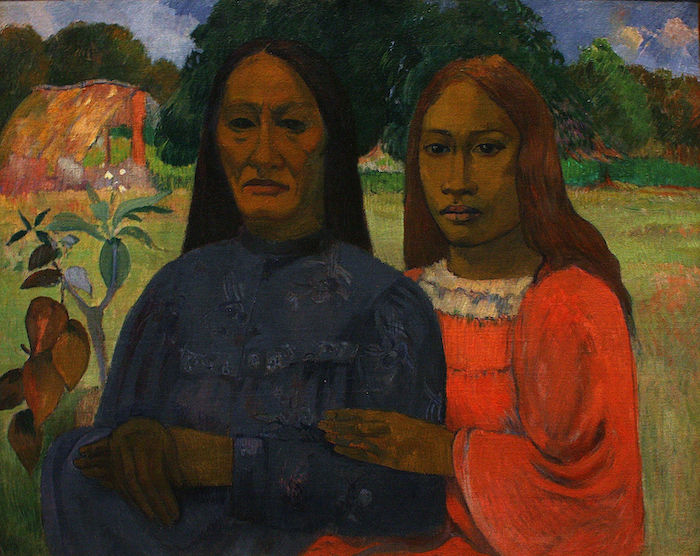
Paul Gauguin: Two Women (1901 or 1902); oil on canvas 73.7 cm (29 in) x 92.1 cm (36.2 in). Metropolitan Museum of Art
Locations
People
Groups
Topics
Subjects
Regions
Subregions
Related Events
Showing 10 events out of 8723 total
Years: 1901 - 1901
Paul Gauguin: Two Women (1901 or 1902); oil on canvas 73.7 cm (29 in) x 92.1 cm (36.2 in). Metropolitan Museum of Art
Locations
People
Groups
Topics
Subjects
Regions
Subregions