
Filters:
Gauguin, disappointed by the extent to which …
Years: 1892 - 1892
Gauguin, disappointed by the extent to which French colonization has actually corrupted Tahiti, attempts to immerse himself in what he believes are the authentic aspects of the culture.
He employs Tahitian titles, such as Fatata te miti ("Near the Sea", 1892; Chester Dale Collection, National Gallery of Art, Washington, D. C.) and Manao tupapau ("The Spirit of the Dead Watching", 1892; Albright-Knox Art Gallery, Buffalo, New York), uses Oceanic iconography, and portrays idyllic landscapes and suggestive spiritual settings.
In an attempt to further remove himself from inherited Western conventions, Gauguin now emulates Oceanic traditions in his sculptures and woodcuts, imparting to them a deliberately rough-hewn look.
He employs Tahitian titles, such as Fatata te miti ("Near the Sea", 1892; Chester Dale Collection, National Gallery of Art, Washington, D. C.) and Manao tupapau ("The Spirit of the Dead Watching", 1892; Albright-Knox Art Gallery, Buffalo, New York), uses Oceanic iconography, and portrays idyllic landscapes and suggestive spiritual settings.
In an attempt to further remove himself from inherited Western conventions, Gauguin now emulates Oceanic traditions in his sculptures and woodcuts, imparting to them a deliberately rough-hewn look.
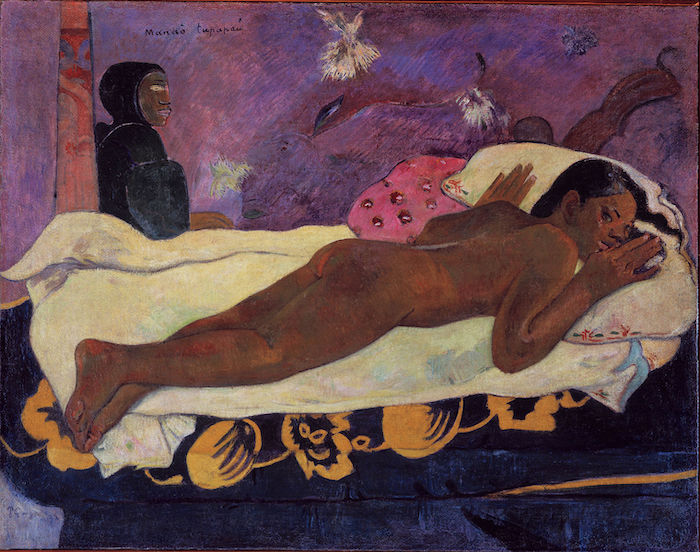
Paul Gauguin: Manaò tupapaú (The Spirit of the Dead Keeps Watch (1892); oil on burlap mounted on canvas 72.4 cm (28.5 ″) x 92.4 cm (36.3 ″); Albright–Knox Art Gallery
Locations
People
Groups
Topics
Subjects
Regions
Subregions
Years: 1892 - 1892
Paul Gauguin: Manaò tupapaú (The Spirit of the Dead Keeps Watch (1892); oil on burlap mounted on canvas 72.4 cm (28.5 ″) x 92.4 cm (36.3 ″); Albright–Knox Art Gallery
Locations
People
Groups
Topics
Subjects
Regions
Subregions