
García's son and heir Fortún is captured …
Years: 860 - 860
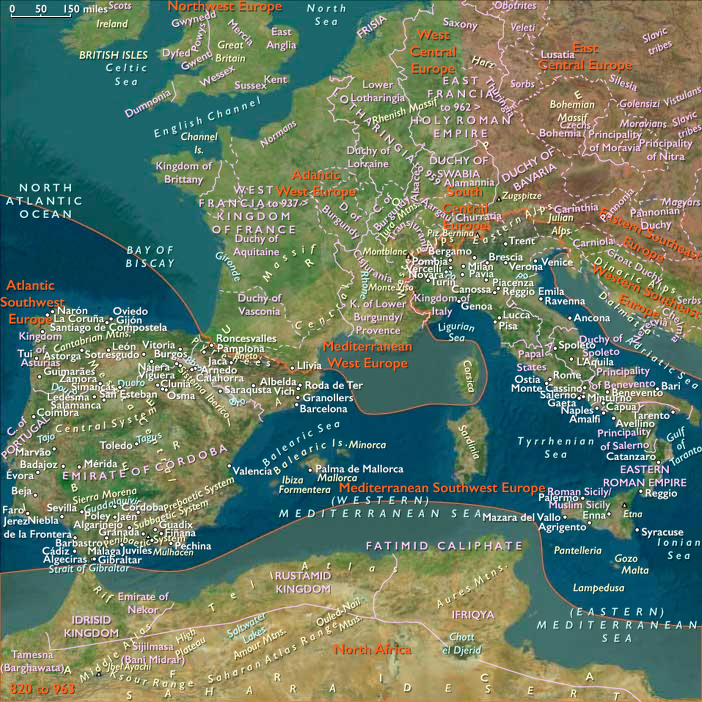
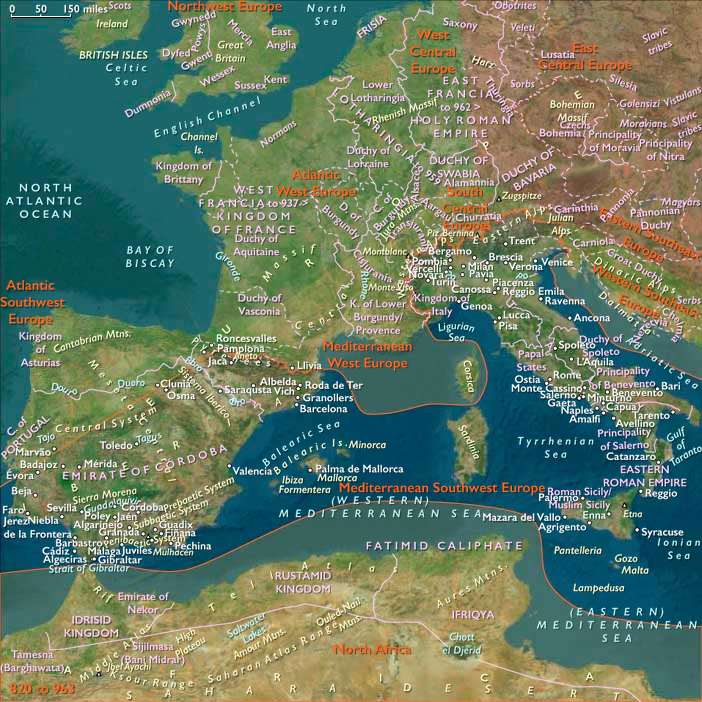
García's son and heir Fortún is captured in 860 and imprisoned in Córdoba, where he will languish for the next twenty years.
Locations
People
Groups
- Moors
- Galicia, Kingdom of
- Christianity, Chalcedonian
- Muslims, Sunni
- Banu Qasi
- Córdoba, Umayyad Emirate of
- Navarre, Kingdom of
- Asturias, Kingdom of
Topics
Commodoties
Subjects
Regions
Subregions
Related Events
Filter results
Showing 10 events out of 54065 total
Fan Chuo, a secretary serving a second tenure under the Jie-du (similar to the Eastern Roman thema) with headquarters located at Hanoi, is able to get his hands on the updated diplomatic and military documents of Tang China and Nanzhao, since the Hanoi thema is China’s frontier with Nanzhao, a Bai kingdom centered around present-day Yunnan in China.
He had also lived in Hanoi during his first tenure; therefore he has some firsthand information of the city, such as trades, deployments, population, etc.
As the Nanzhao army sacked the city for the first time, he had barely escaped capture by jumping into the Red River and swimming to the opposite bank.
Servimg subsequently under another Jie-du located at Guangzhou, he there compiled the first draft of Manchu (literally, barbarous document; roughly meaning the book on the southern tribes).
In 862, during a second tenure in Hanoi, he finishes the book, which is an invaluable source of Tang-Nanzhao relations and for anthropological research on the Hmong and Vietnamese during the later years of the T'ang Dynasty.
Kiev, located on the right bank of the Dnepr River, at the halfway point of its fourteen hundred-mile (two thousand two hundred and fifty-five -kilometer) route from northwest Russia to the Black Sea, is first mentioned in Russian chronicles in 860.
The eventual capital of Kievan Rus', its name supposedly derives from that of its legendary founder, Prince Kii.
Kiev’s location, above the Dnepr rapids where the open steppe meets with the belt of Slavic settlements in the forest-meadow region, endows the city with great strategic importance.
The legend of Kyi, Schek and Khoriv speaks of a founder-family consisting of a Slavic tribe leader Kyi, the eldest, his brothers Schek and Khoriv, and also their sister Lybid, who had founded the city.
Kyiv/Kiev is translated as "belonging to Kyi".
It is unclear when Kiev had fallen under the rule of the Khazar empire but, in an event attributed to the ninth century, the Primary Chronicle (a main source of information about the early history of the area) mentions Slavic Kievans telling Askold and Dir that they live without a local ruler and pay a tribute to Khazars.
At least during the eighth and ninth centuries Kiev functions as an outpost of the Khazar empire on its border with Levédia, an area settled by the Magyars in the ninth century, located in the territory of present-day eastern Ukraine.
They had moved to this area from Magna Hungaria situated on the western side of the Urals in the region today known as Bashkortostan.
A hill-fortress, called Sambat (Old Turkic for "High Place") is built to defend the area (although there is no evidence of an urban settlement on the site of Kiev prior to the 880s, and archaeological finds from the period in the vicinity of Kiev are almost nonexistent).
Norway in the Viking Age is divided into petty kingdoms ruled by chiefs who contend for land, maritime supremacy or political ascendance and seek alliances or control through marriage with other royal families, either voluntary or forced.
These circumstances produce the generally turbulent and heroic lives recorded in the Heimskringla.
Harald Fairhair, or Finehair, on the death in 860 of his father Halfdan the Black Gudrødsson, had succeeded to the sovereignty of several small and somewhat scattered kingdoms in Vestfold, which had come into his father's hands through conquest and inheritance, and lie chiefly in southeast Norway.
Harald in 866 makes the first of a series of conquests over the many petty kingdoms that will compose Norway, including Värmland in Sweden, and modern day southeastern Norway, which had sworn allegiance to the Swedish king Erik Eymundsson (Eric Anundsson).
Michael, on another campaign in 860, is forced to return to Constantinople, which has for the first time come under siege from Volga Rus' raiders.
The invaders, however, probably withdraw before the Emperor returns with his army.
Basil the Macedonian, a member of a peasant family, perhaps of Armenian origin, that had settled in Macedonia, had gained employment in influential official circles in Constantinople.
A handsome and physically powerful man, he had been fortunate enough to attract the imperial eye of the reigning emperor.
One story asserts that he had spent a part of his childhood in captivity in Bulgaria, where his family had, allegedly, been carried off as captives of the Khan Krum in 813.
Basil lived there until 836, when he and several others escaped to imperial territory in Thrace.
Basil was ultimately lucky enough to enter the service of Theophilitzes, a relative of the Caesar Bardas (the uncle of Emperor Michael III), as a groom.
While serving Theophilitzes, he had visited the city of Patras, where he had gained the favor of Danielis, a wealthy woman who had taken him into her household and endowed him with a fortune.
He had also earned the notice of Michael III by his abilities as a horse tamer and in winning a victory over a Bulgarian champion in a wrestling match; after rapid promotion, he had become the Emperor's companion, confidant, and bodyguard (parakoimomenos).
Michael falls increasingly under Basil’s influence.
Persistent persecution by Constantinople has fragmented the Paulicians, some of whom join the Arabs in fighting against the Christians.
Muslims supported by the Paulicians defeat Michael's army in 860 on the Euphrates River in northern Syria.
The nine-year war, waged from 851, has devolved into a series of skirmishes, resulting in a treaty and an exchange if prisoners.
The Empire, following the rapid Muslim conquests of the seventh century, had found itself confined to Asia Minor, the southern coasts of the Balkans, and parts of Italy.
As Constantinople remains the Caliphate's major infidel enemy, Arab raids (razzias) into Asia Minor continue throughout the eighth and ninth centuries.
These expeditions, launched from bases in the Arab frontier zone on an almost annual basis, have over time cquired a quasi-ritualized character.
The imperial forces during this period have generally been on the defensive, and have suffered some catastrophic defeats such as the razing in 838 of Amorium, the home city of the Empire’s reigning dynasty.
With the waning of the Abbasid Caliphate's power after 842 and the rise of semi-independent emirates along the Empire’s eastern frontier, however, Constantinople is increasingly able to assert its own power.
The most persistent threats to the Empire in the 850s had been the emirate of Melitene (Malatya) under Umar al-Aqta, the emirate of Tarsus under Ali ibn Yahya ("Ali the Armenian"), the emirate of Qaliqala (Theodosiopolis, modern Erzurum) and the Paulicians of Tephrike under their leader Karbeas.
Melitene, in particular, is a major threat to the Empire as its location on the western side of the Anti-Taurus range allows direct access to the Anatolian plateau.
An indication of the threat posed by these states comes in 860, when Umar and Karbeas raid deep into Asia Minor and return with much plunder; they are followed shortly after by another raid by the forces of Tarsus under Ali, while a naval attack from Syria sacks the major imperial naval base at Attaleia.
One Constantine (later called Cyril), a member of a noble family of Thessaloniki and the librarian of Constantinople's church of Hagia Sophia, resigns in 860 to join his brother Methodius, the abbot of a Greek monastery, in missionary journeys to the Khazars and Bulgarians.
Charles of Provence had been only a child at the death of his father, Emperor Lothair I, and the governance of his realm had been undertaken by his tutor, Count Gerard II of Vienne, whose wife had been a sister-in-law of the Emperor.
Gerard is a vigorous regent, defending the kingdom from the Northmen, who raid up the Rhone as far as Valence.
He ejects them from the Rhone delta in 860.
In 854 CE, King Ordoño I of Asturias supports a Mozarab rebellion against Muslim rule, but the effort ends in defeat at the Battle of Guadacelete. However, rather than discouraging him, this setback only strengthens his resolve to consolidate control over the "Desert of the Duero", the depopulated buffer zone between the Asturian Cordilleraand the Douro River.
To achieve this, Ordoño initiates the Repoblación, a strategic effort to resettle key towns in the region. Under his direction, the Christian population expands southward, successfully repopulating and fortifying:
- León, ...
Years: 860 - 860
Locations
People
Groups
- Moors
- Galicia, Kingdom of
- Christianity, Chalcedonian
- Muslims, Sunni
- Banu Qasi
- Córdoba, Umayyad Emirate of
- Navarre, Kingdom of
- Asturias, Kingdom of
