
Fulk, in capturing the fort of Banias, …
Years: 1140 - 1140
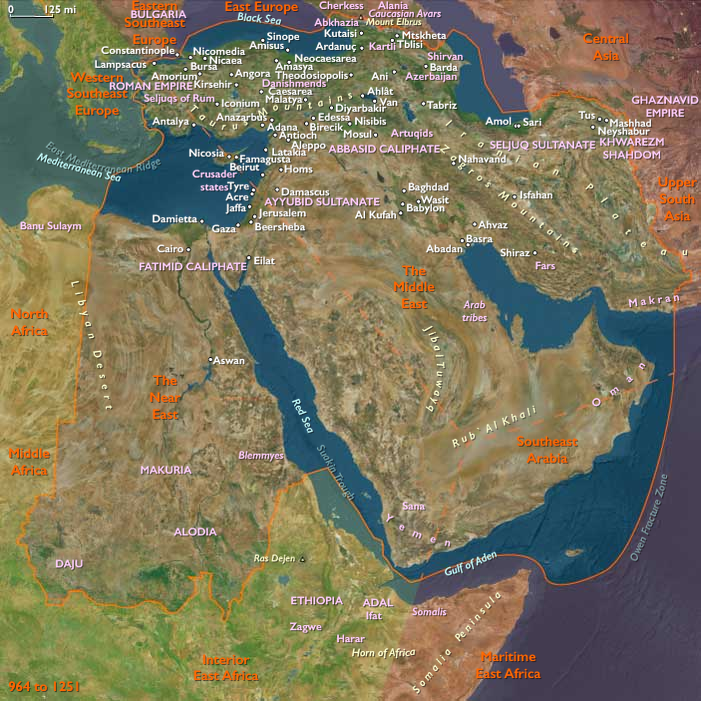
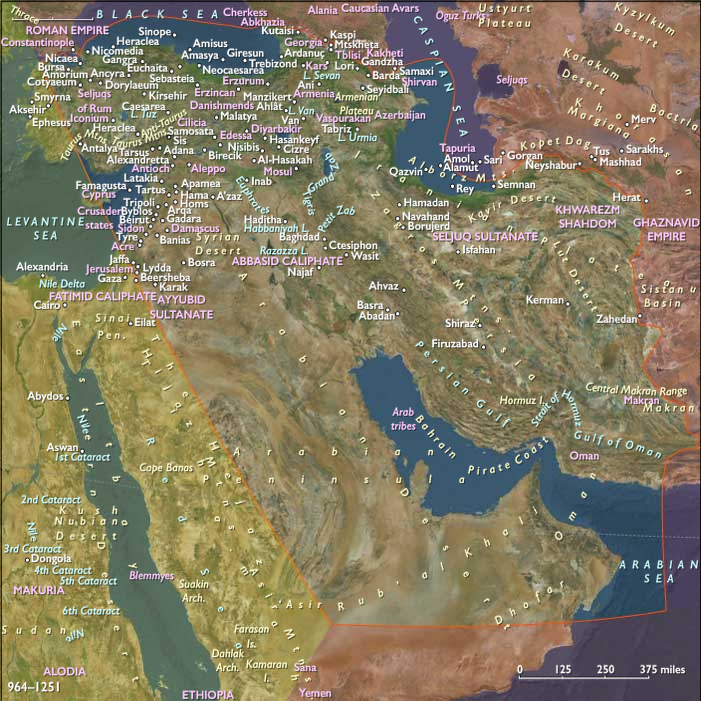
Fulk, in capturing the fort of Banias, to the north of Lake Tiberias, secures Jerusalem’s northern frontier.
Locations
People
Groups
- Muslims, Sunni
- Muslims, Shi'a
- Turkmen people
- Fatimid Caliphate
- Christians, Roman Catholic
- Edessa, County of
- Jerusalem, Latin Kingdom of
- Palestine, Frankish (Outremer)
- Damascus, Burid Emirate of
- Tripoli, County of
- Mosul, Zengi's Emirate of
Topics
Commodoties
Subjects
Regions
Subregions
Related Events
Filter results
Showing 10 events out of 48968 total
Chinese general Yue Fei, a northern Chinese from a humble background, had participated in the Song Dynasty's attempt in 1122 to capture the sixteen prefectures lost to the Jin Dynasty, and had defended Kaifeng after the Jin armies withdrew in 1127.
Yue had moved south with other loyalist forces in 1129, and had taken an active part during the Jin advance back across the Yangtze River that year.
He had continued to advance in rank and to increase the size of his army as he repeatedly led successful offensives into northern China and suppressed rebellions within Song territory.
Several other generals are also successful against the Jin Dynasty, and their combined efforts secure the survival of the Song Dynasty.
Yue, like most of them, is committed to recapturing northern China.
Yue, supported by the Song fleet on the Chang Jiang, had defeated the Jurzhen Jin dynasty’s forces in northern China, driving them back north of the river.
He has continued this push for a decade, retaking Jin cities as he advanced.
Just as he is threatening to attack and retake Kaifeng, corrupt officials advise Emperor Gaozong to recall Yue to the capital and sue for peace with the Jurchens.
Fearing that a defeat at Kaifeng might cause the Jurchens to release Emperor Qinzong, threatening his claim to the throne, Emperor Gaozong follows their advice, sending thirteen orders in the form of thirteen gold plaques to Yue Fei, recalling him back to the capital.
Knowing that a success at Kaifeng could lead to internal strife, Yue submits to the emperor's orders and returns to the capital, where he is imprisoned and where Qin Hui will eventually arrange for him to be executed on false charges.
Conrad III of Hohenstaufen, elected King of the Romans in 1138, has tried to amend relations between the two thrones of Bohemia and Germany.
At the Reichstag of Bamberg in the same year, he had given Sobeslav the hereditary dignity of the archcupbearer of the Holy Roman Empire and the promise to vest his eldest son Vladislaus with Bohemia upon his death.
The duke's reign has seen the foundation of many new German colonies in Czech lands in the course of the Ostsiedlung.
Sobeslav dies on February 14, 1140 at Hostinné Castle.
The succession by his son fails, as the Bohemian estates calls for his nephew Vladislaus II, the son of his elder brother and predecessor Duke Vladislaus, who becomes duke with the approval by Conrad.
Louis I, Landgrave of Thuringia, thanks to his marriage to Hedwig of Gudensberg, obtains the rule over an extensive heritage, after the death of his father-in-law, Count Giso IV, which leads to the union of Thuringia and Hesse.
In 1137, Louis had become Landgrave of Hesse-Gudensberg as well.
His close relationship to the King Lothair III had favored his rise into the rank of a prince.
After the death of Lothair, in 1137, Louis had decided to support the Hohenstaufen in their struggle for power in the Reich against the Welf party.
The Landgrave dies on January 12, 1140 and is buried inside the abbey of Reinhardsbrunn.
Louis has a daughter, Judith of Thuringia, who will become the second wife of king Vladislaus II of Bohemia.
The Christianization of Pomerania is considered one of the greatest accomplishments of Boleslaw’s III Pomeranian policy.
Once the missionary activities of Otto of Bamberg had taken took root in Pomernia, Boleslaw III had begun to implement an ecclesiastical organization of Pomerania.
Pomerelia had been added to the Diocese of Włocławek, known at this time as the Kujavian Diocese.
A strip of borderland north of Noteć had been split between the Diocese of Gniezno and Diocese of Poznan.
The bulk of Pomerania is however made an independent Pomeranian bishopric, set up in the territory of the Duchy of Pomerania in 1140, after Boleslaw had died in 1138 and the duchy has broken away from Poland.
With Boleslaw's death, Polish authority over Pomerania had ended, triggering competition of the Holy Roman Empire and Denmark for the area.
Zengi’s move against Damascus sparks a recognition of their common danger and results in a Jerusalem-Damascus alliance, a kind of diplomacy by now common with the second-generation Franks.
Fulk helps the Muslims of Damascus, under the vizier Mu'in ad-Din Unur, to ward off Zengi's armies in 1140.
Fulk has initiated the construction of a series of fortresses to protect Jerusalem, including Krak (Kerak) of Moab to the south of the Dead Sea, built by his butler Paganus.
Fulk has Blanche Garde, Ibelin, and other forts built in the southwest to overpower the Egyptian fortress at Ascalon and to enable the kingdom’s access to the Red Sea.
Roman triumphal arches provide the inspiration for the triple portals of the church of Saint-Gilles-du-Gard, begun in St. Gilles around 1140.
Afonso Henriques’ Galician Campaign and the Trial at Valdevez (1140)
Seeking to assert his mother’s rightful claims to lands in Galicia, Afonso Henriques pressed northward, provoking his cousin, King Alfonso VII of León and Castile, to raise an army and invade Portuguese territory in 1140. Rather than engaging in open warfare, the two rulers agreed to settle their dispute through a chivalric trial by combat at Valdevez.
The Trial at Valdevez and Portuguese Victory
In this grand tourney, Portuguese and Leonese knights clashed in a mock battle, where the Portuguese forces emerged victorious. As a result, the disputed Galician lands came under Portuguese control, and Alfonso VII, though reluctant, acknowledged Afonso Henriques’ authority over Portugal.
Towards Formal Recognition: The Peace of Zamora (1143)
Although this encounter effectively confirmed Portugal’s de facto independence, it was not until 1143, at the Peace of Zamora, that Alfonso VII formally recognized Afonso Henriques as King of Portugal, laying the foundation for the kingdom’s full sovereignty.
The Construction of Salamanca’s Old Cathedral (c. 1140–14th Century)
Around 1140, construction began on the Cathedral of Salamanca, now known as the Old Cathedral (Catedral Vieja de Salamanca). Founded by Bishop Jerome of Périgord, the cathedral was designed in the Romanesque style, though later additions incorporated Gothic elements.
The ambitious project spanned several centuries, with construction continuing into the 14th century, ultimately resulting in one of Spain’s most remarkable medieval ecclesiastical structures.
The West Facade of Saint-Denis and the Transition from Romanesque to Gothic (1140 CE)
The west facade of the Abbey Church of Saint-Denis, consecrated in 1140 CE, marks a crucial moment in the transition from Romanesque to Gothic architecture. While later scholars have classified its triple portals and sculptural decoration as Proto-Gothic, much of its sculptural style remains overwhelmingly Romanesque in character.
Architectural and Sculptural Features
-
Triple Portals: A Symbol of Royal and Ecclesiastical Power
- The three grand entrances reflect the growing complexity of medieval church facades, later influencing Gothic cathedral designs.
- This tripartite arrangement reinforced the prestige of Saint-Denis, the burial site of French kings, aligning it with the monumental royal image of the Capetian monarchy.
-
Romanesque Influence in the Sculptural Program
- The sculpted tympana and lintels above the portals exhibit Romanesque characteristics, including:
- Dramatic, elongated figures, with a sense of spiritual intensity.
- Highly detailed, expressive carving, particularly in the Last Judgment scenes.
- Crowded compositions, typical of Romanesque sculpture, emphasizing narrative over realism.
- The sculpted tympana and lintels above the portals exhibit Romanesque characteristics, including:
-
Proto-Gothic Innovations
- While still Romanesque in style, the facade also introduces early Gothic elements, including:
- The increased verticality of the portals.
- More naturalistic drapery and greater spatial depth in the figures.
- A focus on light and openness, which would later define the full Gothic aesthetic.
- While still Romanesque in style, the facade also introduces early Gothic elements, including:
Significance of the West Facade of Saint-Denis
- A Prototype for Gothic Facades – The triple portal arrangement and sculptural themes would heavily influence later Gothic cathedrals, including Notre-Dame de Paris and Chartres Cathedral.
- Suger’s Vision of a “Heavenly Jerusalem” – Abbot Suger, the mastermind behind Saint-Denis’ reconstruction, envisioned the church as a sacred gateway to divine light and harmony, foreshadowing the Gothic emphasis on ethereal beauty.
- A Royal Monument – As the resting place of French kings, Saint-Denis’ monumental west facade reinforced the idea of the Capetian monarchy as divinely ordained, setting a precedent for the close ties between royal authority and ecclesiastical grandeur.
While rooted in Romanesque traditions, the west facade of Saint-Denis (1140) was a key stepping stone toward the full expression of Gothic architecture, blending old sculptural traditions with emerging Gothic structural innovations.
Years: 1140 - 1140
Locations
People
Groups
- Muslims, Sunni
- Muslims, Shi'a
- Turkmen people
- Fatimid Caliphate
- Christians, Roman Catholic
- Edessa, County of
- Jerusalem, Latin Kingdom of
- Palestine, Frankish (Outremer)
- Damascus, Burid Emirate of
- Tripoli, County of
- Mosul, Zengi's Emirate of
