
The climate in Britain becomes cooler and …
Years: 13005BCE - 11278BCE
The climate in Britain becomes cooler and dryer in what is known as the Younger Dryas period, from twelve thousand seven hundred to eleven thousand five hundred years ago.
Food animal populations seem to have declined although woodland coverage expanded.
Tool manufacture in the Final Upper Palaeolithic revolved around smaller flints but bone and antler work became less common.
Typically there are parallel-sided flint blades known as "Cheddar Points".
There are scrapers, some of which are marked with what may be calendars.
However, the number of known sites is much larger than before and more widely spread.
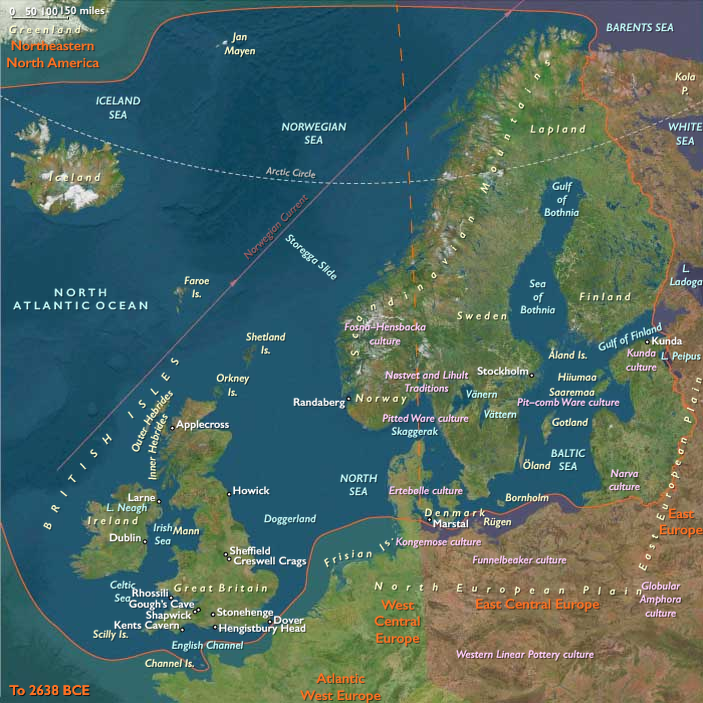
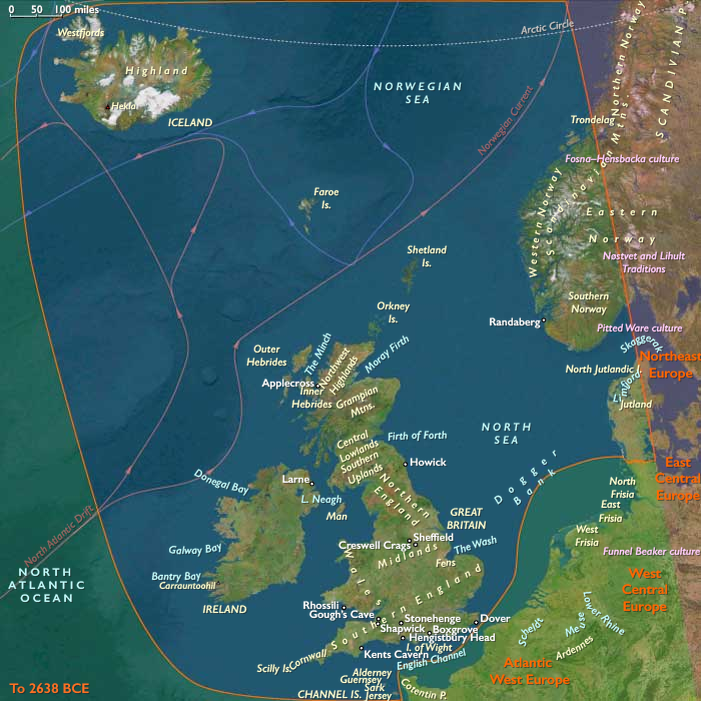
Many more open air sites are known, such as that at Hengistbury Head.
Locations
Topics
Subjects
Regions
Subregions
Related Events
Filter results
Showing 10 events out of 69412 total
A dramatic and rapid rise in global sea-levels of around fourteen meters is linked by coral off the South Pacific island of Tahiti to the collapse of massive ice sheets fourteen thousand six hundred years ago.
An Aix-Marseille University-led team, including Oxford University scientists Alex Thomas and Gideon Henderson, confirmed that a dramatic and rapid rise in global sea-levels of around fourteen meters occurred at the same time as a period of rapid climate change known as the Bølling oscillation.
The Bølling oscillation, a warm interstadial period between the Oldest Dryas and Older Dryas stadials, at the end of the last glacial period, is used to describe a period of time in relation to Pollen zone Ib—in regions where the Older Dryas is not detected in climatological evidence, the Bølling-Allerød is considered a single interstadial period.
The beginning of the Bølling is also the high-resolution date for the sharp temperature rise marking the end of the Oldest Dryas at 14,670 BP and the beginning of the so-called Humid Period in North Africa.
The region that will later become the Sahara is wet and fertile, its aquifers full.
During the Bølling warming high latitudes of the Northern hemisphere warmed as much as 15 degrees Celsius in a few tens of decades.
The team has used dating evidence from Tahitian corals to constrain the sea level rise to within a period of three hundred and fifty years, although the actual rise may well have occurred much more quickly and would have been distributed unevenly around the world's shorelines.
A leading theory is that the ocean's circulation changed so that more heat was transported into Northern latitudes.
A considerable portion of the water causing the sea-level rise at this time must have come from melting of the ice sheets in Antarctica, which sent a 'pulse' of freshwater around the globe.
However, whether the freshwater pulse helped to warm the climate or was a result of an already warming world remains unclear.
The Domestication of Dogs: Early Human-Canine Cooperation
By 12,000 BCE, humans had likely successfully domesticated dogs, marking one of the earliest known interspecies partnerships. While the exact timeline and process of dog domestication remain debated, it is widely accepted that human interaction played a crucial role in shaping the modern dog (Canis lupus familiaris).
The Timeline of Dog Domestication
- Genetic evidence confirms that dogs genetically diverged from wolves at least 15,000 years ago, though some researchers suggest an even earlier domestication event.
- Mitochondrial DNA studies and archaeological findings place the earliest domesticated dogs within a timeframe of 17,000–14,000 years ago, around the Upper Paleolithic-Pleistocene/Holocene boundary.
- The exact date remains indeterminate, with contradictory evidence complicating the debate.
How Did Domestication Occur?
There are two major hypotheses regarding how dogs evolved from wolves:
-
Active Domestication by Humans
- Early humans may have intentionally raised and bred certain wolves for hunting, guarding, or companionship, leading to gradual domestication.
-
Self-Domestication through Natural Selection
- Some wolves may have gathered near human campsites to scavenge leftover food.
- Over time, wolves that were less fearful and more tolerant of humans would have been more successful in obtaining food, favoring traits that led to domestication.
Scientific Evidence: Archaeology and Genetics
- Archaeological findings provide evidence of dog burials and human-dog associations dating back more than 15,000 years.
- Mitochondrial DNA studies support the idea that dog domestication began at multiple locations, possibly in Europe, Asia, or the Middle East.
- Despite ongoing research, the origin and exact timeline remain controversial, with findings pointing to multiple domestication events or hybridization with wild wolf populations.
Significance of Early Domestication
- The domestication of dogs represents one of the earliest examples of animal domestication, shaping human hunting, security, and companionship practices.
- This relationship likely played a role in human survival and social organization, as domesticated dogs aided in tracking prey, guarding settlements, and forming deep bonds with humans.
Though many aspects of dog domestication remain uncertain, what is clear is that humans and dogs have shared an extraordinary evolutionary journey, forming one of the most enduring and successful interspecies partnerships in history.
Aboriginal rock paintings in Queensland and other areas of Australia date from 13,000 BCE.
The Magdalenian Period and Technological Advancements
The Lower Magdalenian period corresponds with the latter half of the Würm III glacial stadial, concluding around 13,000 BCE. This phase of the Upper Paleolithic was marked by continued adaptations to the cold Ice Age environment and the development of increasingly specialized tools.
During the Upper Magdalenian sequence, a significant technological advancement occurred with the emergence of multibarbed harpoons crafted from antler. These harpoons became the primary tool for hunting and fishing, reflecting:
- Greater efficiency in capturing aquatic and land animals, as barbed points prevented prey from slipping off.
- Increased reliance on fishing, suggesting shifts in subsistence strategies.
- Refinements in tool-making techniques, demonstrating advanced craftsmanship and resource utilization.
The development of multibarbed harpoons highlights the Magdalenian people's ability to innovate in response to their environment, paving the way for further technological and cultural advancements in Late Upper Paleolithic societies.
The artistic achievements of the Middle Magdalenian period reach their peak around 12,000 BCE at Altamira, where astonishingly lifelike depictions of bison, horses, deer, and other animals cover the low cave ceilings, showcasing a remarkable level of realism and artistic skill.
Engravings at Les Combarelles: A Glimpse into Upper Paleolithic Art
Around 12,000 BCE, engravers at Les Combarelles, a cave near Les Eyzies in the Dordogne region of France, created a remarkable collection of prehistoric depictions. These engravings, associated with the Magdalenian culture, showcase a rich diversity of Ice Age fauna and rare anthropomorphic figures.
Subjects Depicted in Les Combarelles Cave Art
-
Commonly Depicted Animals:
- Mammoths
- Bison
- Reindeer
- Horses
- Ibex
-
Rarely Portrayed Species:
- Cave lions
- Cave bears
- Wolves
-
Human Representations:
- Anthropomorphic figures – Possibly symbolic or mythical depictions.
- Mask-like images – Their purpose remains uncertain but may suggest ritual or shamanic significance.
Significance of the Les Combarelles Engravings
- The engravings reflect exceptional artistic skill, capturing naturalistic details of both common and rare species.
- The presence of carnivores and human-like figures suggests a broader symbolic or spiritual meaning beyond mere representation of prey animals.
- As one of the finest examples of Paleolithic rock engravings, Les Combarelles provides invaluable insight into Magdalenian culture and artistic traditions, helping to reconstruct the symbolic and environmental landscape of Ice Age Europe.
Flint seems to have been brought into areas of Britain where local resources are limited; the stone tools found in the caves of Devon, such as Kent's Cavern, seem to have been sourced from Salisbury Plain, one hundred miles (one hundred and sixty-one kilometers) east.
This is interpreted as meaning that the early inhabitants of Britain were highly mobile, roaming over wide distances and carrying 'toolkits' of flint blades with them rather than heavy, unworked flint nodules or improvising tools extemporaneously.
The possibility that groups also traveled to meet and exchange goods or sent out dedicated expeditions to source flint has also been suggested.
Sites such as Gough's Cave in Somerset, dated at 12,000 BCE, provide evidence suggesting that humans returned to Britain towards the end of this ice age, in a warm period known as the Dimlington interstadial although further extremes of cold right before the final thaw may have caused them to leave again and then return repeatedly.
The environment during this ice age period would have been a largely treeless tundra, eventually replaced by a gradually warmer climate, perhaps reaching 17 degrees Celsius (62.6 Fahrenheit) in summer which encouraged the expansion of birch trees as well as shrub and grasses.
The first distinct culture of the Upper Palaeolithic in Britain is what archaeologists call the Creswellian industry, with leaf-shaped points probably used as arrowheads.
It produced more refined flint tools but also made use of bone, antler, shell, amber, animal teeth, and mammoth ivory.
These were fashioned into tools but also jewelry and rods of uncertain purpose.
Skilled big-game hunters, the so-called Paleo-Indians, arrive in what is now Wisconsin between 12,000 and 11,000 BCE, after the retreat of the last continental glacier, to follow mastodon, giant beavers, deer, caribou, and elk.
The relationship between the Paleo-Indians and the indigenous peoples present when Europeans arrived in the second millennium CE has not been clearly traced.
The Taima-Taima site in present western Venezuela, in the north of the South American continent, is thought to be twelve thousand five hundred years old.
