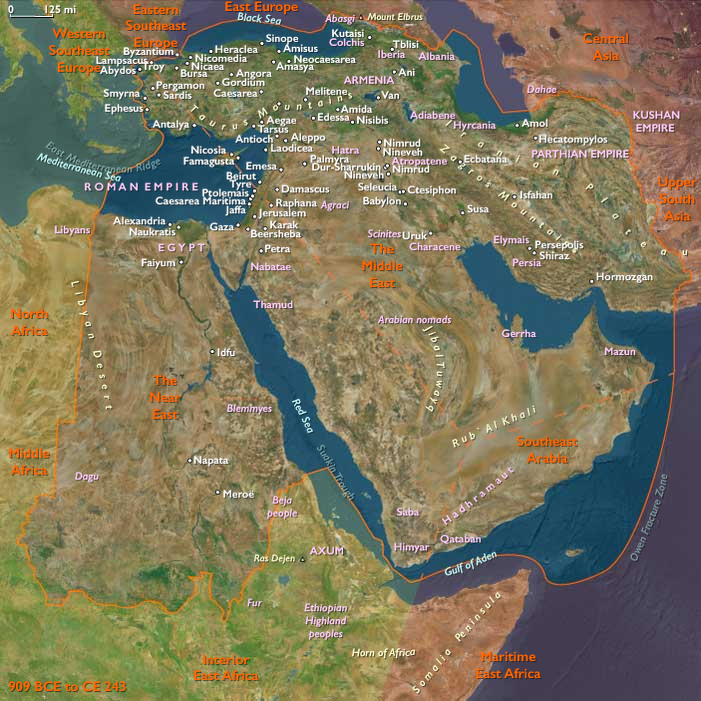
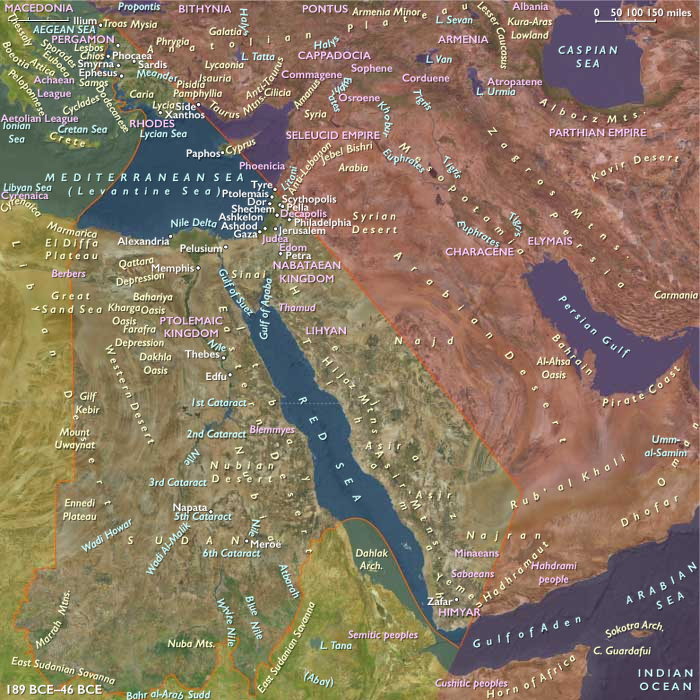
From Cyprus, Lathyros invades northern Syria in …
Years: 107BCE - 107BCE
From Cyprus, Lathyros invades northern Syria in 107 BCE to assist one of the claimants to the crumbling Seleucid empire, while …
Locations
People
Groups
- Jews
- Greeks, Hellenistic
- Egypt, Ptolemaic Kingdom of
- Seleucid Empire
- Cyprus, Roman
- Hasmonean dynasty
Topics
Commodoties
Subjects
Regions
Subregions
Related Events
Filter results
Showing 10 events out of 62922 total
Pontus, sprawling along the southern coast of the Black Sea, includes Greek colonies and a native population; the largest section of the people, including the rulers, is Iranian.
Mithridates is able, cunning, and ambitious.
Through his rescue of the Greek cities of the Tauric Chersonese and the Cimmerian Bosporus (Crimea and Straits of Kerch) from Sarmatian and Scythian attacks, he consolidates control of the entire north coast of the Black Sea, commandeers its shipping, and attracts many recruits for his army.
He secures money and men by expanding to the north, beginning his long career of conquest by dispatching successful expeditions to the Crimea and to Colchis (on the eastern shore of the Black Sea).
Both districts are added to the Pontic kingdom.
Mithridates next turns to western Anatolia, the Aegean islands, and even Greece, where the financial oppression of the Romans make him appear a liberator.
Intent on consolidating his power in Anatolia, the young king gathers support against Rome.
…Cleopatra III, allying herself with the Jewish king Hyrcanus, actively aids another Seleucid pretender.
Alexander has meanwhile returned to Egypt as coregent, but his mother takes official precedence and is the actual ruler.
Drusus had been elected censor along with the elder Marcus Aemilius Scaurus in 109 BCE, but had died the following year.
Gaius Marius, ordered to replace Metellus (given the title "Numidicus" for his efforts, although he has accomplished precisely nothing in his time there) and prosecute the war in Numidia, disregards standing recruitment qualifications and regularizes the recruitment of the landless poor, thus transforming the citizens’ militia into a professional army.
The Roman forces are again unable to subdue Jugurtha, despite Metellus’s policy of laying waste to the Numidian countryside.
An internal Roman struggle develops between Metellus and his subordinate commander (legate), Gaius Marius.
Metellus permits Marius to return to Rome and Marius is elected consul in 107 BCE.
Metellus is fully aware of Marius' ambitions in Roman politics and refuses for days to allow him to sail to Rome and stand for the consulship.
Metellus is, however, unaware that Marius wants his command in Numidia.
Numidia is not an area designated to be protected by consul by the Roman Senate.
However, the populares pass a law in its Tribal Assembly, which gives the command against Jugurtha to Marius in 107 BCE.
This is significant because the Assembly has usurped the Senate's rights and powers in this matter and the Senate has yielded.
The Cimbri and Their Allies Defeat Rome Again at Burdigala (107 BCE)
Following their victories at Noreia (113 BCE) and in Gallia Narbonensis (109 BCE), the Cimbri and their allied tribes continued their campaign of destruction in Roman territory. In 107 BCE, they clashed with another Roman army at Burdigala (modern Bordeaux), dealing the Republic another devastating defeat.
The Battle of Burdigala and the Death of Gaius Cassius Longinus Ravilla
- The Roman consul Gaius Cassius Longinus Ravilla led a military campaign against the Cimbri and their allies, seeking to halt their advances in southern Gaul.
- At Burdigala (modern Bordeaux), the Roman forces were decisively defeated, with Longinus himself killed in battle.
- This marked yet another catastrophic loss for Rome, demonstrating its inability to contain the Cimbrian threat.
Consequences of the Defeat
- The Roman Senate and military leadership were in crisis, as the Republic had now suffered three major defeats against the Cimbri and Teutons within just six years (113–107 BCE).
- The continued military failures in Gaul fueled panic in Rome, leading to calls for military reform and new leadership.
- The Cimbri, however, did not immediately invade Italy, instead continuing their movements through Gaul, searching for lands to settle.
Toward the Climax of the Cimbrian War
The Roman defeats at Noreia, Gallia Narbonensis, and Burdigala set the stage for one of the greatest military crises of the Roman Republic, eventually leading to the rise of Gaius Marius, who would later be tasked with defeating the Cimbri and their allies in a series of decisive battles (102–101 BCE).
The Cimbrian victories in Gaul reinforced their status as one of Rome’s most formidable adversaries, contributing to the political instability and military reforms that would shape the late Republic.
The Cimbri’s Arrival in Gaul and the Spark of Celtic Resistance (109 BCE–107 BCE)
The arrival of the Cimbri in Gaul in 109 BCE and their decisive defeat of the Roman consul Marcus Junius Silanus triggered unrest among the recently conquered Celtic tribes in southern Gaul. This defeat destabilized Roman rule in the region, emboldening local Gallic and Alpine tribes to resist Roman authority.
The Cimbri’s Request for Land and Roman Rejection
- Before their battle with Silanus, the Cimbri had requested land within Roman territory to settle.
- The Roman Senate refused their request, maintaining its expansionist policies in Gaul.
- In response, Silanus launched a military campaign against the Cimbri, only to be completely defeated at an unknown location in Gallia Transalpina (southern Gaul).
The Role of the Tigurini and Their Migration South (109 BCE)
- The Tigurini, a pagus (clan or sub-tribe) of the Helvetii, encountered the Cimbri while traveling through the Alps.
- The two groups formed an alliance, and the Tigurini migrated southward into the Roman province of Gallia Narbonensis (modern Provence).
- This movement further weakened Roman control over the region, as local Celtic tribes saw an opportunity to challenge Rome’s dominance.
The Defeat of Lucius Cassius Longinus at Agen (107 BCE)
- Two years later (107 BCE), the Roman consul Lucius Cassius Longinus led a campaign against the Tigurini in an effort to reassert Roman authority in Gaul.
- Near Agen, Longinus was completely defeated, marking yet another humiliating loss for the Roman Republic.
- Gaius Popillius Laenas, the senior surviving Roman officer, was forced to negotiate for the survival of his army by:
- Surrendering half of the baggage to the victors.
- Submitting to the ultimate Roman humiliation—having his army "march under the yoke," a symbolic act of total submission to the enemy.
Consequences of These Defeats
- The back-to-back defeats at the hands of the Cimbri and Tigurini severely damaged Rome’s prestige in Gaul, leading to increased Celtic resistance and unrest.
- The failure of Roman military leadership highlighted the Republic’s vulnerability to large-scale migratory groups, leading to panic in Rome and urgent calls for military reform.
- The Roman defeats of 109 and 107 BCE set the stage for the Cimbrian War (113–101 BCE), which would culminate in the rise of Gaius Marius and his sweeping military reforms to counter the barbarian threat.
These events mark a critical phase in Rome’s struggle for dominance in Gaul, foreshadowing the larger conflicts and political shifts that would shape the late Republic and the expansion of Roman control in Western Europe.
Ptolemy Alexander, while Egypt’s queen mother continues to pursue the family dispute, finds himself drawn into the civil war in the Seleucid kingdom, after his brother has lent active aid to the opponents of his mother's allies.
The Romans had begun their conquest of southern Gaul (later known as the Provincia) in 125 BCE.
Moving westward, they had founded in 118 BCE the colony of Narbo Martius (Narbonne), the Mediterranean city nearest to inland Tolosa, and thus have come into contact with the Tolosates, famous for their wealth and the key position of their capital for trade with the Atlantic.
Archaeological evidence dates human settlement in Toulouse to the eighth century BCE.
The location is very advantageous, at a place where the Garonne River bends westward toward the Atlantic Ocean and can be crossed easily.
It is a focal point for trade between the Pyrenees, the Mediterranean and the Atlantic Immediately north of these hills is a large plain suitable for agriculture.
People gather on the hills overlooking the river, south of the plain, nine kilometers south of today's downtown Toulouse.
The name of the city is Tolosa.
Researchers today agree that the name is probably Aquitanian, related to the old Basque language, but the meaning is unknown.
The name of the city has remained almost unchanged over centuries despite Celtic, Roman and Germanic invasions, which is rare for French cities.
The first inhabitants seem to have been Aquitanians, of whom little is known.
Later came Iberians from the south, who, like the Aquitanians, were non-Indo-European people.
In the third century BCE, there came a Celtic Gallic tribe called the Volcae Tectosages from Belgium or southern Germany, the first Indo-European people to appear in the region.
They settled in Tolosa and interbred with the local people.
Their Gaulish language became predominant.
Tolosa is attested by 200 BCE to be the capital of the Volcae Tectosages (based on coins found), which Julius Caesar will later call Tolosates in his famous account of the Gallic wars (De Bello Gallico, 1.10), singular Tolosas.
Archeologists say Tolosa was one of the most important cities in Gaul, and certainly it was famed in pre-Roman times for being the wealthiest one.
There are many gold and silver mines nearby, and the offerings to the holy shrines and temples in Tolosa have accumulated a tremendous wealth in the city.
Another consul, Quintus Servilius Caepio, marches to Gaul in 106 BCE and plunders the temples of Tolosa, finding a huge sum of money: over fifty thousand fifteen-pound bars of gold and ten thousand fifteen-pound bars of silver.
Strabo reports a story told in his time of this semi-legendary treasure, the aurum Tolosanum, supposed to have been the "cursed gold" looted during the sack of Delphi during the Gallic invasion of the Balkans in 279 BCE.
The riches of Tolosa are shipped back to Rome via Massilia, but only the silver arrives; the gold is stolen by a band of marauders, who are believed to have been hired by Caepio himself.
The Gold of Tolosa will never be found, and is said to have been passed all the way down to the last heir of the Servilii Caepiones, Marcus Junius Brutus, the famous assassin of Julius Caesar.
Tolosa chooses to ally with the daunting Romans, who in 106 establish a military fort in the plain north of the city, a key position near the border of independent Aquitania, but otherwise leave the inhabitants free to rule themselves in semi-independence.

The northern region of the Korean peninsula and Manchuria had been occupied by the nascent states of Buyeo, Goguryeo, Okjeo, Dongye, and other minor statelets after the defeat of Gojoseon by China's Han dynasty of China in 108 BCE.
Goguryeo's traditional founding date is 37 BCE, but it is mentioned in Chinese records as early as 75 BCE, or possibly even the second century BCE.
The little-understood state of Jin in the southern part of the Korean peninsula has given rise to the loose confederacies Jinhan, Byeonhan, and Mahan, or collectively, Samhan.
Jinhan, like the other Samhan confederacies, had arisen out of the confusion and migration following the fall of Gojoseon in 108 BCE.
Years: 107BCE - 107BCE
Locations
People
Groups
- Jews
- Greeks, Hellenistic
- Egypt, Ptolemaic Kingdom of
- Seleucid Empire
- Cyprus, Roman
- Hasmonean dynasty