
Friends of the young Alexios II now …
Years: 1182 - 1182
Friends of the young Alexios II now try to form a party against the empress mother and the prōtosebastos.
Empress Maria’s Latin origins and culture have led to creeping resentment from her Greek subjects (who felt insulted enough by the late Manuel's Western tastes, let alone being ruled by his Western wife), building up to an explosion of rioting that almost becomes a full civil war when Alexios II's half-sister Maria, wife of Caesar John (Renier of Montferrat), stirs up riots in the streets of the capital in early April 1182.
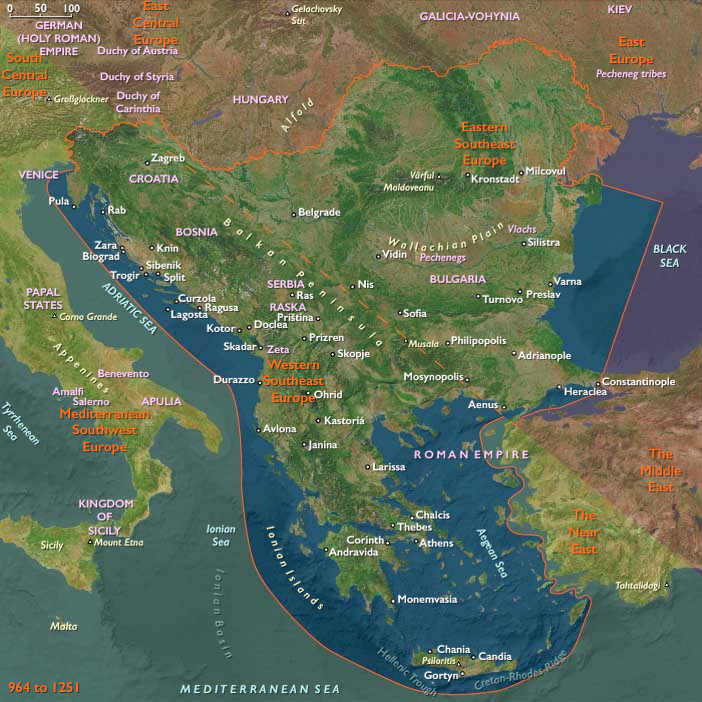
Andronikos Komnenos, having raised an army, is waiting at Chalcedon when anti-Latin riots break out.
Taking advantage of these disorders to aim at the crown, he enters Constantinople, where he is received with almost divine honors, and overthrows the government.
The defection of the commander of the imperial navy, megas doux Andronikos Kontostephanos, and the general Andronikos Angelos, play a key role in allowing the rebellious forces to enter Constantinople.
The unpopular regent is captured and blinded, and Andronikos enters Constantinople posing as the protector of the young emperor Alexios II.
Almost immediately, the celebrations spill over into violence towards the hated Latins, and after entering the city's Latin quarter, a mob begins attacking the inhabitants.
Many had anticipated the events and escape by sea.
The ensuing massacre is indiscriminate: neither women nor children are spared, and Latin patients lying in hospital beds are murdered.
Houses, churches, and charitable institutions are looted.
Latin clergymen receive special attention, and Cardinal John, the papal legate, is beheaded and his head is dragged through the streets at the tail of a dog.
Although Andronikos himself has no particular anti-Latin attitude, he allows the massacre to proceed unchecked.
The bulk of the Latin community, estimated at over sixty thousand at the time, is wiped out or forced to flee.
The Genoese and Pisan communities especially are decimated, and some four thousand survivors are sold as slaves to the Turks.
A few years later, Andronikos I himself will be deposed and handed over to the mob of Constantinople citizenry, and will be tortured and summarily executed in the Hippodrome by Latin soldiers.
The massacre further worsens the image of Constantinople in the West, and although regular trade agreements will soon be resumed between Constantinople and Latin states, the underlying hostility will remain, leading to a spiraling chain of hostilities: a Norman expedition under William II of Sicily in 1185 will sack Thessalonica, the Empire's second largest city, and the German emperors Frederick Barbarossa and Henry VI will both threaten to attack Constantinople.
The worsening relationship will culminate with the brutal sack of the city of Constantinople by the Fourth Crusade in 1204, which will lead to the permanent alienation of Eastern Orthodox and Roman Catholics.
After allowing Alexios II to be crowned, Andronikos promptly has most of the young emperor's actual or potential defenders executed, including his half-sister, the Caesar, and the dowager empress Maria, whose death warrant her son Alexios is made to sign.
He refuses to allow Alexios the smallest voice in public affairs.
This troubled succession weakens the dynastic continuity and solidarity on which the strength of the empire has come to rely.
All hope of effective cooperation between Constantinople and the Latins vanishes.
Locations
People
Groups
- Pisa, (first) Republic of
- Genoa, (Most Serene) Republic of
- Christians, Roman Catholic
- Christians, Eastern Orthodox
- Roman Empire, Eastern: Komnenos dynasty, restored
- Italians (Latins)
- Seljuq Empire, Western capital
- Venice, (Most Serene) Republic of
Topics
Commodoties
Subjects
Regions
Subregions

Related Events
Showing 10 events out of 48139 total
Years: 1182 - 1182
Locations
People
Groups
- Pisa, (first) Republic of
- Genoa, (Most Serene) Republic of
- Christians, Roman Catholic
- Christians, Eastern Orthodox
- Roman Empire, Eastern: Komnenos dynasty, restored
- Italians (Latins)
- Seljuq Empire, Western capital
- Venice, (Most Serene) Republic of
Topics
Commodoties
Subjects
Regions
Subregions