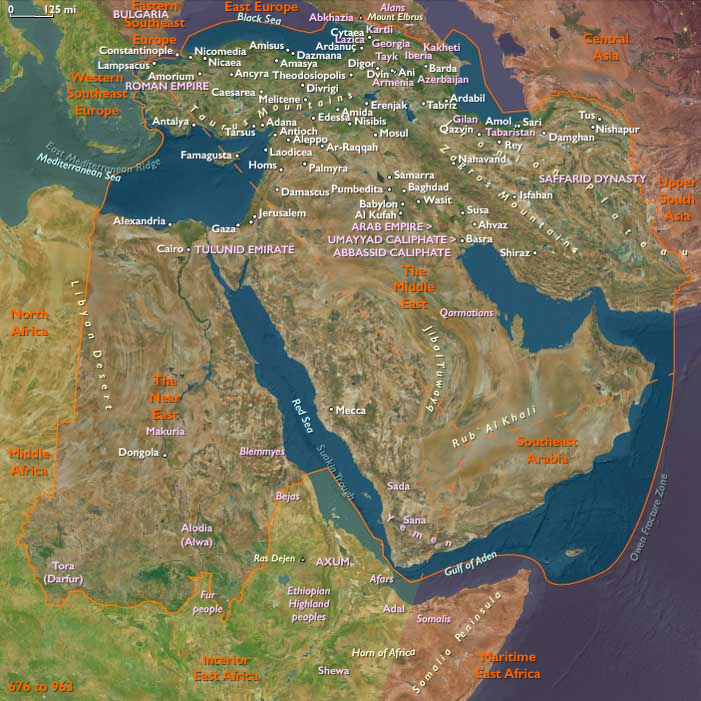
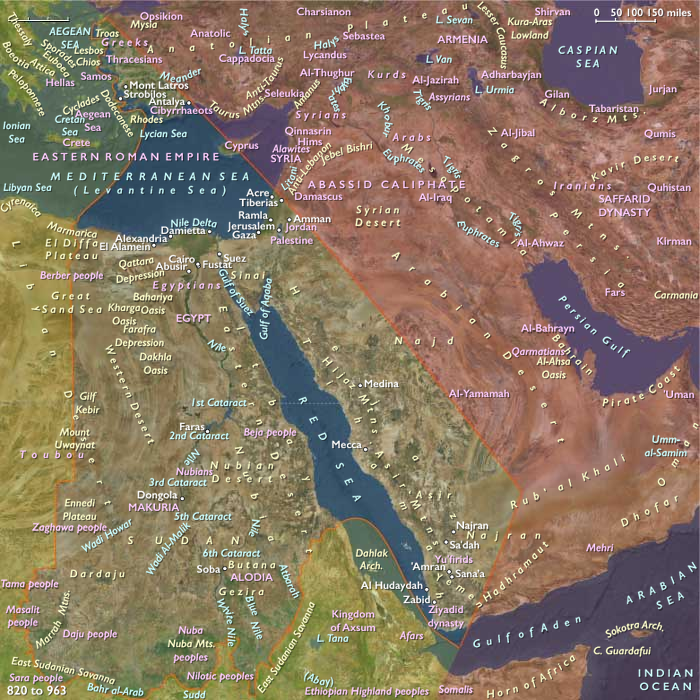
Frequent pro-Umayyad uprisings receive Palestinian support. …
Years: 841 - 841
Frequent pro-Umayyad uprisings receive Palestinian support.
Abu Sarb, a Yemenite, in 840 and 841 unfurls the white banner of the Umayyads and succeeds in recruiting a large number of peasant followers, mainly among the Palestinian population, who regard him as the savior whose appearance is to save the land from the hated 'Abbasids.
The insurrection is put down but unrest persists.
Locations
Groups
Topics
Commodoties
Subjects
Regions
Subregions
Related Events
Filter results
Showing 10 events out of 54260 total
Consort Wei had already died by the time her son took the throne, and Emperor Wuzong had posthumously honored her as an empress dowager.
Also, knowing that Yang Sifu and Li Jue had not supported him as Emperor Wenzong's successor, he had had them removed from their offices and instead installed Li Deyu, who was formerly a chancellor during Emperor Wenzong's reign, as a chancellor and effectively put most of the responsibilities of governance in Li Deyu's hands.
In 841, Emperor Wuzong further orders Liu Hongyi and Xue Jileng to commit suicide and plansto order Yang and Li Jue to do so as well, but Yang and Li Jue are spared (and only demoted) after the intercession of Li Deyu and the other chancellors Cui Gong, Cui Dan, and Chen Yixing.
Iconoclasm has been given full rein under Theophilos.
To weaken the political influence of Greek Orthodox monasticism, the Emperor and his former teacher John "the Grammarian", now patriarch of Constantinople as John VII, have mounted a persecution against the users of icons in Orthodox liturgy and devotion.
Support for Iconoclasm soon wanes, however, and the vast majority of the Greek Christians rally to the defense of their sacred art.
The cultural revival stimulated by Theophilos includes two significant advances in the area of classical studies: the gradual substitution of the minuscule, or smaller, cursive hand for the uncial, or larger, script, and the increase in the number of scriptoria, or copyists' workshops.
Theophilos has also restored the University of Constantinople after its eighth-century decline and appointed the brilliant teacher Leo the Mathematician as its new rector.
In the aftermath of the sack of Amorium, Theophilos had sought the aid of other powers against the Abbasid threat: embassies had been sent to both the western emperor Louis the Pious and to the court of Abd ar-Rahman II, Emir of Córdoba.
The imperial envoys had been received with honors, but no help has materialized.
The Abbasids, however, have not followed up on their success.
Warfare will continued between the two empires with raids and counter-raids for several years, but after a few imperial successes, a truce and prisoner exchange—which excludes the high-ranking captives from Amorium—is agreed in 841.
Theophilus, exploiting dissension within the Arab camp, captures Melitene on the Armenian border with the help of Spanish Moors in 841, forcing al-Mu'tasim to sign a truce, ending a decade of warfare between Caliphate and Empire.
The Cretan Saracens have attacked Euboea between 835 and 840, Lesbos in 837, and the coasts of the Thracesian Theme, whose governor (strategos), Constantine Kontomytes, inflicts a severe defeat on the Cretan Saracens in 841 when they raid the rich monastic community of Mount Latros.
Shortly before or soon after, Constantine's daughter marries the magistros Bardas, who is the nephew of Empress Theodora on his mother's side and of Patriarch John VII the Grammarian on his father's.
Bardas will later assume his father-in-law's surname.
The Carolingian Civil War: The Alliance of Charles the Bald and Louis the German (841)
As the conflict between Lothair I and his brothers intensifies, Charles the Bald and Louis the German strengthen their alliance against Lothair, culminating in the pivotal Battle of Fontenay (841).
The Burgundian Reinforcements for Charles (March 841)
- Many Burgundian nobles, disillusioned with Lothair’s imperial ambitions, remain loyal to Charles the Bald.
- In March 841, Guerin of Provence, a prominent supporter of Charles, leads the Burgundian forces to join him in preparation for a decisive confrontation.
The Meeting of the Armies at Châlons-sur-Marne (May 841)
- By May 841, Louis of Bavaria (Louis the German) marches westward with his Bavarian troops and meets Charles’s army at Châlons-sur-Marne.
- This meeting formalizes the military alliance between the two brothers against Lothair I and Pepin II of Aquitaine.
Toward the Battle of Fontenay (June 841)
- This Frankish civil war reaches its climax at the Battle of Fontenay (June 25, 841), where Charles and Louis decisively defeat Lothair.
- Their victory solidifies their hold over their respective kingdoms and leads to the Treaty of Verdun (843), which permanently divides the Carolingian Empire.
Significance of the 841 Alliance
- The meeting at Châlons-sur-Marne marks the final preparations for the decisive battle.
- The Burgundian nobles play a crucial role in supporting Charles, reinforcing the political fragmentation of the empire.
- The unity between Charles and Louis directly leads to the long-term division of Francia into what will become France and Germany.
Thus, the March and May 841 events are critical steps leading to the Battle of Fontenay, the Treaty of Verdun, and the permanent reshaping of medieval Europe.
Pepin II of Aquitaine Joins Lothair I at Auxerre (June 841)
As the Carolignian civil war intensifies, Pepin II of Aquitaine—the grandson of Louis the Pious and son of the late Pepin I—formally aligns with Lothair I in June 841, meeting him at Auxerre.
Strategic Importance of the Alliance
- Pepin II had been sidelined by his grandfather, Louis the Pious, in 839, when the emperor granted Aquitaine to Charles the Bald, effectively disinheriting him.
- With the empire now fractured by war, Pepin sees an opportunity to reassert his claim to Aquitaine by siding with Lothair, who seeks to maintain his imperial authority over his brothers.
- Auxerre, located in Burgundy, is a strategic meeting point, allowing Pepin’s forces to reinforce Lothair’s army before the upcoming Battle of Fontenoy (June 25, 841).
The Outcome
- Despite their combined forces, Lothair and Pepin suffer a crushing defeat at Fontenoy, leading to Lothair’s retreat to Aachen.
- Pepin continues to fight for his claim to Aquitaine, but after the Treaty of Verdun (843), Charles the Bald is officially recognized as King of West Francia, permanently reducing Pepin to the status of a regional rebel.
This moment marks Pepin’s last chance to reclaim his kingdom through imperial backing, but his defeat alongside Lothair ensures that his struggle will be confined to local conflicts rather than the larger imperial contest.
The Battle of Fontenoy (June 25, 841): The Decisive Clash of the Carolingian Civil War
The Battle of Fontenoy, fought on June 25, 841, marks the culmination of the Carolingian civil war, as Lothair I and Pepin II of Aquitaine face off against Charles the Bald and Louis the German in one of the bloodiest battles of the era.
Early Success for Lothair and Pepin
- Lothair and Pepin initiate the battle, launching a fierce assault on their brothers’ forces.
- Initially, Lothair gains the upper hand, pushing back the army of Louis the German.
- Meanwhile, Pepin II’s contingent steadily forces Charles the Bald’s army into retreat.
The Arrival of Guerin of Provence and the Shift in Momentum
- At the crucial moment, Guerin of Provence arrives with his reinforcements, consisting of a battle-hardened army from Provence.
- His forces turn the tide in favor of Charles, particularly against Lothair’s army, which begins to falter under the combined assault of Louis the German and the Provençals.
Bernard of Septimania’s Entry Secures Victory
- As the battle reaches its climax, Bernard of Septimania enters the conflict on the side of Charles, tipping the scales decisively.
- With Bernard’s reinforcements, the battle becomes a rout, and Lothair’s forces are driven from the field.
Casualties and Aftermath
- The battle is incredibly costly, with an estimated 40,000 dead, making it one of the most devastating battles of the Carolingian period.
- Notable casualties include:
- Gerard of Auvergne, a close ally of Charles, falls in battle.
- Ricwin of Nantes, another loyal supporter, also dies fighting alongside Charles.
Lothair’s Flight to Aachen
- Despite his personal bravery, Lothair is defeated and forced to flee to Aachen, his imperial capital.
- His retreat marks the end of his attempt to dominate the empire, as Charles and Louis solidify their control.
Consequences of the Battle
- The defeat of Lothair at Fontenoy paves the way for the Treaty of Verdun (843), which permanently divides the Carolingian Empire.
- Charles the Bald and Louis the German consolidate their respective kingdoms, while Lothair, though still emperor, is left politically weakened.
- The massive loss of life and destruction further accelerates the fragmentation of the empire, ensuring that Charlemagne’s dream of a unified Frankish realm will never be restored.
The Battle of Fontenoy, though a civil war among brothers, reshapes the political landscape of medieval Europe, setting the stage for the eventual formation of France and Germany.
The Sack of Rouen (841): The First Viking Incursion into the Lower Seine
In 841, Danish Vikings launch their first recorded raid into the lower Seine Valley, marking the beginning of sustained Norse incursions into northern France. Their primary target is Rouen, a major trading and religious center in the region.
The Raid on Rouen
- A Danish fleet sails up the Seine, exploiting the river as an easy route into the Frankish interior.
- The Vikings sack Rouen, looting its monasteries, churches, and settlements.
- The attack signals the vulnerability of West Francia, which is already destabilized by the ongoing Carolingian civil war between Charles the Bald and Lothair I.
Consequences of the 841 Viking Raid
- The lower Seine becomes a frequent target for future Viking incursions, leading to further raids on Paris and other settlements in the following decades.
- Frankish rulers struggle to mount an effective defense, as they are preoccupied with internal conflicts and territorial disputes.
- The raid on Rouen foreshadows the eventual Norse occupation of Normandy, culminating in the granting of lands to Viking leader Rollo in 911, leading to the formation of the Duchy of Normandy.
The 841 sack of Rouen is a turning point in Viking expansion, marking the beginning of their long-term presence in what would become one of the most Viking-influenced regions of medieval France.
Archbishop Amulo’s Anti-Jewish Advocacy and the Diet of Epernay (841–842)
In 841, Amulo, the newly appointed Archbishop of Lyon, succeeds Agobard, a longtime advocate of anti-Jewish policies in the Carolingian realm. Upon taking office, Amulo continues his predecessor’s hostility toward Jewish communities, pushing for harsher restrictions and state-sanctioned persecution.
The Letter to King Charles of Aquitaine
- Amulo writes to Charles of Aquitaine, urging him to ratify anti-Jewish measures at the Diet of Epernay (841–842), a Frankish assembly addressing political and ecclesiastical concerns.
- His arguments draw on traditional Christian supersessionist theology, portraying Jews as enemies of Christianity who hold too much economic and social influence.
- He calls for restrictions on Jewish rights, particularly in trade, finance, and public office, reinforcing earlier Carolingian Church policies.
Impact and Consequences
- King Charles does not immediately enforce Amulo’s demands, likely due to pragmatic concerns about disrupting commerce and royal revenues.
- However, Amulo’s letter becomes highly influential, as his justifications for Jewish persecution are widely circulated and adopted by Church authorities.
- His arguments contribute to the long-term institutionalization of anti-Jewish policies in medieval Christendom, influencing Church doctrine, later councils, and local restrictions.
Legacy
Though Amulo does not achieve direct success at the Diet of Epernay, his writings play a pivotal role in shaping medieval Christian attitudes toward Jews. His advocacy helps solidify ecclesiastical opposition to Jewish communities, paving the way for future restrictions and expulsions across medieval Europe.
The freemen and freedmen known as Stellinga ("companions, comrades"), during the civil war of 840–843 in the Carolingian Empire between the heirs of Louis the Pious, have the support of Lothair I, who has promised to grant them the rights they had had when formerly pagan and whom they in turn have promised to support for the throne of East Francia.
Saxony, on the eve of the Stelling uprising, is divided into two noble factions: the Saxons supportive of Hattonid influence (and thus of imperial unity) and the Saxones sollicitati, who in 839 had allied with Louis the German in his invasion of Alemannia.
When Louis the Pious died, the German Louis had deposed the Hattonid leader Banzleib from his royal offices and bestowed them on the Abbey of Corvey.
Among Louis's chief supporters in Saxony are the Ecbertiner and the Bardonids.
Having patronized new families and removed from power old ones, Louis the German has made the Saxon aristocracy his organ of government there and forced his foes, such as Lothair, to look to the lower classes for support in Saxony.
The chief sources for the Stellinga are the Annales Xantenses, Annales Bertiniani (written by Prudentius of Troyes), Annales Fuldenses (written by Rudolf of Fulda), and the Historiae of Nithard.
Gerward, author of the Annales Xantenses, wrote under the year 841 that "throughout all of Saxony the power of the slaves rose up violently against their lords. They usurped for themselves the name Stellinga ... [a]nd the nobles of that land were violently persecuted and humiliated by the slaves."
Both Nithard and the Annales Bertiniani indicate that an anti-Christian reaction was prevalent among the Stellinga.
Lothair and his young son Lothair II at Speyer late in 841 meet the leaders of the Stellinga uprising, among other Saxon notables who are loyal to him.
Louis the German, however, marches against the Saxon "freedmen seeking to oppress their lawful lords" and "crushed [them] ruthlessly by sentencing the ringleaders to death".