
Filters:
Paul Gauguin, a French painter living in …
Years: 1888 - 1899
Paul Gauguin, a French painter living in Tahiti, develops Synthetism, a term used by post-Impressionist artists like Gauguin, Émile Bernard and Louis Anquetin, to distinguish their work from Impressionism.
Earlier, Synthetism has been connected to the term Cloisonnism, and later to Symbolism.
Synthetist artists aimed to synthesize three features:
• The outward appearance of natural forms.
• The artist’s feelings about their subject.
• The purity of the aesthetic considerations of line, color and form.
In 1890, Maurice Denis summarizes the goals for synthetism as,
"It is well to remember that a picture before being a battle horse, a nude woman, or some anecdote, is essentially a flat surface covered with colors assembled in a certain order."
The term had been first used in 1877 to distinguish between scientific and naturalistic impressionism, and in 1889 when Gauguin and Emile Schuffenecker organized an Exposition de peintures du groupe impressioniste et synthétiste in the Café Volpini at the Exposition Universelle in Paris.
The confusing title has been mistakenly associated with impressionism.
Synthetism emphasizes two-dimensional flat patterns, thus differing from impressionist art and theory.
Earlier, Synthetism has been connected to the term Cloisonnism, and later to Symbolism.
Synthetist artists aimed to synthesize three features:
• The outward appearance of natural forms.
• The artist’s feelings about their subject.
• The purity of the aesthetic considerations of line, color and form.
In 1890, Maurice Denis summarizes the goals for synthetism as,
"It is well to remember that a picture before being a battle horse, a nude woman, or some anecdote, is essentially a flat surface covered with colors assembled in a certain order."
The term had been first used in 1877 to distinguish between scientific and naturalistic impressionism, and in 1889 when Gauguin and Emile Schuffenecker organized an Exposition de peintures du groupe impressioniste et synthétiste in the Café Volpini at the Exposition Universelle in Paris.
The confusing title has been mistakenly associated with impressionism.
Synthetism emphasizes two-dimensional flat patterns, thus differing from impressionist art and theory.
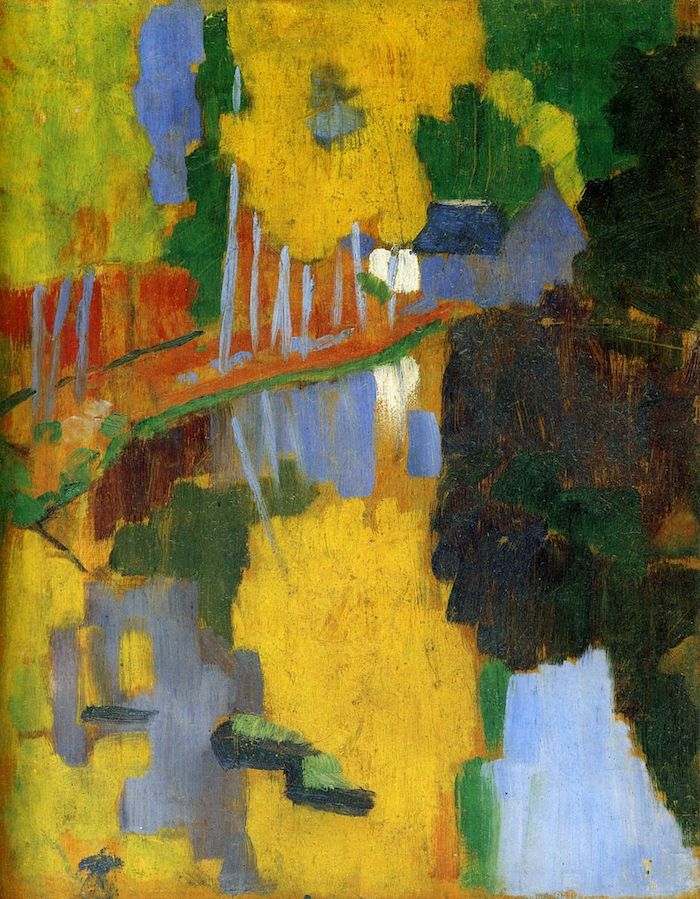
Paul Sérusier: The Talisman, also known as Landscape at the Bois d'Amour (1888); oil on panel 27 x 21.5 cm. Musée d'Orsay
Locations
People
Groups
Topics
Subjects
Regions
Subregions
Years: 1888 - 1899
Paul Sérusier: The Talisman, also known as Landscape at the Bois d'Amour (1888); oil on panel 27 x 21.5 cm. Musée d'Orsay
Locations
People
Groups
Topics
Subjects
Regions
Subregions