
Filters:
John II’s Return to English Captivity and …
Years: 1364 - 1364
April
John II’s Return to English Captivity and the Accession of Charles V (1363–1364)
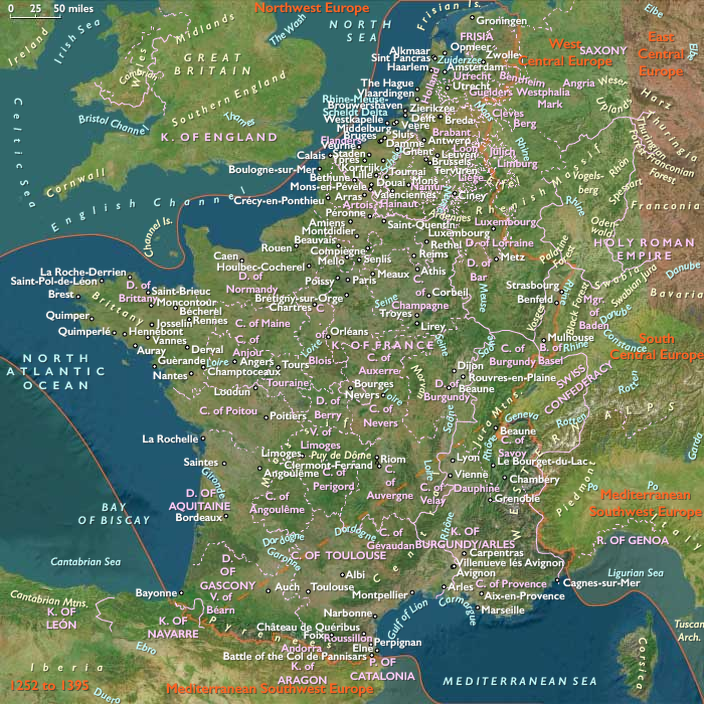
After failing to raise the full ransom required for his release under the Treaty of Brétigny-Calais (1360), King John II of France ("John the Good") voluntarily returned to English captivity in 1363. He died in London on April 8, 1364, making him one of the few medieval monarchs to willingly surrender himself as a prisoner. His eldest son, Charles, aged 26, assumed the French throne as King Charles V, despite violating the terms of the Brétigny agreement.
John II’s Return to Captivity (1363)
- Under the Treaty of Brétigny, France had agreed to pay 3 million gold crowns to ransom John II, but the country struggled to meet the payments.
- To guarantee the installments, France had provided hostages, including John’s own son, Louis of Anjou.
- In 1362, Louis of Anjou escaped captivity, breaking the terms of the agreement.
- Feeling honor-bound to uphold his promise, John II voluntarily returned to England in 1363, a rare act of chivalric loyalty and personal sacrifice.
John II’s Death and the Accession of Charles V (April 1364)
- John II died in London on April 8, 1364, ending a tumultuous reign marked by French defeats, economic turmoil, and political instability.
- His son, Charles V, took the throne despite the fact that his accession violated the Brétigny agreement, which had:
- Effectively disinherited John’s heirs in exchange for peace.
- Required that England retain sovereignty over large French territories.
- Charles, now King of France, rejected the treaty’s conditions, setting the stage for the renewal of the Hundred Years’ War.
Significance of Charles V’s Accession
- Unlike his father, Charles V proved to be a shrewd and politically astute ruler, ushering in a period of French resurgence.
- His military and financial reforms, along with his reliance on commanders like Bertrand du Guesclin, allowed France to reverse many of the English territorial gains from the Treaty of Brétigny.
- The war would resume in 1369, marking the beginning of France’s recovery from its earlier defeats.
John II’s return to captivity in 1363 and his death in 1364 marked the end of a disastrous reign, but Charles V’s accession signaled the beginning of a more competent and strategic French leadership, setting France on a path toward reclaiming lost territories.
Locations
People
- Bertrand du Guesclin
- Charles V of France
- Edward III of England
- Edward, the Black Prince
- John II of France
- Louis I, Duke of Anjou
Groups
Topics
Commodoties
Subjects
Regions
Subregions
Years: 1364 - 1364
April
Locations
People
- Bertrand du Guesclin
- Charles V of France
- Edward III of England
- Edward, the Black Prince
- John II of France
- Louis I, Duke of Anjou
Groups
Topics
Commodoties
Subjects
Regions
Subregions