French forces eventually aid Norodom to defeat …
Years: 1886 - 1886
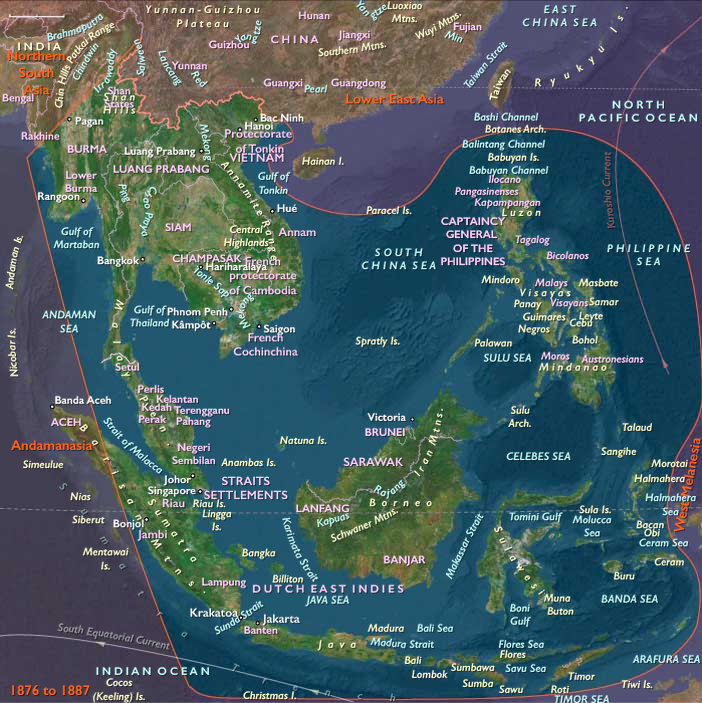
French forces eventually aid Norodom to defeat Si Votha under agreements that the Cambodian population be disarmed and acknowledge the resident-general as the highest power in the protectorate.
Locations
People
Groups
- French Cochinchina
- British Raj; India (Indian Empire)
- Cambodia, French protectorate of
- France (French republic); the Third Republic
Topics
Subjects
Regions
Subregions
Related Events
Filter results
Showing 10 events out of 10921 total
Young English artists returning from studying art in Paris mount the first exhibition of the New English Art Club in April 1886 n protest of the pseudoclassicism prevalent in the Royal Academy.
Among them are William Laidlay, Thomas Cooper Gotch, Frank Bramley, John Singer Sargent, Philip Wilson Steer, George Clausen and Stanhope Forbes.
Another founding member is G. P. Jacomb-Hood.
An early name suggested for the group was the 'Society of Anglo-French Painters', which gives some indication of their origins.
As a note in the catalogue to their first exhibition explains, 'This Club consists of 50 Members, who are more or less united in their art sympathies. They have associated themselves together with the view of holding an Annual Exhibition, hoping that a collective display of their works, which has hitherto been impossible, will prove not only of interest to the public, but will better explain the aim and method of their art.'
The Society will hold regular Spring and Autumn exhibitions, a number of which will be held at the Egyptian Hall in Piccadilly, London, until its demolition in 1905
The Great Vancouver Fire razes the entire city on June 13, 1886, a little more that two months after its incorporation on April 6, in the same year that the first transcontinental train arrived.
CPR president William Van Horne had arrived in Port Moody to establish the CPR terminus recommended by Henry John Cambie, and had given the city its name in honor of George Vancouver.
The Vancouver Fire Department is established this year and the city quickly rebuilt.
Vancouver will quickly become the largest city in the province, its ports conveying both the resource wealth of the province as well as that transported from the prairie provinces by rail, to markets overseas.
The Fraser Gold Rush of 1858 had brought over twenty-five thousand men, mainly from California, to New Westminster (founded February 14, 1859) on the Fraser River, on their way to the Fraser Canyon, bypassing what will become Vancouver.
Vancouver is among British Columbia's youngest cities; the first European settlement in what is now Vancouver was not until 1862 at McLeery's Farm on the Fraser River, just east of the ancient village of Musqueam in what is now Marpole.
A sawmill established at Moodyville (now the City of North Vancouver) in 1863, had begun the city's long relationship with logging.
It had quickly been followed by mills owned by Captain Edward Stamp on the south shore of the inlet.
Stamp, who had begun lumbering in the Port Alberni area, had first attempted to run a mill at Brockton Point, but difficult currents and reefs had forced the relocation of the operation in 1867 to a point near the foot of Gore Street.
This mill, known as the Hastings Mill, becomes the nucleus around which Vancouver forms.
The mill's central role in the city wanes after the arrival of the Canadian Pacific Railway (CPR) in the 1880s.
It will nevertheless remain important to the local economy until it closed in the 1920s.
The settlement which comes to be called Gastown had grown up quickly around the original makeshift tavern established by "Gassy" Jack Deighton in 1867 on the edge of the Hastings Mill property.
In 1870, the colonial government had surveyed the settlement and laid out a townsite, renamed "Granville" in honor of the then-British Secretary of State for the Colonies, Lord Granville.
This site, with its natural harbor, had been selected in 1884 as the terminus for the Canadian Pacific Railway, to the disappointment of Port Moody, New Westminster and Victoria, all of which had vied to be the railhead.
A railway had been among the inducements for British Columbia to join the Confederation in 1871, but the Pacific Scandal and arguments over the use of Chinese labor had delayed construction until the 1880s.

Hawaii's King Kalākaua is said to have wanted to build a Polynesian Empire.
In 1886, the legislature grants the government thirty thousand dollars (seven hundred and seventy-six thousand dollars today) for the formation of a Polynesian confederation.
The King sends representatives to Sāmoa, where Malietoa Laupepa agrees to a confederation between the two kingdoms.
This confederation will not last very long, however, since King Kalākaua will lose power the next year to the Bayonet Constitution, and thus a reformist party will come into power that will end the alliance.
French, British, German, and American vessels routinely stop at Samoa by the late nineteenth century, as they value Pago Pago Harbor as a refueling station for coal-fired shipping and whaling.
The United Kingdom, Germany and the United States all claim parts of the kingdom of Samoa, and have established trading posts in the latter part of the nineteenth century.
The rivalry between these powers exacerbates the indigenous factions that are struggling to preserve their ancient political system.
Britain also sends troops to protect British business enterprise, harbor rights, and the consulate office in 1886.
There follows an eight-year civil war, where each of the three powers will supply arms, training, and in some cases, combat troops to the warring Samoan parties.
The United States had begun operations at the excellent Samoan harbor of Pago Pago on Tutuila in 1877 and formed alliances with local native chieftains, most conspicuously on the islands of Tutuila and Manu'a (which will later be formally annexed as American Samoa).
British business enterprises, harbor rights, and consulate office are the basis on which the United Kingdom had cause to intervene in Samoa.
New Zealand feminists, by demanding that men take responsibility for the right of women to walk the streets in safety, deploy the rhetoric of white slavery to argue for women's sexual and social freedom.
Feminists are using the rhetoric of "white slavery" by the 1880s to reveal men's sexual and social oppression of women.
Burma becomes a province of British India in 1886.
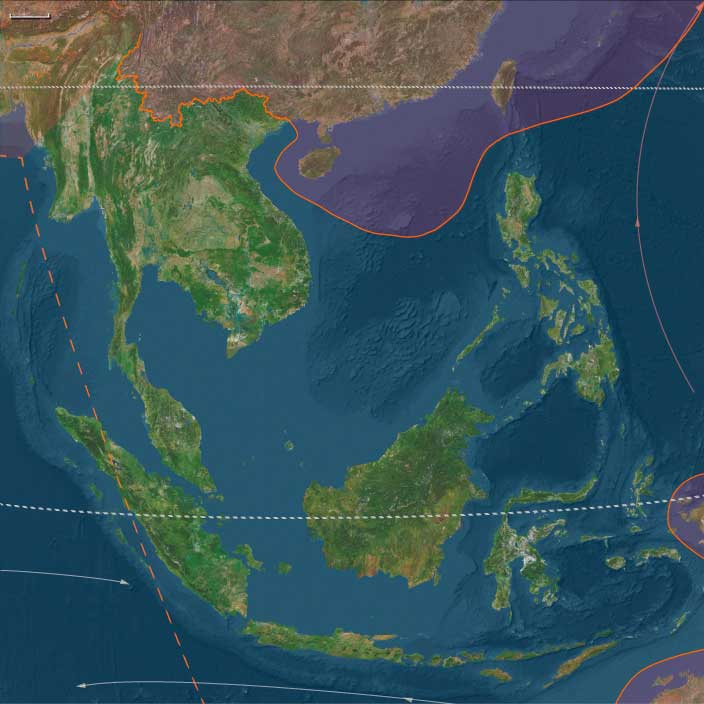
The first two decades of French rule in Cambodia have included numerous reforms into Cambodian politics, such as the reduction of the monarch's power and abolition of slavery.
The governor of Cochinchina, Charles Anthoine François Thomson, had attempted to overthrow the monarch in 1884, and establish full French control over Cambodia by sending a small force to the royal palace in Phnom Penh.
The movement is only slightly successful as the first governor-general of French Indochina, who will assume office in 1887 on the creation of that polity, will prevent full colonization due to possible conflicts with Cambodians.
The monarch's power is further reduced, however, to that of a figurehead.
In 1885, Si Votha, half brother of Norodom and contender for the throne, had launched a rebellion to dispose of the French-backed Norodom after coming back from exile in Siam.
Gathering support from opposition to Norodom and the French, Si Votha’s rebellion is primarily concentrated in the jungles of Cambodia and the city of Kampot.
Japan institutes compulsory vaccination in 1886.
Asher Ginsberg, better known by his pen name Ahad Ha'am (”One of the People”), moves to Odessa at thirty with the vague hope of modernizing Judaism.
Here he is influenced both by Jewish nationalism and by the materialistic philosophies of the Russian left-wing nihilist Dmitry Pisarev and the English and French positivists.
The son of a Hasidic rabbi, he is typical of the Russian maskalim, the leaders of the Haskalah (”enlightenment”) movement.
Reared in Russia in a rigidly Orthodox Jewish family, he had mastered rabbinic literature but soon was attracted to the rationalist school of medieval Jewish philosophy and to the writings of the Haskala.
The civil list of the Imperial family has been reduced, and estimates for the army, navy and civil service have been cut down considerably.
This has allowed the introduction of a series of financial reforms that tend to ameliorate the condition of the peasantry: the poll tax is abolished in 1886, a law is passed to accelerate legal transfer of the land allotted to the peasants in 1861, the payments due from them for this land are greatly reduced, Crown lands are made available for leasing or purchase to the peasants on advantageous terms, and great stretches of Crown lands in Eastern Russia and Siberia are opened for peasant emigration and resettlement.
Years: 1886 - 1886
Locations
People
Groups
- French Cochinchina
- British Raj; India (Indian Empire)
- Cambodia, French protectorate of
- France (French republic); the Third Republic