
Antoine Laumet de La Mothe, sieur de …
Years: 1689 - 1689
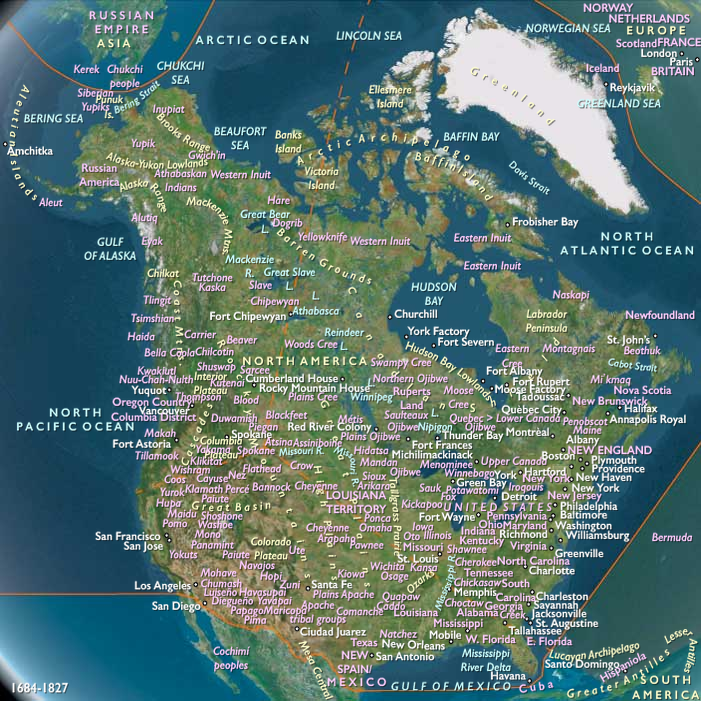
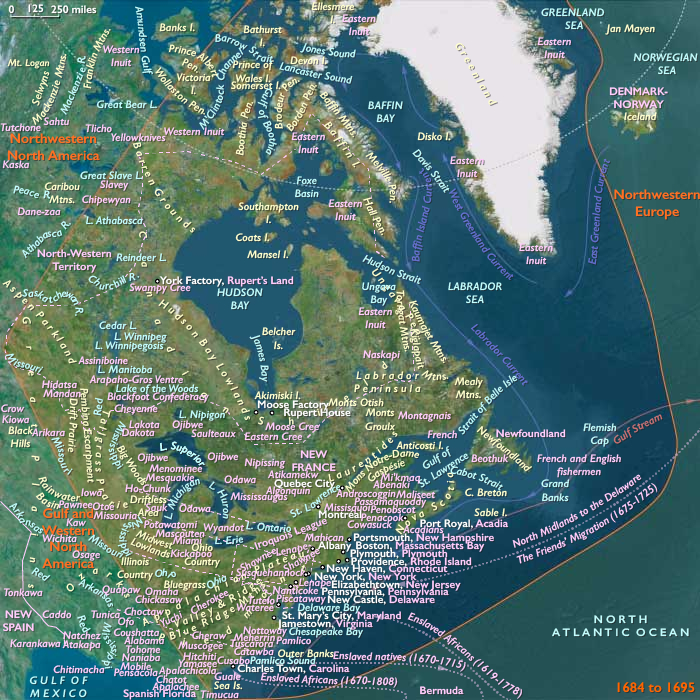
Antoine Laumet de La Mothe, sieur de Cadillac, a French army lieutenant who had gone to Canada in 1683, had during the next four years explored his new country in all directions, extending his explorations to New England and New Holland, pushing on south to the Caroline (present North Carolina and South Carolina) and familiarizing himself with the native languages and habits.
He had probably entered into a business relationship with Denis Guyon, a merchant of Quebec, whose seventeen-year-old daughter Marie-Thérèse he had married on June 25, 1687.
His marriage will prove to be a fertile one, and the Lamothe-Cadillac couple is to have six daughters and seven sons.
The marriage certificate is the first document where his new identity appeared.
He calls himself "Antoine de Lamothe, écuyer, sieur de Cadillac", and signs as "De Lamothe Launay".
Lke many immigrants, he has taken advantage of his arrival in the New World to create a new identity, perhaps to conceal the reasons that had driven him from France.
This new identity "ne sort pas de son sac" ("I did not create this identity out of nowhere"), as he will write later.
The former Antoine Laumet likely remembered Sylvestre d'Esparbes de Lussan de Gout, baron of Lamothe-Bardigues, lord of Cadillac, Launay and Le Moutet; adviser to the Parliament of Toulouse.
He knew him for at least two reasons: Bardigues, Cadillac, Launay and Le Moutet all are villages and localities close to his birthplace, Saint-Nicolas-de-la-Grave, and his father Jean Laumet was a lawyer in the Parliament of Toulouse.
It is probable that the sons knew each other during their studies.
The second son in his family, Laumet identified with the second son of the baron while taking advantage of the phonic similarity between his own name and that of Launay, creating Antoine de Lamothe-Launay and taking the title of écuyer (squire), the rank held by a family's second son, followed by the title sieur (sire) of Cadillac.
This accords with the Gascon custom whereby the junior family member succeeds the elder son upon the latter's death.
Laumet has thus created a new identity as well as noble origin, while protecting himself from possible recognition by someone who had known him in his home country.
In addition, he presents his own titles of nobility as illustrated by armorial bearings that he has created by associating the shield with the three “merlettes” (birds with no legs nor bill) of the baron de Lamothe-Bardigues and that of the Virès family (of France's Languedoc region).
He receives from Denonville in 1688 the concession of the seigniory (estate) of Les Douacques (which will later become the town of Bar Harbor, Maine, well-known fishing town reputed for its lobster and surmounted by Mount Desert, later known as Cadillac Mountain).
His concession brings him no income, even from agriculture, and so he has entered into partnership with officers of Port Royal and started trading, an activity facilitated by the possibility of using a ship belonging to the Guyon brothers.
Sent in 1689 on an expedition in the vicinity of Boston, he asks, on his return, the governor of Acadia, Louis-Alexandre des Friches de Méneval, for a job as notary, to bring in a minimum income; his request is turned down.
He is then introduced to the governor Louis de Buade de Frontenac in Quebec, who sends him on an exploratory mission along the coasts of New England, aboard the frigate "L'Embuscade" (The Ambush); strong head winds force the ship to return to France.
Locations
People
- Antoine Laumet de La Mothe, sieur de Cadillac
- Jacques-René de Brisay de Denonville
- Louis de Buade, Comte de Frontenac et de Palluau
Groups
Topics
Subjects
Regions
Subregions
Related Events
Showing 10 events out of 29345 total
Years: 1689 - 1689
Locations
People
- Antoine Laumet de La Mothe, sieur de Cadillac
- Jacques-René de Brisay de Denonville
- Louis de Buade, Comte de Frontenac et de Palluau
Groups
Topics
Subjects
Regions
Subregions