Freemasons' Hall, the permanent headquarters of English …
Years: 1776 - 1776
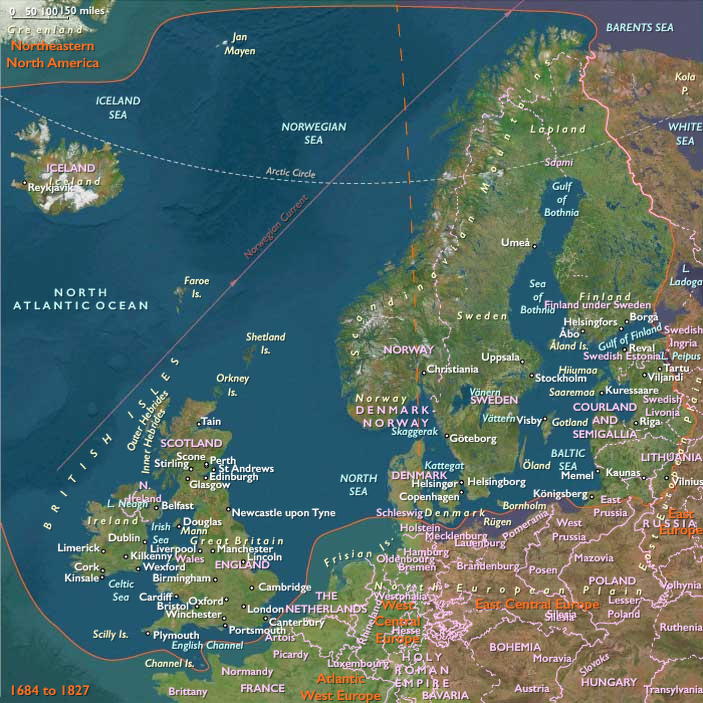
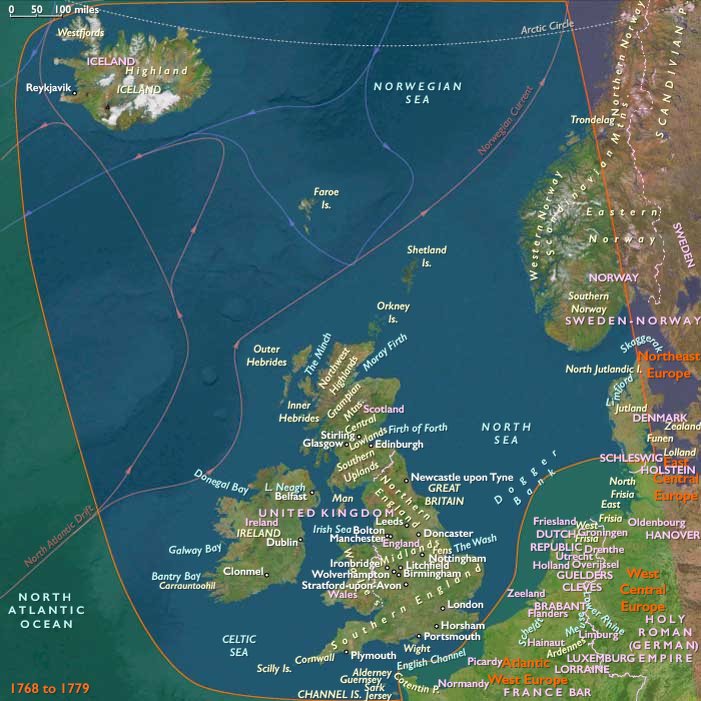
Freemasons' Hall, the permanent headquarters of English Masonry, opens in London in 1776.
Locations
Groups
Regions
Subregions
Related Events
Filter results
Showing 10 events out of 25581 total
During his two-year stay in England, Omai has become much admired within London high society.
Renowned for his charm, quick wit and exotic good looks, he had quickly become a favorite of the aristocratic elite.
Banks has regularly invited Omai to dine with the Royal Society and arranged meetings with notable celebrities of the time, including Lord Sandwich, Dr. Samuel Johnson, Frances Burney, and Anna Seward, among others.
Richard Holmes, a British author and academic best known for his biographical studies of major figures of British and French Romanticism, remarks that Omai's idiosyncratic behavior and distinctive bow were widely celebrated.
Indeed, during one famed meeting with King George III at Kew, Omai is said to have delivered his bow then grasped the King's hand, declaring, "How do, King Tosh!"
His portrait was painted by Sir Joshua Reynolds among others, and his journey to England and subsequent return to Tahiti with Cook on his third voyage in 1776 will become the subject of a theatrical production, written and directed by the dramatist John O'Keefe, entitled Omai – A Voyage ‘round the World that will be performed during the 1785 Christmas season at London’s Theatre Royal in Covent Garden.
Researchers establish in 1776 that the Chinese alloy pai-t'ung (now called nickel silver), is composed of copper, nickel, and zinc.
Timur Shah Durrani, who spends much of his reign in quelling the rebellions of the tribal chiefs, shifts his capital from Qandahar to Kabul in 1776 because of this opposition.
Later in 1776, Raghunathrao unsuccessfully tries to get help from the Portuguese.
After this he comes to Bombay.
During this period Company gives him fifteen thousand rupees.
The Treaty of Purandhar (March 1, 1776) annuls that of Surat, Raghunathrao is pensioned and his cause abandoned, but the revenues of Salsette and Broach districts are retained by the British.
The Bombay government rejects this new treaty and gives refuge to Raghunathrao.
The debt incurred by France during the Seven Years' War, still unpaid, is further exacerbated by Vergennes' prodding Louis XVI to get involved in Great Britain's war with its North American colonies, due to France's traditional rivalry with Great Britain.
Holy Roman Emperor Joseph, amid preparations for sending help to France, and in the atmosphere of the first wave of libelles, comes to call on his sister and brother-in-law on April 18, 1777, the subsequent six-week visit in Versailles a part of the attempt to figure out why their marriage has not been consummated.
It is due to Joseph's intervention that, on August 30, 1777, the marriage is officially consummated.
The southern colonies, which produce tobacco, rice, and indigo and export them to Britain, had been granted higher credit than the northern colonies, where competitive commodities are produced.
It is estimated that in 1776 the total amount of debt that British merchants claimed from the colonies equaled £2,958,390; southern colonies had claims of £2,482,763, nearly eighty-five per cent of the total amount.
Before the crisis, the commission system of trading had prevailed in the southern plantation colonies.
The merchants in London had helped the planters sell their crops and had shipped what planters wanted to purchase in London as returns.
The commission equaled the price of the British goods minus the revenue of the crops.
The planters were usually granted credit for twelve months without interest and at five per cent on the unpaid balance after the deadline.
After the outbreak of the crisis, British merchants urgently called for debt repayment, and American planters faced the serious problem of how to pay the debt for several reasons.
First, because of the economic boom before the crisis, planters were not prepared for large-scale debt liquidation.
As the credit system broke down, bills of exchange were rejected and almost all gold was sent to Britain.
Second, without the support of credit, planters were unable to continue producing and selling their goods.
Since the whole market became crippled, the fallen price of their goods also intensified the pressure on planters.
Owing to the crisis, the colonies have endured hard times to maintain the balance of payments.
Adam Smith publishes his masterwork, An Inquiry into the Nature and Causes of the Wealth of Nations, in 1776.
His major thesis is that, save for such limited functions as defense, justice, and certain public works, the state should not interfere with the economic life of a nation.
He suggests that businessmen and merchants (in whom he places no trust to do anything other than conspire together against the public or raise prices) are guided “as if by an invisible hand” to promote the well-being of society.
An exponent of free trade, he champions competition and sees monopoly, private or state-imposed, as a great evil.
By some readings, Smith is seen as blessing the expansion of Britain's opium trade and nourishing British policy to maintain the American colonies as backward producers of raw materials and consumers of finished goods.

Howe demands a retraction of the Declaration of Independence, which is refused, and negotiations end.
The British now quickly seize New York City and nearly capture Washington's army.
They make New York their main political and military base of operations in North America, holding it until November 1783.
The city becomes the destination for Loyalist refugees and a focal point of Washington's intelligence network.
Washington crosses the Delaware River back into New Jersey in a surprise attack in late December 1776 and defeats Hessian and British armies at Trenton and Princeton, thereby regaining control of most of New Jersey.
The victories give an important boost to Patriots at a time when morale is flagging, and will become iconic events of the war.