Frederick William, Elector of Brandenburg, reconfirms the …
Years: 1653 - 1653
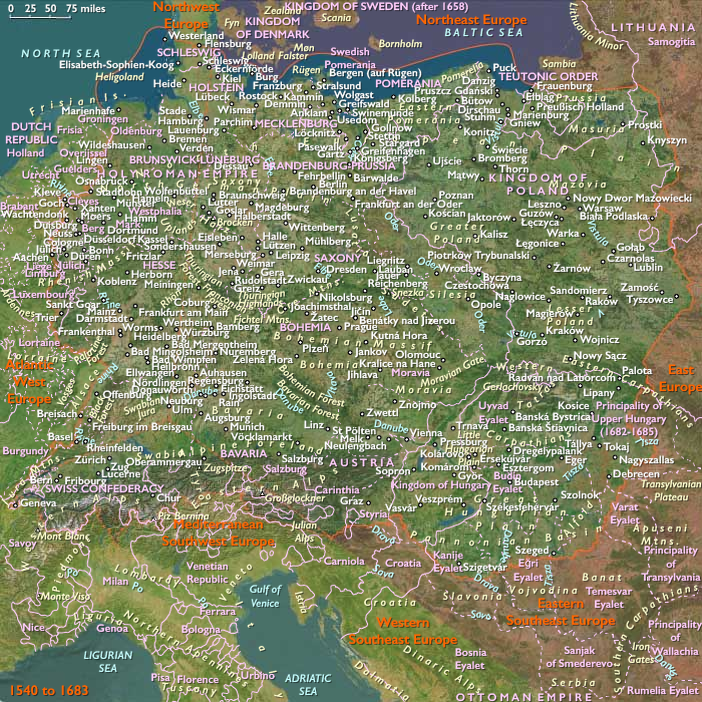
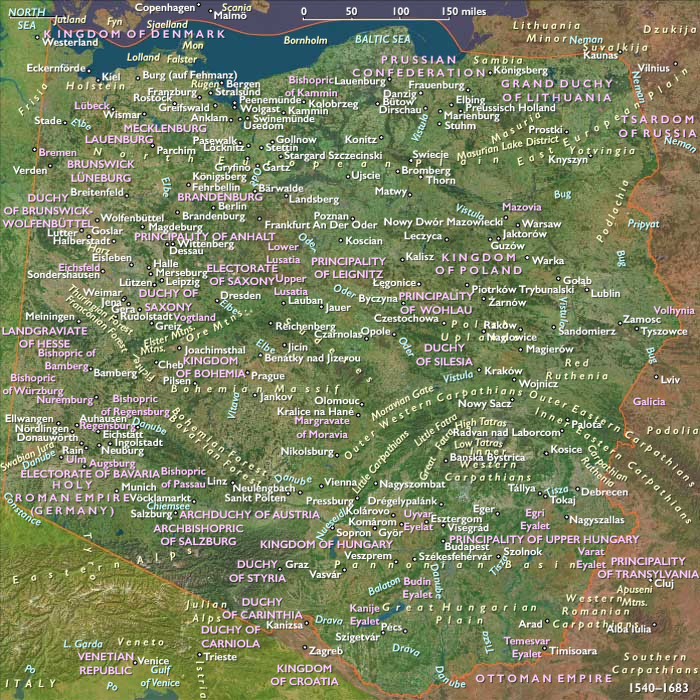
Frederick William, Elector of Brandenburg, reconfirms the nobility's freedom from taxation and its unlimited control over the peasants.
Locations
People
Groups
Subjects
Regions
Subregions
Related Events
Filter results
Showing 10 events out of 31651 total
Christina is interested in theater and ballet.
A French ballet-troupe under Antoine de Beaulieu has been employed by the court from 1638, and there are also an Italian and a French Orchestra at the royal chapel at court, all of which inspire her greatly.
She has invited foreign companies to play at Bollhuset, such as an Italian Opera troupe in 1652 and a Dutch theater troupe in 1653.
Among the foreign artists she employs at court is Anne Chabanceau de La Barre, who has been made made court singer.
She is also herself an amateur actress, and amateur theater is very popular at court during her reign.
Her court poet Georg Stiernhielm has written her several plays in the Swedish language, such as Den fångne Cupido eller Laviancu de Diane, performed at court with Christina in the main part of the goddess Diana.
She establishes the dance order Amaranterordern in 1653.
The grieving widower Shah Jahan, emperor during the Mughal empire's period of greatest prosperity, had begin construction of the Taj Mahal in 1632, one year after the death of his wife.
The principal mausoleum had been completed in 1648 and the surrounding buildings and garden are finished five years later.
While earlier Mughal buildings were primarily constructed of red sandstone, Shah Jahan has promoted the use of white marble inlaid with semiprecious stones, and buildings under his patronage have reached new levels of refinement.
Taj Mahal incorporates and expands on design traditions of Persian architecture and earlier Mughal architecture.
Specific inspiration came from such successful Timurid and Mughal buildings as the Gur-e Amir (the tomb of Timur, progenitor of the Mughal dynasty, in Samarkand), Humayun's Tomb, Itmad-Ud-Daulah's Tomb (sometimes called the Baby Taj), and Shah Jahan's own Jama Masjid in Delhi.
Widely considered as one of the most beautiful buildings in the world, the Taj Mahal stands today as a symbol of eternal love.
The Catalan Revolt has affected a large part of Catalonia since the declaration in 1640 of the Catalan Republic.
The conflict extends beyond the Peace of Westphalia, which concluded the Thirty Years' War in 1648, with the confrontation between two sovereigns and two Generalitats, one based in in Perpinyà (Perpignan), under the occupation of France, and ...
...the other based in Barcelona, under the control of Spain.
For the past decade, the Catalans and French have fought as allies, until in 1652 a Spanish offensive captures Barcelona, bringing the Catalan capital under Spanish control again.
Irregular resistance is to continue for several years afterwards, but the successful siege of Barcelona marks the end of major fighting.
The French authorities in 1652 renounce Catalonia but hold control of Roussillon, thereby leading to the signing in 1659 of the Treaty of the Pyrenees.
Charles de Menou d'Aulnay, officially in possession of the governorship of Acadia from 1647, had not had long to enjoy his triumph, as in 1650 he had died following a canoe accident, throwing the title of Acadia again into question.
His archrival Charles de Saint-Étienne de la Tour, discovering the devastation had made at St. John in his absence immediately on his return from Quebec in 1645, had sailed for France and laid the facts before the court.
Eventually rehabilitated, la Tour had not only secured a restoration of his title and privileges, but had been made d'Aulnay's successor.
D'Aulnay's widow Jeanne Motin, heavily in debt, was still living in Acadia with her children.
Alarmed at the turn affairs had taken, she had begun making preparations offensive and defensive but all hostilities had suddenly ceased.
The leaders of the opposing forces conclude to end their troubles by marriage on February 24, 1653, when Charles La Tour marries a third time, to Jeanne Motin.

The Iroquois have gained additional territory in the west and south by dispersing the Petun, or Tobacco Nation and the Chonnonton or Neutrals, upon whom the Iroquois had declared war in 1650.
Like the Huron, both tribes are Iroquoian-speaking nations.
Following decimation by disease, Huron, Petun and Chonnonton survivors are dispersed by Iroquois warfare and encroachment after 1650.
By 1653, the Neutrals are practically annihilated, and their villages are wiped out, including Kandoucho, the nearest to the Hurons.
The remnants of the Petuns join with some refugee Hurons to become the Huron-Petuns, later known as the Wyandot.
The evolution of Montrèal and of all New France is essentially guaranteed by the arrival of another one hundred and forty individuals at Ville Marie on November 16, 1653.
Marguerite Bourgeoys founds the Congrégation de Notre-Dame, Montrèal's first school, in this year.
A new plan of municipal government had been arranged in the Netherlands, and the name "New Amsterdam" is officially declared on February 2, 1653.
Stuyvesant makes a speech for the occasion, saying that his authority will remain undiminished.
A meeting of the commissioners on boundaries had taken place in September 1650, in Hartford, Connecticut.
The border had been arranged to the dissatisfaction of the Nine Men, who declared that "the governor had ceded away enough territory to found fifty colonies each fifty miles square."
Stuyvesant had then threatened to dissolve the council.
Stuyvesant is now ordered to the Netherlands, but the order is soon revoked under pressure from the States of Holland and the city of Amsterdam.
Stuyvesant prepares against an attack by ordering the citizens to dig a ditch from the North River to the East River and to erect a fortification.
A convention of two deputies from each village in New Netherland in 1653 demands reforms, and Stuyvesant commands that assembly to disperse, saying: "We derive our authority from God and the company, not from a few ignorant subjects."
The Dutch see important farming potential along the Rondout Creek and return to the area once more: the first recorded permanent settler in what will become the city of Kingston is Thomas Chambers, who comes from the area of Rensselaerswyck to the north in 1653.
The new settlement is called Esopus after the local Lenape people.
The Fronde gradually loses steam and ends in February 1653, when Mazarin returns unopposed.
The Fronde as a civil war is now over.
The whole country, wearied of anarchy and disgusted with the princes, have come to look to the king's party as the party of order and settled government, and thus the Fronde has prepared the way for the absolutism of Louis XIV.
The general war continues in Flanders, Catalonia, and Italy wherever a Spanish and a French garrison are face to face, and Condé, with the wreck of his army, openly and defiantly enters the service of the king of Spain.
This "Spanish Fronde" is almost purely a military affair.