Frederick II, made master of Germany by …
Years: 1220 - 1220
April
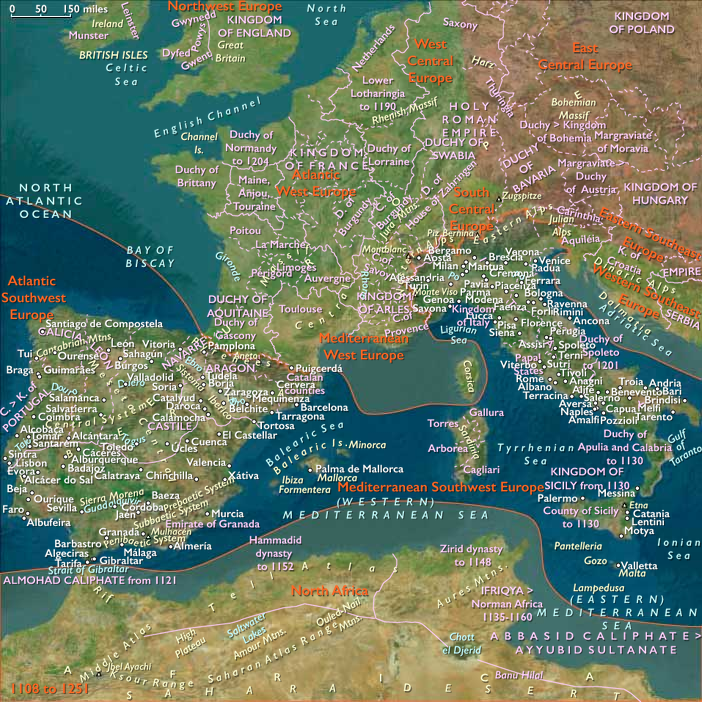
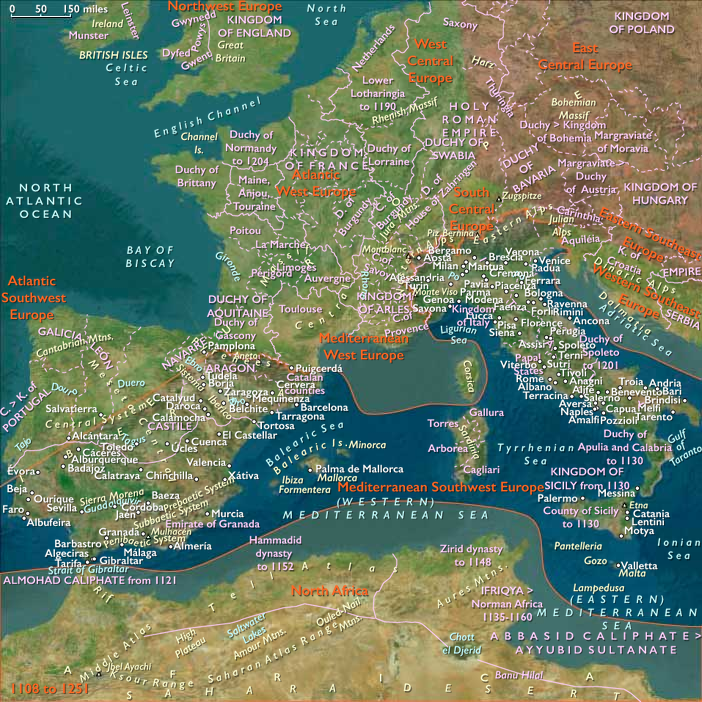
Frederick II, made master of Germany by Otto IV’s defeat in 1214 at the Battle of Bouvines, remains in Germany until 1220.
With the permission of Pope Honorius III, he then exchanges Germany for Sicily as the kingdom he can best retain, and assigns Germany to his infant son Henry.
Locations
People
Groups
- Papal States (Republic of St. Peter)
- Holy Roman Empire
- Christians, Roman Catholic
- Sicily, Hohenstaufen Kingdom of
Topics
Commodoties
Subjects
Regions
Subregions
Related Events
Filter results
Showing 6 events out of 6 total
The young king marries Philippa of Hainaut in 1328.
The Siege of Calais (September 1346 – August 1347): Edward III Secures England’s Foothold in France
Following his victory at the Battle of Crécy (August 26, 1346), Edward III of England advanced north and besieged the city of Calais, an important seaport on the English Channel. This siege, which lasted nearly a year, resulted in one of England’s most significant territorial acquisitions of the Hundred Years’ War, allowing the English to maintain a permanent military presence in northern France for over two centuries.
The Strategic Importance of Calais
- Calais, originally a fishing village, had grown into a prosperous seaport, serving as a major crossing point between England and France.
- Situated on an island surrounded by canals and harbors, the city was strongly fortified and could be supplied by sea, making it difficult to capture by land.
- Edward III recognized its strategic value, as controlling Calais would:
- Secure an English foothold in northern France.
- Provide a base for further invasions.
- Ensure safe passage for English reinforcements and supplies.
The Siege (September 1346 – August 1347)
- Edward III began the siege in September 1346, following his triumph at Crécy.
- The French garrison, led by Jean de Vienne, resisted fiercely, relying on naval resupply to sustain itself.
- However, Edward’s blockade cut off the city’s food and reinforcements, leading to widespread starvation among the defenders.
- By early 1347, the city’s population was exhausted and starving, forcing the leadership to negotiate surrender terms.
The Surrender: The Burghers of Calais
- To avoid mass slaughter, six prominent burghers (citizens) of Calais offered themselves as hostages to Edward III.
- They walked out of the city barefoot and wearing only sackcloth, expecting to be executed as a symbolic act of submission.
- Edward’s wife, Queen Philippa of Hainaut, intervened, pleading for their lives to be spared, which Edward granted.
The Establishment of the Pale of Calais
- With Calais now in English hands, Edward III expelled the city’s French inhabitants and repopulated it with English settlers.
- The English established the Pale of Calais, a fortified English-controlled zone around the city.
- Calais became a critical stronghold for England, allowing them to:
- Station troops safely in northern France.
- Launch further military campaigns into France.
- Control a major trade and naval route in the English Channel.
Calais Under English Control (1347–1558)
- Calais remained an English possession for over 200 years, serving as a military and commercial hub.
- Even after England lost most of its French territories, Calais remained its last continental stronghold.
- It was finally recaptured by the French in 1558 during a successful siege by Francis, Duke of Guise, marking the end of English rule in France.
The Siege of Calais (1346–1347) was one of Edward III’s greatest strategic victories, providing England with a lasting base in France and further cementing English dominance in the early phases of the Hundred Years’ War.
Edward III Intervenes in the Hook and Cod Wars: The Naval Battle off Veere (1351)
In 1351, Edward III of England intervened in the Hook and Cod Wars, siding with his sister-in-law, Margaret of Bavaria, in her struggle against her son, William V of Holland. His involvement led to a decisive naval victory off Veere, strengthening Margaret’s position in the conflict.
Edward III’s Involvement
- Margaret of Bavaria was the sister of Philippa of Hainault, Edward III’s queen consort.
- As the Cods (urban elites) supported William V and the Hooks (nobility) backed Margaret, the struggle escalated into a full-scale civil war in Holland and Zeeland.
- Edward III, already engaged in the Hundred Years' War, saw the conflict as an opportunity to extend English influence in the Low Countries.
- In 1351, he sent a fleet to support Margaret, resulting in a naval battle off Veere (in present-day Zeeland, Netherlands).
The Naval Battle off Veere (1351)
- Edward III’s fleet engaged the forces of William V, who had the backing of the Cod League and its supporters.
- The English navy defeated William’s fleet, giving Margaret and the Hooks temporary control over Zeeland.
- This victory secured English influence in the region, demonstrating England’s naval superiority and allowing Margaret to continue her struggle against her son.
Impact and Consequences
- Despite the victory, the war continued, as William V still held strong support among the urban elite in Holland.
- Margaret’s position was strengthened, but the conflict remained undecided until 1354, when William V ultimately secured control of Holland.
- Edward III’s involvement deepened English influence in the Low Countries, ensuring that Holland and Zeeland remained entangled in broader Anglo-French rivalries.
Edward III’s naval victory off Veere in 1351 was a key moment in the Hook and Cod Wars, reinforcing Margaret’s resistance but failing to deliver a decisive resolution to the civil war in Holland.
André Beauneveu: Royal Sculptor and Artist of Fourteenth-Century France
André Beauneveu, a sculptor, painter, and architect from Valenciennes, was one of the most highly esteemed artists of the French royal family in the second half of the fourteenth century. Despite the scarcity of biographical records, his impressive commissions and lasting artistic influence attest to his renown in both France and England.
Early Career and Work in England (Before 1364)
- Beauneveu worked under the patronage of Philippa of Hainault, the Queen of England and wife of Edward III.
- The earliest documentary reference to "Master Andrew the Painter" (presumed to be Beauneveu) appears in 1359, when he worked for Duchess Yolande de Bar, decorating a chapel in her castle at Nieppe (now destroyed).
Royal Patronage in France Under Charles V (1364–1366)
- By 1364, Beauneveu had moved to Paris, becoming part of King Charles V’s artistic workshop.
- The king referred to him as “our esteemed Andreu Bauneveu, our sculptor,” signaling his prominence at the royal court.
- In 1365, Charles V commissioned Beauneveu to create four monumental tomb sculptures for the royal crypt at Saint-Denis, the dynastic burial site of French kings.
The Saint-Denis Royal Tomb Project
- Charles V aimed to legitimize and reinforce the authority of the new Valois dynasty by creating spectacular tombs for himself and his immediate ancestors, placing them in the Capetian necropolis at Saint-Denis.
- Beauneveu designed the tombs in the latest artistic style, featuring:
- Brilliant white marble gisants (recumbent effigies of the deceased).
- Polished black marble slabs, creating a striking contrast.
- These effigies, particularly that of Charles V, were crafted in the representacion au vif style (representation from life), displaying highly personalized and lifelike features, distinguishing them from earlier, more stylized medieval tomb sculptures.
Completion by Other Artists and Legacy
- Beauneveu was paid 4,700 gold francs for his work, demonstrating his high status and the importance of the project.
- Records of payments to Beauneveu cease in 1366, suggesting that he left the project, which was then completed by Jean de Liège and other sculptors.
- Although the tombs were destroyed in 1793 during the French Revolution, their form is preserved in late seventeenth-century drawings commissioned by Roger de Gaignières.
- The surviving gisants (effigies) of Charles V and his family are still at Saint-Denis, though now mounted on plain bases.
Beauneveu’s Influence and Later Recognition
- His work set a new standard for royal tomb sculpture, influencing future commissions, including the Burgundian necropolis at Champmol a decade later.
- His realistic approach to portraiture and refined use of marble established him as one of the most innovative artists of the period.
André Beauneveu’s masterful sculptures at Saint-Denis and his prominent role in Charles V’s court cemented his reputation as one of the leading artists of fourteenth-century France, bridging the artistic traditions of France, England, and the Low Countries.
French historian and poet Jean Froissart is twenty-three-years old in 1360 when he begins work on his “Chronicles,” an account of European affairs beginning in 1325.
Borrowed from the work of his elder contemporary Jean Le Bel for the period up to 1356; he bases his account of subsequent events on eyewitness reports.
A writer of lyric poetry as well as a historian, Froissart expresses the courtly view of life in “Meliador,” a long Arthurian verse romance.
What little is known of Froissart's life comes mainly from his historical writings and from archival sources which mention him in the service of aristocrats or receiving gifts from them.
Although his poems have also been used in the past to reconstruct aspects of his biography, this approach is in fact flawed, as the 'I' persona which appears in many of the poems should not be construed as a reliable reference to the historical author.
Froissart comes from Valenciennes in the County of Hainaut, situated in the western tip of the Holy Roman Empire, bordering France.
Earlier scholars have suggested that his father was a painter of armorial bearings, but there is actually little evidence for this.
Other suggestions include that he began working as a merchant but soon gave that up to become a cleric.
For this conclusion there is also no real evidence, as the poems which have been cited to support these interpretations are not really autobiographical.
By about age twenty-four, Froissart leaves Hainault and enters the service of Philippa of Hainault, queen consort of Edward III of England, in 1361 or 1362.
This service, which will have lasted until the queen's death in 1369, has often been presented as including a position of court poet and/or official historiographer.
Based on surviving archives of the English court, Croenen has concluded instead that this service did not entail an official position at court, and probably was more a literary construction, in which a courtly poet dedicated poems to his 'lady' and in return received occasional gifts as remuneration.
Froissart takes a serious approach to his work.
He travels in England, Scotland, Wales, France, Flanders and Spain gathering material and firsthand accounts for his Chronicles.
He travels with Lionel, Duke of Clarence, to Milan to attend and chronicle the duke's wedding to Violante, the thirteen-year-old daughter of Galeazzo Visconti, in May 1368.
At this wedding, two other significant writers of the Middle Ages are present: Chaucer and Petrarch.

Edward III falls under the influence of his unscrupulous mistress, Alice Perrers, following the death, in 1369, of Philippa of Hainult, his wife of over forty years.
Years: 1220 - 1220
April
Locations
People
Groups
- Papal States (Republic of St. Peter)
- Holy Roman Empire
- Christians, Roman Catholic
- Sicily, Hohenstaufen Kingdom of