
The election of Henry VI's three-year-old son …
Years: 1108 - 1251
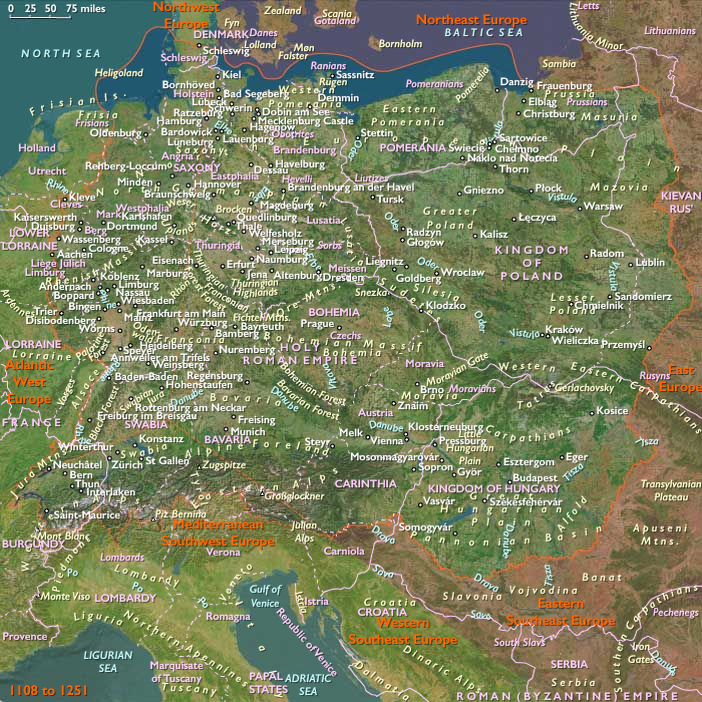
The election of Henry VI's three-year-old son Frederick to be German king appears likely to make orderly rule difficult; therefore, the boy's uncle, Philip, is chosen to serve in his place.
Other factions elect a Welf candidate, Otto IV, as counterking, and a long civil war begins.
Philip is murdered by Otto IV in 1208.
Otto IV in turn is killed by the French at the Battle of Bouvines in 1214.
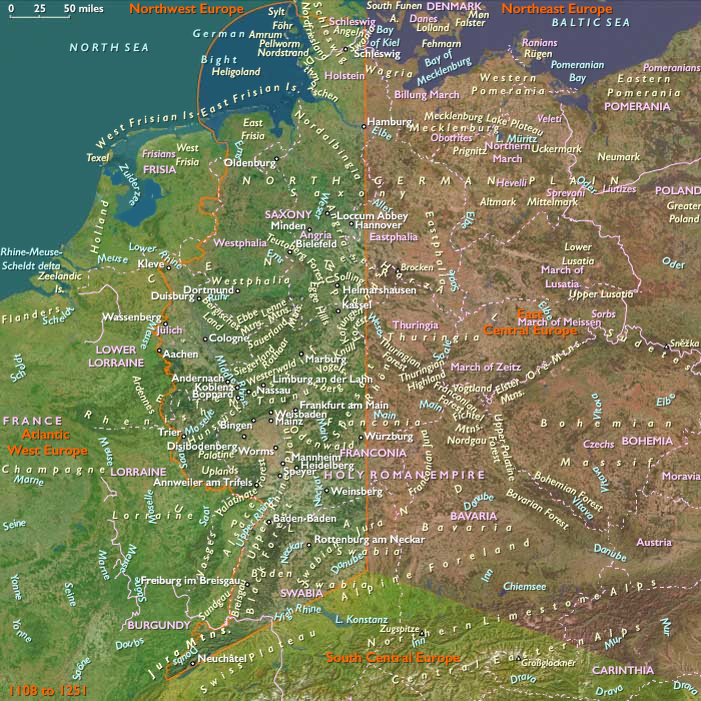
Frederick returns to Germany in 1212 from Sicily, where he had grown up, and becomes king in 1215.
As Frederick II (r. 1215-50), he spends little time in Germany because his main concerns lie in Italy.
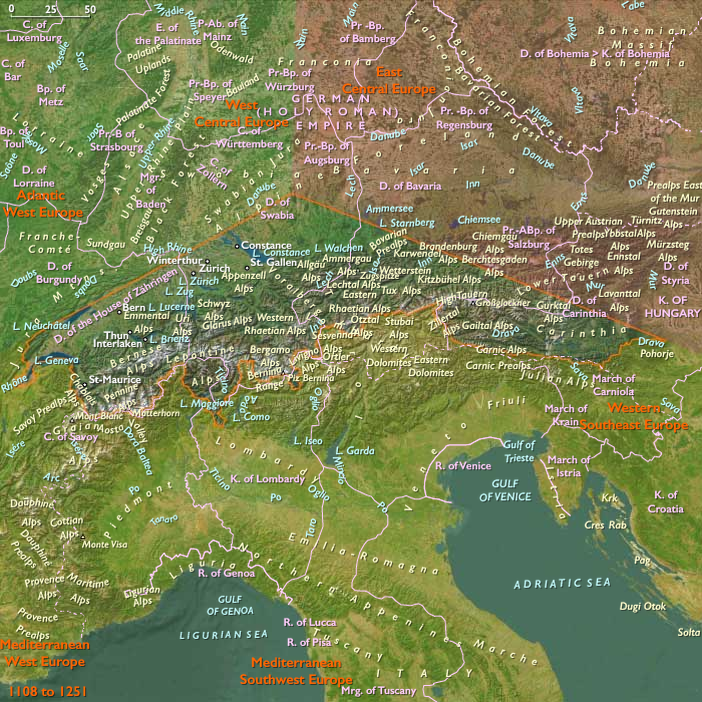
Frederick makes significant concessions to the German nobles, such as those put forth in an imperial statute of 1232, which makes princes virtually independent rulers within their territories.
The clergy also becomes more powerful.
Although Frederick is one of the most energetic, imaginative, and capable rulers of the Middle Ages, he does nothing to draw the disparate forces in Germany together.
His legacy is thus that local rulers have more authority after his reign than before it.
People
Groups
- Germans
- German, or Ottonian (Roman) Empire
- Italy, Kingdom of (Holy Roman Empire)
- French people (Latins)
- France, (Capetian) Kingdom of
- Christians, Roman Catholic
- Welf, House of
- Sicily, Hohenstaufen Kingdom of
Topics
Subjects
Regions
Subregions
Years: 1108 - 1251
People
Groups
- Germans
- German, or Ottonian (Roman) Empire
- Italy, Kingdom of (Holy Roman Empire)
- French people (Latins)
- France, (Capetian) Kingdom of
- Christians, Roman Catholic
- Welf, House of
- Sicily, Hohenstaufen Kingdom of
Topics
Subjects
Regions
Subregions