On the return voyage, le Clerc and …
Years: 1554 - 1554
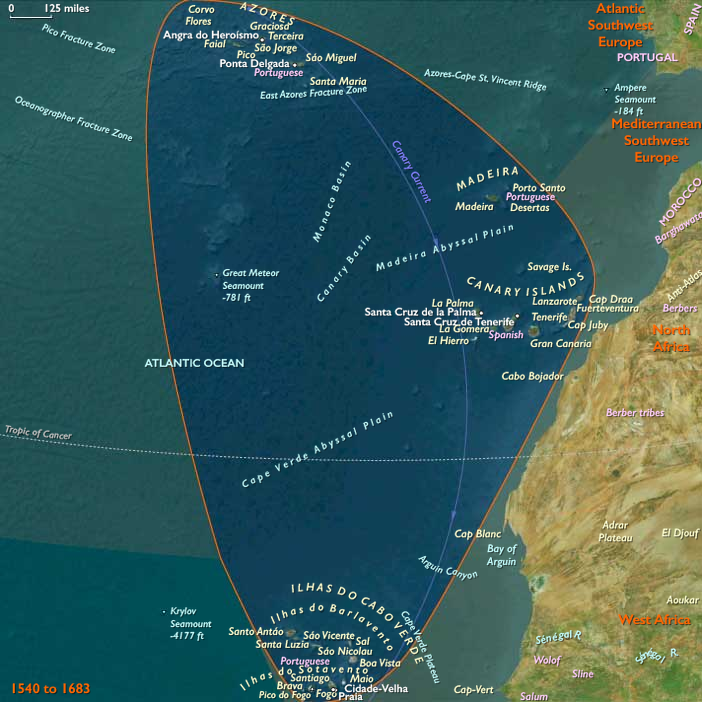
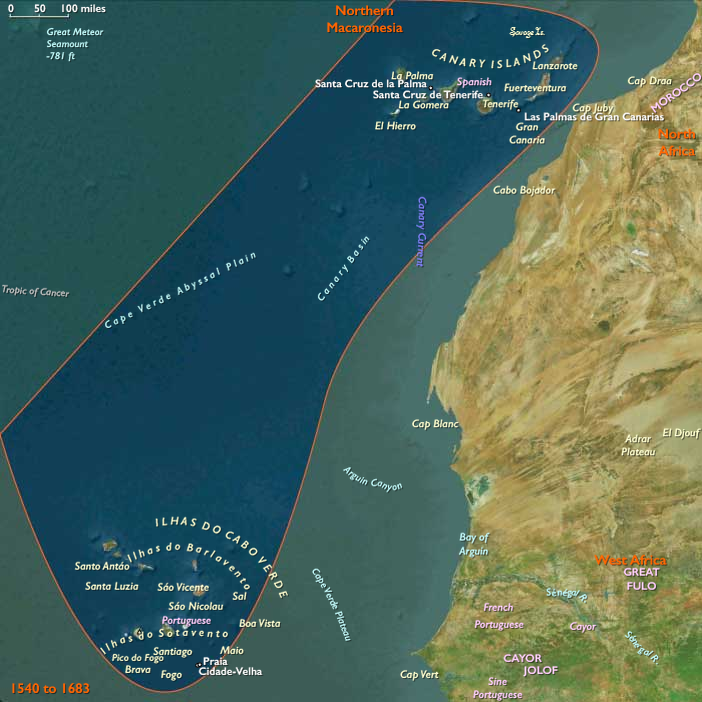
On the return voyage, le Clerc and his corsairs plundered Las Palmas on Grand Canary Island and captured a Genoese carrack, seizing an even richer bounty.
Locations
People
Groups
- Genoa, (Most Serene) Republic of
- Santo Domingo, Captaincy General of
- Spain, Habsburg Kingdom of
- France, (Bourbon) Kingdom of
Topics
Commodoties
- Fish and game
- Weapons
- Hides and feathers
- Gem materials
- Strategic metals
- Slaves
- Sweeteners
- Land
- Tobacco
Subjects
Regions
Subregions
Related Events
Filter results
Showing 8 events out of 8 total
The annexation, partly spurred by the Boers' failure to subjugate the Pedi, is a convenient way of resolving the border dispute between the Boers and the Zulus.
This also saves the Transvaal from financial ruin, as its government has little money.
The Transvaal Boers object, but as long as the Zulu threat remains, they fear that if they take up arms to resist the British annexation actively, King Cetshwayo and the Zulus would take the opportunity to attack.
They also fear a war on two fronts, namely that the local tribes would seize the opportunity to rebel and the simmering unrest in the Transvaal would be re-ignited.he British annexation nevertheless results in resentment against the British occupation and a growing nationalism.
The Transvaal Boers led by Vice President Paul Kruger will hereafter elect to deal first with the perceived Zulu threat to the status quo, and local issues, before directly opposing the British annexation.
Kruger makes two visits to London for direct talks with the British government.
Kruger, whose family was of German descent, was born at Bulhoek, on his grandfather's farm, which was approximately fifteen kilometers west of the town of Steynsburg and one hundred kilometers to the north of Cradock in the Eastern Cape Province, and he had grown up on the farm Vaalbank.
He had received only three months of formal education but from life on the veld had become proficient in hunting and horse riding.
Kruger's father, Casper Kruger, had joined the trek party of Hendrik Potgieter when the Great Trek started in 1835.
The trekkers had crossed the Vaal River in 1838, and had at first stayed in the area that is known today as Potchefstroom.
The trekkers had taken advantage of the political vacuum left after the Zulu wars and their aftermath, and had easily overcome the indigenous peoples.
Kruger's father had later decided to settle in the district now known as Rustenburg.
At the age of sixteen, Kruger had been entitled to choose a farm for himself at the foot of the Magaliesberg, where he had settled in 1841.
The following year, he had married Anna Maria Etresia du Plessis (1826-1846), and they had gone together with Paul Kruger's father to live in the Eastern Transvaal.
After the family had returned to Rustenburg, Kruger's wife and infant died in January, 1846.
He then married his second wife, Gezina Susanna Fredrika Wilhelmina du Plessis (1831-1901) in 1847, with whom he will remain until her death in 1901.
The couple will have seven daughters and nine sons, some dying in infancy.
A deeply religious man, Kruger claims to have only read one book, the Bible.
He also claims to know most of it by heart.
He is a founding member of the Reformed Church in South Africa.
He had begun his military service as a field cornet in the commandos and eventually became Commandant-General of the Zuid Afrikaanse Republiek (South African Republic), or ZAR.
He was appointed member of a commission of the Volksraad, the republican parliament that was to draw up a constitution.
People had begun to take notice of the young man, who had played a prominent part in ending the quarrel between the Transvaal leader, Stephanus Schoeman, and M.W. Pretorius.
Kruger had been present at the Sand River Convention in 1852.
Kruger had resigned as Commandant-General, and for a time had held no office and retired to his farm, Boekenhoutfontein.
However, he had been elected as a member of the Executive Council in 1874 and shortly after became the Vice-President of the Transvaal.

Paul Kruger meets in Pietermaritzburg with the British representatives, Sir Henry Bartle Frere and Lieutenant General Frederic Thesiger (shortly to inherit the title of Lord Chelmsford) in September 1878, on his return from the second visit to London, n order to update them on the progress of the talks.
Sir Theophilus Shepstone, in his capacity as British governor of Natal, has his own concerns about the expansion of the Zulu army under King Cetshwayo and the potential threat to Natal especially given the adoption by the Zulus of muskets and other modern weapons.
Shepstone had been present at Cetshwayo's coronation, but has turned on the Zulus as he feels he is undermined by Cetshwayo's skillful negotiating for land area compromised by encroaching Boers.
In his new role of Administrator of the Transvaal, he is now responsible for protecting the Transvaal and has direct involvement in the Zulu border dispute from the side of the Transvaal.
Persistent Boer representations and Kruger's diplomatic maneuverings add to the pressure.
There are incidents involving Zulu paramilitary actions on either side of the Transvaal/Natal border, and Sir Shepstone increasingly begins to regard King Cetshwayo (who now finds no defender in Natal save Bishop Colenso) as having permitted such "outrages," and to be in a "defiant mood."
Bartle Frere had begun to demand from the Zulus reparations for border infractions, mainly angering Cetshwayo, who keeps his calm until December 11, 1878, when Frere, notwithstanding the reluctance of the British government to start yet another colonial war, presents Cetshwayo with an ultimatum that the Zulu army be effectively be disbanded and the Zulus accept a British resident.
This is unacceptable to the Zulus as it effectively means that Cetshwayo, had he agreed, would lose his throne.
Cetshwayo asks for more time but Frere refuses.
Bartle Frere sends the British No. 3 Column under Lord Chelmsford to invade Zululand on January 11, with about seven thousand regular troops, a similar number of black African "levees" and a thousand white volunteers.
This results in the Battle of Isandlwana on January 22, 1879, which though a disaster for the British, does not end the war.
With the decisive defeat of Chelmsford's central column, the entire invasion of Zululand collapses and will have to be restaged.
Not only are there heavy manpower casualties to the Main Column, but most of the supplies, ammunition and draft animals have been lost.
As King Cetshwayo had feared, the embarrassment of the defeat will force the policy makers in London, who to this point had not supported the war, to rally to the support of the pro-war contingent in the Natal government and commit whatever resources are needed to defeat the Zulus.
Despite local numerical superiority, the Zulus do not have manpower, technological resources or logistical capacity to match the British in another, more extended, campaign.
The Zulus miss a tremendous opportunity to exploit their victory and possibly win the war this day on their own territory.
The reconnaissance force under Chelmsford, more vulnerable to being defeated by an attack than the camp is strung out and somewhat scattered, it had marched with limited rations and ammunition it cannot now replace, and it is panicky and demoralized by the defeat at Isandlwana.
Near the end of the battle, about four thousand Zulu warriors of the unengaged reserve Undi impi, after cutting off the retreat of the survivors to the Buffalo River southwest of Isandlwana, cross the river and attack the fortified mission station at Rorke's Drift.
The station is defended by only one hundred and thirty-nine British soldiers, who nonetheless inflict considerable casualties and repel the attack.
Elsewhere, the left and right flanks of the invading forces are now isolated and without support.
The No. 1 column under the command of Charles Pearson will be besieged for two months by a Zulu force at Eshowe, while the No. 4 column under Evelyn Wood halts its advance and will spend most of the next two months skirmishing in the northwest around Tinta's Kraal.
The British and Colonials had fallen into complete panic over the possibility of a counter invasion of Natal by the Zulus following the battles of Isandlwana and Rorke's Drift.
All the towns of Natal have 'laagered' up and fortified and provisions and stores laid in.
Bartle Frere has stoked the fear of invasion despite the fact that, aside from Rorke's Drift, the Zulus have made no attempt to cross the border.
Immediately following the battle, Zulu Prince Ndanbuko had urged them to advance and take the war into the colony but they were restrained by a commander, kaNthati, reminding them of Cetshwayo's prohibiting the crossing the border.
Unknown to the inhabitants of Natal, Cetshwayo, still hoping to avoid a total war, had prohibited any crossing of the border in retaliation and was incensed over the violation of the border by the attack on Rorke's Drift.
The British government's reasoning for a new invasion is threefold.
The first is jingoistic to a degree and national honor demands that the enemy, victors in one battle, should lose the war.
The second concerns the domestic political implications at the next parliamentary elections. (However, despite the new invasion, the British Prime Minister Disraeli and his party will lose the 1880 election.)
Finally, there are considerations affecting the Empire: unless the British are seen to win a clear-cut victory against the Zulus, it will send a signal that the British Empire is vulnerable and that the defeat of a British field army could alter policy.
If the Zulu victory at Isandlwana encourages resistance elsewhere in the Empire, then committing the resources necessary to defeat the Zulus will, in the long term, prove cheaper than fighting wars that the Zulu success inspire against British Imperialism elsewhere.
After Isandlwana, the British field army is heavily reinforced and again invades Zululand.
Sir Garnet Wolseley is sent to take command and relieve Chelmsford, as well as Bartle Frere.
Chelmsford, however, avoids handing over command to Wolseley and manages to defeat the Zulus in a number of engagements, the last of which is the Battle of Ulundi, followed by capture of King Cetshwayo.
The British encourage the subkings of the Zulus to rule their subkingdoms without acknowledging a central Zulu power.
By the time King Cetshwayo is allowed to return home in 1883 there will no longer be an independent Zulu kingdom.
The measure of respect that the British had gained for their opponents as a result of Isandlwana can be seen in that in none of the other engagements of the Zulu War had the British attempted to fight again in their typical linear formation, known famously as the Thin Red Line in an open-field battle with the main Zulu impi.
In the battles that followed, the British, when facing the Zulu, had entrenched themselves or formed very close-order formations, such as the square.
Sir Garnet Wolseley now turns to the Pedi in the Transvaal, and they are finally defeated by British troops in 1879.
The British now consolidate their power over Natal, the Zulu kingdom and the Transvaal.
Wolseley, promoted to brevet general while serving in South Africa on June 4, 1879, had superseded Lord Chelmsford in command of the forces in the Zulu War, and as governor of Natal and the Transvaal and the High Commissioner of Southern Africa.
Upon his arrival at Durban in July, he had found that the war in Zululand was practically over, and, after effecting a temporary settlement, he had gone on to the Transvaal.
Having reorganized the administration there and reduced the powerful chief, Sekhukhune, to submission, he returns home in May 1880 and is appointed Quartermaster-General to the Forces on July 1, 1880.
For his services in South Africa, he receives the South Africa Medal with clasp, and is advanced to GCB on June 19, 1880.
Years: 1554 - 1554
Locations
People
Groups
- Genoa, (Most Serene) Republic of
- Santo Domingo, Captaincy General of
- Spain, Habsburg Kingdom of
- France, (Bourbon) Kingdom of
Topics
Commodoties
- Fish and game
- Weapons
- Hides and feathers
- Gem materials
- Strategic metals
- Slaves
- Sweeteners
- Land
- Tobacco