
François Boucher, born in Paris, the son …
Years: 1739 - 1739
François Boucher, born in Paris, the son of a lace designer Nicolas Boucher, is perhaps the most celebrated decorative artist of the eighteenth century, with most of his work reflecting the Rococo style.
Boucher at the age of seventeen had been apprenticed by his father to François Lemoyne, but after only three months had gone to work for the engraver Jean-François Cars.
Within three years, Boucher had already won the elite Grand Prix de Rome, although he did not take up the consequential opportunity to study in Italy until four years later.
On his return in 1731 from studying in Italy, he was admitted to the Académie de peinture et de sculpture as a historical painter, and in 1734 became a faculty member.
He had in 1733 married Marie-Jeanne Buzeau, with whom he will have three children.
Along with his painting, Boucher also designs theater costumes and sets, and the ardent intrigues of the comic operas of Favart (1710–1792) closely parallel his own style of painting.
Tapestry design is also a concern.
For the Beauvais tapestry workshops, he had first designed a series of Fêtes italiennes ("Italian festivals") in 1736, which proved to be very successful and will often be rewoven over the years, then, commissioned in 1737, a suite of the story of Cupid and Psyche.
Boucher's early work, reflecting inspiration gained from the artists Watteau and Rubens, Bcelebrates the idyllic and tranquil, portraying nature and landscape with great élan.
His art, however, typically forgoes traditional rural innocence to portray scenes with a definitive style of eroticism, and his mythological scenes are passionate and intimately amorous rather than traditionally epic.
Marquise de Pompadour (mistress of King Louis XV), whose name becomes synonymous with Rococo art, is a great fan of Boucher's, and has the painter under her protection: it is particularly in his portraits of her that this style is clearly exemplified.
Paintings such as The Breakfast of 1739, a family scene, also show Boucher as a master of the genre scene, as he regularly uses his own wife and family as models.
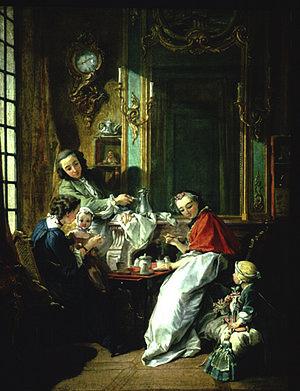
François Boucher: Le Dejeuner (1739) oil on canvas; 81.5 × 61.5 cm (32.1 × 24.2 in); Louvre Museum
Locations
People
Groups
Topics
Subjects
Regions
Subregions
Related Events
Showing 10 events out of 27420 total
Years: 1739 - 1739
François Boucher: Le Dejeuner (1739) oil on canvas; 81.5 × 61.5 cm (32.1 × 24.2 in); Louvre Museum
Locations
People
Groups
Topics
Subjects
Regions
Subregions