
Francisco Jimenez de Cisneros, born as Gonzalo …
Years: 1495 - 1495
Francisco Jimenez de Cisneros, born as Gonzalo Jiménez de Cisneros to a poor family in Torrelaguna in Castile in 1436, had studied at Alcalá de Henares and Salamanca, afterward having been ordained a priest.
In 1459, he had traveled to Rome to work as a consistorial advocate where he attracted the notice of Pope Pius II.
He had returned to Spain in 1465 carrying an "executive" letter from the Pope giving him possession of the first vacant benefice, which turned out to be Uceda.
However, Alfonso Carrillo de Acuña, the Archbishop of Toledo and Primate of Spain, had refused to accept the letter, wishing instead to bestow the benefice upon one of his own followers.
When Cisneros insisted, he was thrown in prison.
For six years, Cisneros held out for his claim, free to leave at any time if he would give it up, but at length in 1480 Carillo relented at Cisneros' strength of conviction and gave him a benefice.
Cisneros had traded it almost at once for a chaplaincy at Sigüenza, under Cardinal Pedro González de Mendoza, the bishop of Sigüenza, who shortly after appointed him vicar general of his diocese.
At Siguenza, Cisneros had won praise for his work and seemed to be on the sure road to success among the secular clergy when, in 1484 at the late age of forty-eight, he had made the abrupt decision to become a Franciscan friar.
Giving up all his worldly belongings, and changing his baptismal name, Gonzalo, for that of Francisco, he had entered the Franciscan friary of San Juan de los Reyes, recently founded by Ferdinand II of Aragon and Isabella I of Castile at Toledo.
Not content with the normal lack of comforts for a friar, he voluntarily slept on the bare ground, wore a cilice, doubled his fasts, and generally denied himself with enthusiasm; indeed throughout his whole life, even when at the height of power, his private life is rigorously ascetic.
He had retired to the isolated friary of Our Lady of Castañar and built a rough hut in the neighboring woods, in which he lived at times as an anchorite, and later became guardian of a friary at Salzeda.
Meanwhile, Mendoza (now Archbishop of Toledo) had not forgotten him, and in 1492 had recommended him to Isabella as her confessor.
Jiménez had accepted the position on condition that he might still live in his community and follow the religious life, only appearing at court when sent for.
The post was politically important, for Isabella had taken counsel from her confessor not only in religious affairs but also matters of state.
Isabella's Alhambra Decree, which expelled the Jews from Spain, followed almost immediately upon Cisneros' appointment as her confessor.
Cisneros' severe sanctity had soon won him considerable influence over Isabella, and in 1494 he had been appointed Minister Provincial of the order for Spain.
Cardinal Mendoza dies in 1495, and Isabella had meanwhile secretly procured a papal bull nominating Cisneros to Mendoza's Archdiocese of Toledo, the richest and most powerful in Spain.
With this office is also given the office of chancellor of Castile.
Isabella tries to surprise Cisneros by presenting the bull as a gift in person, but he does not react as she had expected.
Instead, he flees her presence and runs away, only to be overcome by Isabella's guards and forced to accept the position against his will.
Despite this, Cisneros personally still maintains a simple life: although a message from Rome requires him to live in a style befitting his rank, the outward pomp only conceals his private asceticism.
Locations
People
- Ferdinand II of Aragon
- Francisco Jiménez de Cisneros
- Isabella I of Castile
- Pedro González de Mendoza
Groups
- Jews
- Moors
- Christians, Roman Catholic
- Aragón, Kingdom of
- Aragon, Crown of
- Castile, Crown of
- Moriscos
Subjects
Regions
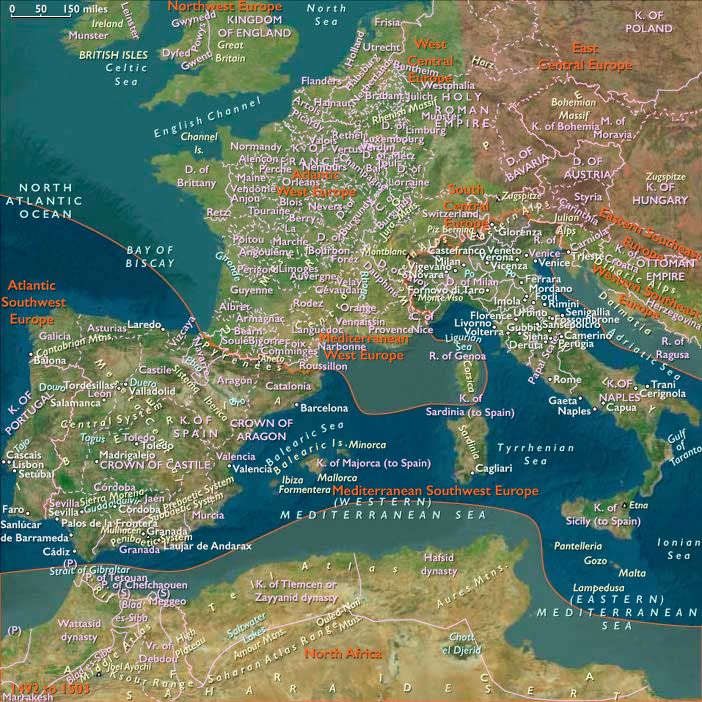
Subregions
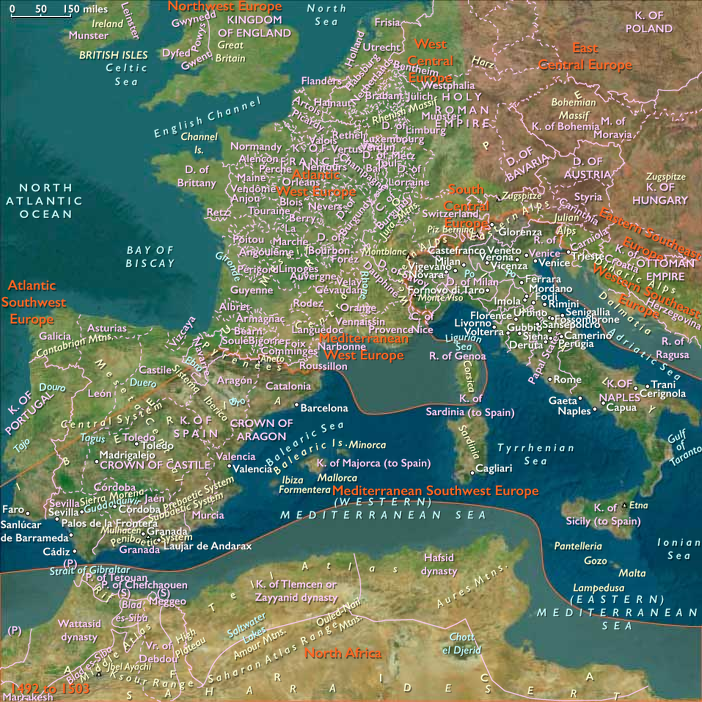
Years: 1495 - 1495
Locations
People
- Ferdinand II of Aragon
- Francisco Jiménez de Cisneros
- Isabella I of Castile
- Pedro González de Mendoza
Groups
- Jews
- Moors
- Christians, Roman Catholic
- Aragón, Kingdom of
- Aragon, Crown of
- Castile, Crown of
- Moriscos
Subjects
Regions
Subregions